. 2022 Apr 20:18:100451.
doi: 10.1016/j.ynstr.2022.100451. eCollection 2022 May.

Effects of chronic social stress on oligodendrocyte proliferation-maturation and myelin status in prefrontal cortex and amygdala in adult mice

Affiliations

Effects of chronic social stress on oligodendrocyte proliferation-maturation and myelin status in prefrontal cortex and amygdala in adult mice

Giulia Poggi et al. Neurobiol Stress. .

Abstract

Stress-related neuropsychiatric disorders present with excessive processing of aversive stimuli. Whilst underlying pathophysiology remains poorly understood, within- and between-regional changes in oligodendrocyte (OL)-myelination status in anterior cingulate cortex and amygdala (ACC-AMY network) could be important. In adult mice, a 15-day chronic social stress (CSS) protocol leads to increased aversion responsiveness, accompanied by increased resting-state functional connectivity between, and reduced oligodendrocyte- and myelin-related transcript expression within, medial prefrontal cortex and amygdala (mPFC-AMY network), the analog of the human ACC-AMY network. In the current study, young-adult male C57BL/6 mice underwent CSS or control handling (CON). To assess OL proliferation-maturation, mice received 5-ethynyl-2'-deoxyuridine via drinking water across CSS/CON and brains were collected on day 16 or 31. In mPFC, CSS decreased the density of proliferative OL precursor cells (OPCs) at days 16 and 31. CSS increased mPFC myelin basic protein (MBP) integrated density at day 31, as well as increasing myelin thickness as determined using transmission electron microscopy, at day 16. In AMY, CSS increased the densities of total CC1+ OLs (day 31) and CC1+/ASPA+ OLs (days 16 and 31), whilst decreasing the density of proliferative OPCs at days 16 and 31. CSS was without effect on AMY MBP content and myelin thickness, at days 16 and 31. Therefore, CSS impacts on the OL lineage in mPFC and AMY and to an extent that, in mPFC at least, leads to increased myelination. This increased myelination could contribute to the excessive aversion learning and memory that occur in CSS mice and, indeed, human stress-related neuropsychiatric disorders.

Keywords: Amygdala; Chronic social stress; Medial prefrontal cortex; Myelin; Oligodendrocyte.


Conflict of interest statement

The authors declare no conflict of interest.

Figures

Image 1
Graphical abstract
Fig. 1
Fig. 1
Chronic social stress (CSS) compared with control (CON) mice had increased day-to-day body weight delta, greater daily water intake and comparable daily EdU intake. (A) Experimental design for CSS effects on oligodendrocyte lineage fate mapping. (B) Comparable increase in body weight in CSS and CON mice at day1 vs. day15 of CSS/CON protocol (2-way ANOVA repeated measures, time: F(1,24) = 36.14, p < 0.0001; group: p ≥ 0.26). (C, D) Increase of day-to-day body weight delta ([(BW day n - BW day n-1)/BW day n-1] x 100) in CSS vs. CON mice (Mann-Whitney U = 37, p = 0.01). (E) Increased daily water intake in CSS vs. CON mice (Mann-Whitney U = 42, p = 0.03). (F) EdU concentration in drinking water was adjusted to daily water intake to ensure comparable EdU administration in CSS and CON (Mann-Whitney U = 51, p = 0.15). Data are presented as individual values and/or mean ± SEM.
Fig. 2
Fig. 2
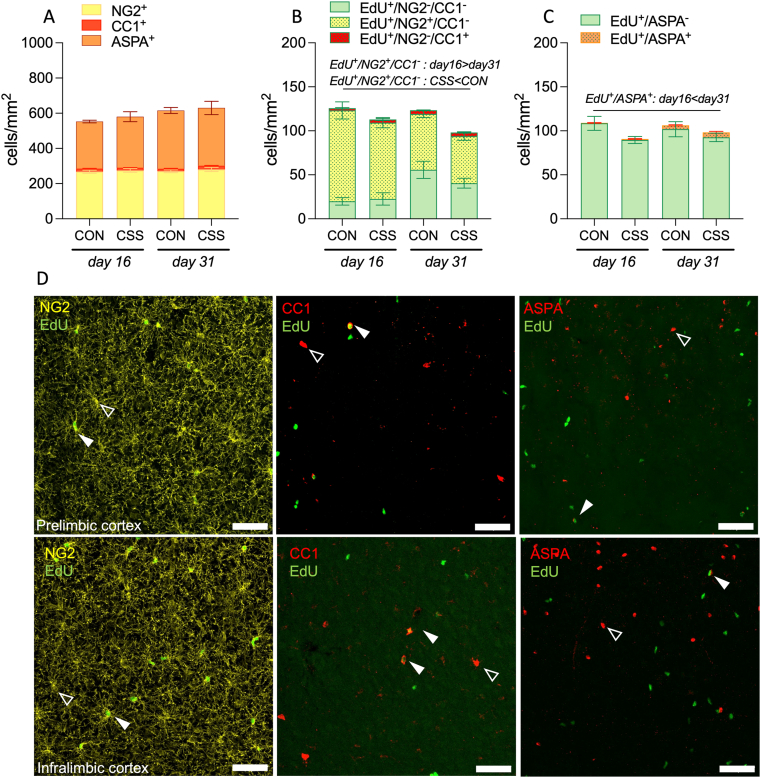
Chronic social stress (CSS) leads to a reduction in OPC proliferation in medial prefrontal cortex. (A) Total densities of OL lineage cell types were comparable between groups and time points (2-way ANOVA, NG2+ group: p = 0.39; time: p = 0.69; group x time interaction: p = 0.88. CC1+ group: p = 0.28; time: p = 0.41; group x time interaction: F(1,22) = 6.053, p = 0.02. ASPA+ group: p = 0.71; time: p = 0.08; group x time interaction: p = 0.65). (B) Density of EdU+/NG2+/CC1- cells was lower in CSS than CON mice and decreased from day 16–31 (2-way ANOVA, group: F(1,22) = 4.396, p = 0.05; time: F(1,22) = 33.56, p < 0.0001; group x time interaction: p = 0.60). Density of EdU+/NG2-/CC1+ cells was comparable between groups and time points (group: p = 0.53; time: p = 0.12; group x time interaction: p = 0.49). (C) Density of EdU+/ASPA+ cells increased from day 16–31, without an effect of CSS (time: F(1,22) = 33.42, p < 0.0001; group: p ≥ 0.18). Data are presented as mean ± SEM cells/mm2, with values for each mouse being the mean of 2 sections x 2 subregions x 2 hemispheres. (D) Representative micrographs of the OL lineage markers in mPFC (open arrows denote OL marker, closed arrows denote OL marker and EdU). Scale bar = 50 μm. Brightness and contrast have been adjusted for display purposes.
Fig. 3
Fig. 3
Chronic social stress (CSS) reduces OPC proliferation and increases the total density of mature oligodendrocytes in basolateral amygdala. (A) Total NG2+ cell density was comparable between groups and time points (2-way ANOVA, group: p = 0.56; time: p = 38; group x time interaction: p = 0.69). Total CC1+ cell density was higher in CSS than CON mice at day 31 (2-way ANOVA, group x time interaction: F(1,22) = 7.248, p = 0.01). Total ASPA+ cell density was higher in CSS than CON mice in the absence of an effect of time (2-way ANOVA, group: F(1,22) = 6.177, p = 0.02; time: p ≥ 0.13). (B) Density of EdU+/NG2+/CC1- cells was lower in CSS than CON mice and decreased from day 16–31 (2-way ANOVA, group: F(1,22) = 4.987, p = 0.04; time: F(1,22) = 46.65, p < 0.0001). Density of EdU+/NG2-/CC1+ cells was comparable between groups and time points (2-way ANOVA, group: p ≥ 0.13; time: p ≥ 0.40). (C) Density of EdU+/ASPA+ cells increased from day 16–31, without an effect of CSS (2-way ANOVA, time: F(1,22) = 13.30, p = 0.001; group: p ≥ 0.55). Data are presented as mean ± SEM cells/mm2, with values for each mouse being the mean of 2 sections x 2 hemispheres per mouse. (D) Representative micrographs of the OL lineage markers in basolateral amygdala (open arrows denote OL marker, closed arrow denotes OL marker and EdU+). Scale bar = 50 μm. Brightness and contrast have been adjusted for display purposes.
Fig. 4
Fig. 4
Chronic social stress (CSS) leads to increased MBP signal in medial prefrontal cortex and is without effect in basolateral amygdala. (A) mPFC MBP intensity density was increased in CSS vs CON mice at day 31 (2-way ANOVA, group x time interaction: F (1, 21) = 5.949, p = 0.02; group: p ≥ 0.08; time: p = 0.002). (B) BLA MBP intensity density was comparable between groups and higher at day 31 than day 16 (2-way ANOVA, group: p ≥ 0.27; time: F(1,20) = 5.90, p = 0.02). Data are presented as mean ± SEM integrated density, with values for each mouse and brain region being the mean of 2 sections x 2 hemispheres per mouse. (C) Representative micrographs of MBP and NF200 in mPFC (prelimbic and infralimbic cortices separately) and BLA. Scale bar = 10 μm.
Fig. 5
Fig. 5
Chronic social stress (CSS) leads to increased myelinated axon density and myelin thickness in the mPFC. (A) Electron micrograph of a coronal section of an axon in the mPFC of a CON mouse and a schema indicating the measurement of relevant parameters: g-ratio was calculated excluding the non-compacted myelin and the periaxonal compartment, i.e. [Ad/Ad(Md-Td)], where Ad = axonal diameter, Md = diameter of: axon + non-compacted myelin (and periaxonal compartment) + compacted myelin, Td = diameter of: non-compacted myelin compartment (and periaxonal compartment) + axon. (B) Myelinated axon density was increased in CSS mice (2-tailed unpaired t-test with Welch's correction, t = 2.43, df = 10, p = 0.05). (C) g-ratio tended to be lower in CSS mice (2-tailed unpaired t-test, t = 2.029, df = 10, p = 0.07). (D) CSS led to increased myelin thickness corrected by axonal diameter (2-tailed unpaired t-test, t = 3.17, df = 10, p = 0.01). (E) Diameter of the analysed myelinated axons was similar in CSS and CON mice (2-tailed unpaired t-test, t = 0.17, df = 10, p = 0.87). (F) g-ratio was correlated positively with axon diameter in CSS and CON mice (CSS Pearson's r = 0.59, p < 0.0001; CON Pearson's, r = 0.51, p < 0.0001). The linear least squares regression equations and corresponding best-fit lines are given for CON and CSS mice separately. (G) Myelin thickness was correlated positively with axon diameter in CSS and CON mice (CSS Pearson's r = 0.45, p < 0.0001; CON Pearson's r = 0.54, p < 0.0001). Data are presented as individual values and mean ± SEM in B-E and as scatter plots in F and G.
Fig. 6
Fig. 6
Chronic social stress (CSS) is without effect on myelinated axon density and myelin thickness in the AMY. CSS and CON mice were similar in terms of: (A) Myelinated axon density (p = 0.34). (B) g-ratio (p = 0.81). (C) Myelin thickness corrected by axonal diameter (p = 0.87). (D) Axon diameter (p = 0.76). (E) g-Ratio was correlated positively with axon diameter in CSS and CON mice (CSS Pearson's r = 0.57, p < 0.0001; CON Pearson's r = 0.60, p < 0.0001). (F) Myelin thickness was correlated positively with axon diameter in CSS and CON mice (CSS Pearson's r = 0.40, p < 0.0001; CON Pearson's r = 0.40, p < 0.0001). Data are presented as individual values and mean ± SEM in A-D and as scatter plots in E and F.
Fig. 7
Fig. 7
Double dissociation of CSS effects in mPFC and AMY: summary of findings and explanatory hypothesis. (A) Summary of findings. The upper part of the figure depicts the mPFC and the lower part the BLA/AMY. In mPFC, CSS led to a decrease in overall cell proliferation attributable to OPCs, at days 16 and 31. CSS led to increases in MBP density at days 16 and 31 and myelin thickness at day 16. In BLA, CSS led to increases in densities of type 1 OLs at day 31 and type 2 OLs at days 16 and 31. CSS led to a decrease in proliferative OPCs at days 16 and 31. CSS was without effects on MBP density or myelin thickness at days 16 and 31. Figure created with BioRender.com. (B) Model of the actual and hypothesized temporal sequences of events in mPFC and AMY. The x-axis depicts time in days from the start of the CSS protocol (day 0) to day 45, and the y-axis depicts the relative quantities of OL lineage cells and myelin across this time period. The light blue area depicts days 16 and 31, the time points at which experimental data were collected. The black line (solid, dashed) depicts the control (CON) condition. The data points prior to day 16 and after day 31 depict data points consistent with the hypothesis that the current findings do not represent a double dissociation between mPFC and AMY, but rather a shift in their temporal responses to CSS in terms of OL lineage status and myelination status. (For interpretation of the references to colour in this figure legend, the reader is referred to the Web version of this article.)

References

    1. Adamcyzk I., Kúkeľová D., Just S., Giovannini R., Sigrist H., Amport R., Cuomo-Haymour N., Poggi G., Pryce C.R. Somatostatin receptor 4 agonism normalizes stress-related excessive amygdala glutamate release and Pavlovian aversion learning and memory in rodents. Biol. Psychiatry Glob. Open Sci. 2021 doi: 10.1016/j.bpsgos.2021.11.006. - DOI - PMC - PubMed
    1. Akay L.A., Effenberger A.H., Tsai L.H. Cell of all trades: oligodendrocyte precursor cells in synaptic, vascular, and immune function. Genes Dev. 2021;35:180–198. doi: 10.1101/GAD.344218.120. - DOI - PMC - PubMed
    1. Azzinnari D., Sigrist H., Staehli S., Palme R., Hildebrandt T., Leparc G., Hengerer B., Seifritz E., Pryce C.R. Mouse social stress induces increased fear conditioning, helplessness and fatigue to physical challenge together with markers of altered immune and dopamine function. Neuropharmacology. 2014;85:328–341. doi: 10.1016/j.neuropharm.2014.05.039. - DOI - PubMed
    1. Bergamini G., Mechtersheimer J., Azzinnari D., Sigrist H., Buerge M., Dallmann R., Freije R., Kouraki A., Opacka-Juffry J., Seifritz E., Ferger B., Suter T., Pryce C.R. Chronic social stress induces peripheral and central immune activation, blunted mesolimbic dopamine function, and reduced reward-directed behaviour in mice. Neurobiol. Stress. 2018;8:42–56. doi: 10.1016/j.ynstr.2018.01.004. - DOI - PMC - PubMed
    1. Bergles D.E., Richardson W.D. Oligodendrocyte development and plasticity. Cold Spring Harbor Perspect. Biol. 2016;8:1–27. doi: 10.1101/cshperspect.a020453. - DOI - PMC - PubMed

LinkOut - more resources