


Linear Growth Trajectories, Catch-up Growth, and Its Predictors Among North Indian Small-for-Gestational Age Low Birthweight Infants: A Secondary Data Analysis
- PMID: 35685868
- PMCID: PMC9173003
- DOI: 10.3389/fnut.2022.827589
Linear Growth Trajectories, Catch-up Growth, and Its Predictors Among North Indian Small-for-Gestational Age Low Birthweight Infants: A Secondary Data Analysis
Abstract
Background: Low birthweight small-for-gestational-age (SGA-LBW) (birthweight below the 10th percentile for gestational age; SGA-LBW) infants are at an increased risk of poor postnatal growth outcomes. Linear growth trajectories of SGA-LBW infants are less studied in South Asian settings including India.
Objectives: To describe the linear growth trajectories of the SGA-LBW infants compared with appropriate-for-gestational-age LBW (AGA-LBW) infants during the first 6 months of life. In addition, we estimated catch-up growth (ΔLAZ > 0.67) in SGA-LBW infants and their performance against the WHO linear growth velocity cut-offs. Additionally, we studied factors associated with poor catch-up growth in SGA-LBW infants.
Methods: The data utilized came from an individually randomized controlled trial that included low birthweight (LBW) infants weighing 1,500-2,250 g at birth. A total of 8,360 LBW infants were included. For comparison between SGA-LBW and AGA-LBW infants, we presented unadjusted and adjusted estimates for mean differences (MDs) or risk ratios (RRs) for the outcomes of length, linear growth velocity, length for age z-score (LAZ) score, and stunting. We estimated the proportion of catch-up growth. Generalized linear models of the Poisson family with log links were used to identify factors associated with poor catch-up growth in SGA-LBW infants.
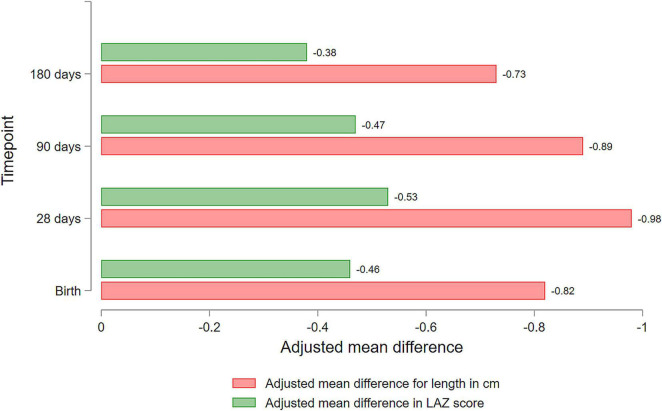
Results: Low birthweight small-for-gestational-age infants had a higher risk of stunting, lower attained length, and a lower LAZ score throughout the first 6 months of life compared with AGA-LBW infants, with differences being maximum at 28 days and minimum at 6 months of age. The linear growth velocity in SGA-LBW infants compared with AGA-LBW infants was significantly lower during the birth-28 day period [MD -0.19, 95% confidence interval (CI): -0.28 to -0.10] and higher during the 3- to 6-month period (MD 0.17, 95% CI: 0.06-0.28). Among the SGA-LBW infants, 55% showed catch-up growth for length at 6 months of age. Lower wealth quintiles, high birth order, home birth, male child, term delivery, non-exclusive breastfeeding, and pneumonia were associated with the higher risk of poor catch-up in linear growth among SGA-LBW infants.
Conclusion: Small for gestational age (SGA) status at birth, independent of gestational age, is a determinant of poor postnatal linear growth. Promotion of institutional deliveries, exclusive breastfeeding, and prevention and early treatment of pneumonia may be helpful to improve linear growth in SGA-LBW infants during early infancy.
Clinical trial registration: [https://clinicaltrials.gov/], identifier [NCT02653534].
Keywords: catch-up growth (CUG); growth faltering; linear growth; low birthweight (LBW) infant; small for gestational age (SGA).
Copyright © 2022 Sinha, Choudhary, Nitika, Kumar, Mazumder, Taneja and Bhandari.
Conflict of interest statement
The authors declare that the research was conducted in the absence of any commercial or financial relationships that could be construed as a potential conflict of interest.
Figures


References
-
- Lee AC, Kozuki N, Cousens S, Stevens GA, Blencowe H, Silveira MF, et al. Estimates of burden and consequences of infants born small for gestational age in low and middle income countries with INTERGROWTH-21(st) standard: analysis of CHERG datasets. BMJ. (2017) 358:j3677. 10.1136/bmj.j3677 - DOI - PMC - PubMed
Associated data
LinkOut - more resources
Full Text Sources
Medical
Research Materials
Miscellaneous
