Review
. 2022 May 24:12:875188.
doi: 10.3389/fonc.2022.875188. eCollection 2022.

An Extensive Review on Preclinical and Clinical Trials of Oncolytic Viruses Therapy for Pancreatic Cancer

Affiliations
Review

An Extensive Review on Preclinical and Clinical Trials of Oncolytic Viruses Therapy for Pancreatic Cancer

Maryum Nisar et al. Front Oncol. .

Abstract

Chemotherapy resistance and peculiar tumor microenvironment, which diminish or mitigate the effects of therapies, make pancreatic cancer one of the deadliest malignancies to manage and treat. Advanced immunotherapies are under consideration intending to ameliorate the overall patient survival rate in pancreatic cancer. Oncolytic viruses therapy is a new type of immunotherapy in which a virus after infecting and lysis the cancer cell induces/activates patients' immune response by releasing tumor antigen in the blood. The current review covers the pathways and molecular ablation that take place in pancreatic cancer cells. It also unfolds the extensive preclinical and clinical trial studies of oncolytic viruses performed and/or undergoing to design an efficacious therapy against pancreatic cancer.

Keywords: Adenovirus; clinical trials; immunotherapy; oncolytic virus therapy; pancreatic cancer; preclinical studies; recombinant virus; therapy-resistance.


Conflict of interest statement

The authors declare that the research was conducted in the absence of any commercial or financial relationships that could be construed as a potential conflict of interest.

Figures
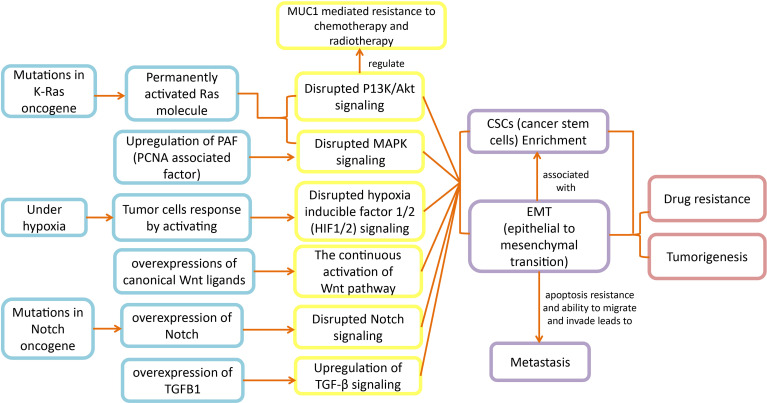
Figure 1
Figure 1
Disrupted pathways in pancreatic cancer: Disruptions in K-Ras, hypoxia, Notch signaling, MAPK, PI3K/Akt and TGF-β signaling pathways lead to EMT and CSCs development, which ultimately expedite metastasis and chemoresistance in pancreatic cancer patients.
Figure 2
Figure 2
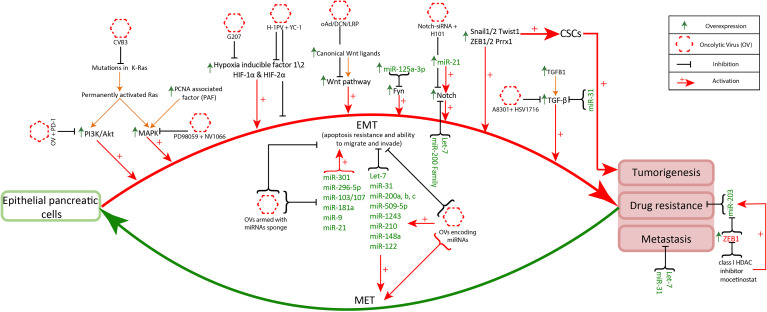
Disrupted pathways targeting with oncolytic viruses: Disruptions in K-Ras, hypoxia, Notch signaling, MAPK, PI3K/Akt and TGF-β signaling pathways facilitates increased anticancer specificity of oncolytic viruses. CVB3 and reovirus effectively infect cancer cells with mutant K-Ras (111). The administration of oncolytic viruses along with PD-1 in PI3k/Akt upregulated cancer cells can exhibit increased antitumor immune memory (112). Likewise, oncolytic viruses administration along with the inhibitors of overexpressed genes (MAPK, Wnt, TGF-β, Notch1, HIF-1α) facilitates oncolytic virus infection and enhances its antitumor property (–116). The multiple overexpressed miRNAs (miR-301, miR-296-5p, miR-103/107, miR-181a, miR-9, miR-21) promote EMT related signaling increasing invasiveness and chemoresistance of pancreatic cancer. Targeting these miRNAs with oncolytic viruses armed with miRNAs sponges helps in the reduction of cancer progression and increases antiviral activity (117). On the other hand miRNAs (Let-7, miR-31, miR-200 family, miR-509-5p, miR-1243, miR-210, miR-148a, miR-122) regulate normal functioning in the pancreas and inhibit EMT associated signaling. These miRNAs are underexpressed in pancreatic cancer and the oncolytic viruses encoding these miRNAs have better cancer cell specificity and anticancer response (118).
Figure 3
Figure 3
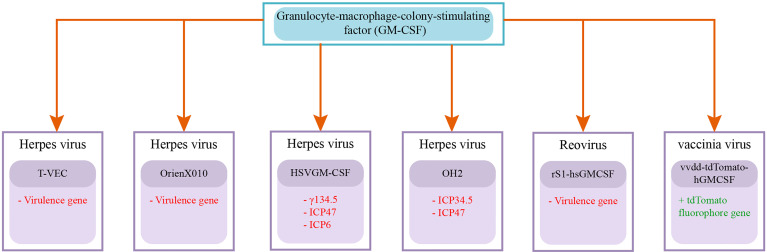
Recombinant Oncolytic Viruses armed with GM-CSF gene: GM-CSF is significant in oncolytic immunotherapy as its overexpression is associated with suppressing tumor growth (243). Talimogene laherparepvec (T-VEC) and OrienX010 are herpes simplex viruses that are genetically modified to omit and incorporate virulence and GM-CSF genes, respectively (160). HSVGM-CSF is also an oncolytic herpes simplex virus that is genetically altered to delete γ134.5, ICP47, and ICP6, and express GM-CSF genes for improving antitumor response (169). OH2 (oncolytic herpes simplex virus 2) is generated to express GM-CSF transgene with deleted ICP34.5 and ICP47 genes expressions for improved tumor selective replication (244). A recombinant reovirus rS1-hsGMCSF was also generated for expressing the GM-CSF gene for stimulating antitumor activity (175). Vaccinia virus is also genetically altered to generate vvdd-tdTomato-hGMCSF by inserting GM-CSF and tdTomato fluorophore transgenes for dealing with immune suppression in pancreatic cancer (201). Deleted genes are written in red color with the (–) sign and added genes are written in green color with the (+) sign.
Figure 4
Figure 4
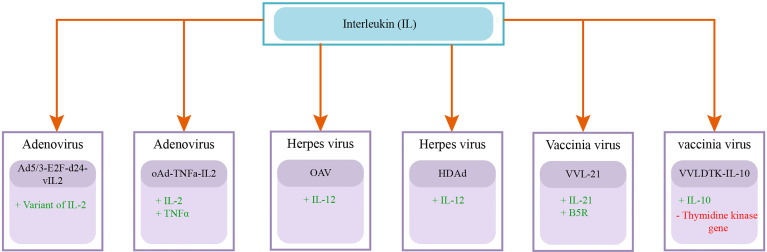
Recombinant Oncolytic Viruses armed with Interleukin (IL) genes: Interleukins function as a mode of communication between immune and non-immune cells. They play a crucial role in both innate and adaptive immune responses. These proteins also regulate cancer development by concurrently promoting cancer cell progression and evoking tumor targeted immune activity. Based on these properties, interleukins could be utilized in immunotherapy for impeding adverse effects and improved efficacy (245). Ad5/3- E2F-d24-vIL2 is a genetically altered adenovirus that expresses a variant of IL-2 for prolonged survival and eliciting immune response (135). Another recombinant adenovirus, oAd-TNFa-IL2, is specifically designed to express TNF-α and IL-2. The treatment of oAd-TNFa-IL2 combined with meso-CAR T cells resulted in curbed metastasis and improved immune activity in mouse models (139). Oncolytic viruses are genetically modified to express an antitumor cytokine, Interleukin 12. IL-12 expression aids in restricting tumor angiogenesis, in the differentiation of T-helper cells, which eventually promotes T cells directed cancer cell destruction (246). Oncolytic herpes simplex viruses are genetically modified by inserting IL-12 exogenous gene to generate OAV and HDAd. The administration of OAV caused high toxicity associated with overexpression of IL-12 in cancer cells, and treatment with HDAd resulted in comparatively slow release of IL-12 from the liver, which eventually caused restricted tumor growth (150). VVL-21 is a recombinant vaccinia virus, particularly designed to treat pancreatic cancer by incorporating B5R and IL-21 genes. The administration of VVL-21 combined with (α-PD1) triggered immune activity opposed to cancer cells (191). VVLDTK-IL-10, another recombinant vaccinia virus, is designed by omitting TK gene and inserting IL-10 exogenous gene for promoting antitumor response and prolonged survival (200). Interleukin (IL) gene along with other added genes written in green with + sign and deleted genes written in red with - sign.

References

    1. Sung H, Ferlay J, Siegel RL, Laversanne M, Soerjomataram I, Jemal A, et al. Global Cancer Statistics 2020: Globocan Estimates of Incidence and Mortality Worldwide for 36 Cancers in 185 Countries. CA: Cancer J Clin (2021) 71:209–49. doi: 10.3322/caac.21660 - DOI - PubMed
    1. Hidalgo M, Cascinu S, Kleeff J, Labianca R, Löhr JM, Neoptolemos J, et al. Addressing the Challenges of Pancreatic Cancer: Future Directions for Improving Outcomes. Pancreatology (2015) 15:8–18. doi: 10.1016/j.pan.2014.10.001 - DOI - PubMed
    1. Rahib Smith L. BD, Aizenberg R, Rosenzweig AB, Fleshman JM, Matrisian LM. Projecting Cancer Incidence and Deaths to 2030: The Unexpected. Cancer Res (2014) 74:2913–21. doi: 10.1158/0008-5472.CAN-14-0155 - DOI - PubMed
    1. De La Cruz M, Young AP, Ruffin MT. Diagnosis and Management of Pancreatic Cancer. Am Fam Physician (2014) 89(8):626–32. - PubMed
    1. Kuehn BM. Looking to Long-Term Survivors for Improved Pancreatic Cancer Treatment. JAMA (2020) 324:2242–4. doi: 10.1001/jama.2020.21717 - DOI - PubMed

LinkOut - more resources