. 2022 Jun 10;130(3):317-330.
doi: 10.1093/aob/mcac074. Online ahead of print.

Root grafts matter for inter-tree water exchange - a quantification of water translocation between root grafted mangrove trees using field data and model based indication

Affiliations

Root grafts matter for inter-tree water exchange - a quantification of water translocation between root grafted mangrove trees using field data and model based indication

Marie-Christin Wimmler et al. Ann Bot. .

Abstract

Background and aims: Trees interconnected through functional root grafts can exchange resources, but the effect of exchange on trees remains under debate. A mechanistic understanding of resources exchange via functional root grafts will help understand their ecological implications for tree water exchange for individual trees, groups of trees, and forest stands.

Methods: To identify the main patterns qualitatively describing the movement of sap between grafted trees, we reviewed available literature on root grafting in woody plants that focus on tree allometry and resource translocation via root grafts. We then extended the BETTINA model, which simulates mangrove (Avicennia germinans) tree growth on the individual tree scale, in order to synthesize the available empirical information. Using allometric data from a field study in mangrove stands, we simulated potential water exchange and analyzed movement patterns between grafted trees.

Key results: In the simulations, relative water exchange ranged between -9.17 and 20.3 %, and was driven by gradients of water potential, i.e. differences in tree size and water availability. Moreover, the exchange of water through root grafts alters the water balance of trees and their feedback with the soil: grafted trees that receive water from their neighbors reduce their water uptake.

Conclusions: Our individual-tree modelling study is a first theoretical attempt to quantify root graft-mediated water exchange between trees. Our findings indicate that functional root grafts represent a vector of hydraulic redistribution, helping to maintain the water balance of grafted trees. This non-invasive approach can serve as a fundament for designing empirical studies to better understand the role of grafted root interaction networks on a broader scale.

Keywords: Avicennia germinans; BETTINA model; La Mancha Lagoon; agent-based model; conceptual model; mangroves; natural root grafting; tree-tree interaction; water exchange.


Figures

Fig. 1.
Fig. 1.
Graphical representation of (A) a non-grafted model tree (left) and (B) a pair of grafted model trees (right) including the resistance at the root surface (Rro) and the xylem resistances at the root, stem and crown (Rxy,ro, Rxy,st, Rxy,cr, respectively) as well as the water potential around the root system (ψO) and at the leaves (ψL). The resistances are grouped according to their field of action in relation to potentially grafted roots as below- and above-graft resistance (Rbg, Rag). Blue arrows indicate the flow streams through and between the trees. ABS is the amount of water absorbed from the soil, AVAIL is the amount of water available for growth and maintenance, AWG is the absolute water gain, i.e. the water translocated between connected trees, and RGW is the relative water gain, i.e. the proportion of AWG in AVAILng. Indices indicate the graft status: root grafted (rg) or non-grafted (ng). For non-grafted trees, ABS equals AVAIL. The grey shading of the soil gives a fictitious gradient in the osmotic potential, determined by the salinity of the pore water.
Fig. 2.
Fig. 2.
Schematic representation of setups (rows) and scenarios (columns). Circles represent trees and lines show the connection of trees through root grafts. Colours indicate porewater salinity. In the homogeneous scenario, all trees have a fixed porewater salinity of 35 ppt, and in the heterogeneous scenario, porewater salinity ranges between 35 and 40 ppt.
Fig. 3.
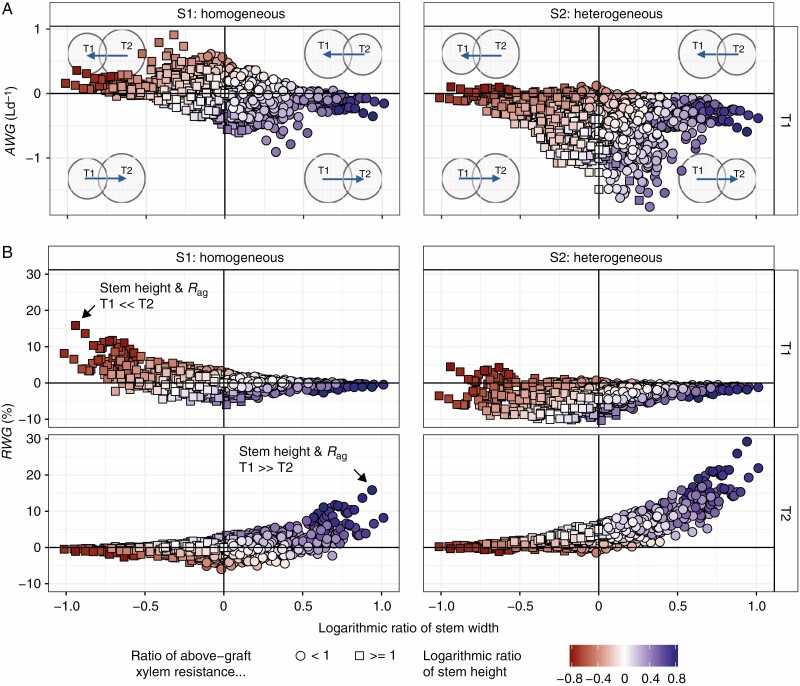
Fig. 3.
Calculated water flow patterns of trees T1 and T2 in setup ‘Fictitious Grafting’ as (A) absolute water gain (AWG) of tree T1 (L d–1) and (B) relative water gain (RWG) of trees T1 and T2 (percentage of water uptake of the non-grafted tree version). Pictograms in A represent trees T1 and T2, whereby the size of the circle indicates which tree is greater or smaller in stem radius, and the arrow indicates the direction of water flow. Ratios of biometric measures are logarithmic and given from the perspective of T1. That is, if the respective value is greater than 0, this parameter is greater for T1 than for T2.
Fig. 4.
Fig. 4.
Density estimates of relative water gain (RWG) of trees T1 and T2, setup ‘Fictitious Grafting’. In scenario S1, both trees have a porewater salinity of 35 ppt. In scenario S2, trees T1 and T2 have a porewater salinity of 35 and 40 ppt, respectively.
Fig. 5.
Fig. 5.
Schematic representation of three groups consisting of two, three and six grafted trees. The numbers indicate the absolute (AWG) and relative (RWG) water gain, respectively. The colour indicates the RWG (%). Both calculated with the homogeneous salinity distribution (i.e. scenario S1). Setup ‘Observed Grafting’.
Fig. 6.
Fig. 6.
Density estimate of relative water gain (RWG) for (A) individual trees and (B) groups, shown as absolute values. The colour indicates whether the tree gained or lost water, i.e. had more water available than it absorbed. The values give the skewness of the distribution of RWG. Setup ‘Observed Grafting’.

References

    1. Adonsou KE, Desrochers A, Tremblay F.. 2016a. Physiological integration of connected balsam poplar ramets. Tree Physiology 36: 797–806. doi:10.1093/treephys/tpv142. - DOI - PubMed
    1. Adonsou KE, Drobyshev I, DesRochers A, Tremblay F.. 2016b. Root connections affect radial growth of balsam poplar trees. Trees 30: 1775–1783. doi:10.1007/s00468-016-1409-2. - DOI
    1. Appel DN. 1994. Identification and control of oak wilt in Texas urban forests. Journal of Arboriculture 20: 250–258.

    1. Bader MK-F, Leuzinger S.. 2019. Hydraulic coupling of a leafless kauri tree remnant to conspecific hosts. iScience 19: 1238–1247. doi:10.1016/j.isci.2019.05.009. - DOI - PMC - PubMed
    1. Ball MC, Farquhar GD.. 1984. Photosynthetic and stomatal responses of two Mangrove species, Aegiceras corniculatum and Avicennia marina, to long term salinity and humidity conditions. Plant Physiology 74: 1–6. doi:10.1104/pp.74.1.1. - DOI - PMC - PubMed