Review
. 2022 Jun 1;149(11):dev186536.
doi: 10.1242/dev.186536. Epub 2022 Jun 10.

Enhancer-gene specificity in development and disease

Affiliations
Review

Enhancer-gene specificity in development and disease

Tomás Pachano et al. Development. .

Abstract

Enhancers control the establishment of spatiotemporal gene expression patterns throughout development. Over the past decade, the development of new technologies has improved our capacity to link enhancers with their target genes based on their colocalization within the same topological domains. However, the mechanisms that regulate how enhancers specifically activate some genes but not others within a given domain remain unclear. In this Review, we discuss recent insights into the factors controlling enhancer specificity, including the genetic composition of enhancers and promoters, the linear and 3D distance between enhancers and their target genes, and cell-type specific chromatin landscapes. We also discuss how elucidating the molecular principles of enhancer specificity might help us to better understand and predict the pathological consequences of human genetic, epigenetic and structural variants.

Keywords: Enhanceropathies; Enhancers; Promoters; Specificity; Tethering elements.


Conflict of interest statement

Competing interests The authors declare no competing or financial interests.

Figures
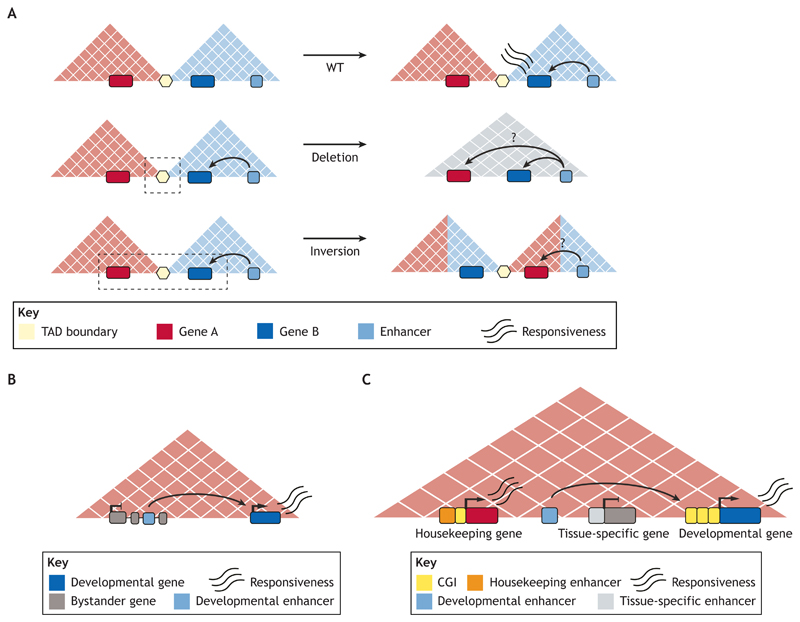
Fig. 1
Fig. 1. The role of TADs in enhancer function and specificity.
(A) Enhancers and their target genes usually lie within the same TAD, enabling robust gene expression (top panel). However, structural variants can cause rearrangements of the genes and enhancers present within TADs. Deletions (middle panel) or inversions (lower panel) encompassing TAD boundaries can expose genes to new regulatory environments. Predicting the transcriptional effect of these rearrangements is not obvious, as genes do not always adopt enhancers located in the same TAD. (B) The majority of TADs contain several genes and enhancers. In these multi-gene TADs, enhancers associated with developmental genes can be found in the introns of neighboring genes with unrelated expression patterns (bystander genes). However, bystander genes do not respond to these enhancers, despite being within the same TAD, and are linked with their own regulatory elements. (C) The genetic diversity of promoters might explain the specificity of multi-gene TADs: housekeeping genes respond to housekeeping enhancers located within or close to the promoter regions; tissue-specific genes contain CpG-poor promoters and are responsive to proximal tissue-specific enhancers; while developmental genes contain promoters with large CpG island (CGI) clusters and respond to distal enhancers.
Fig. 2
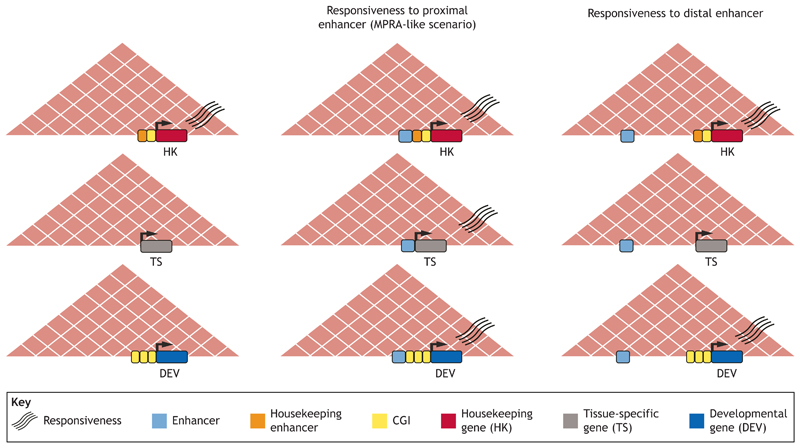
Fig. 2. Linear distance influences enhancer-gene regulatory specificity.
The responsiveness of different promoter types to enhancers can depend on linear distance. The promoters of housekeeping (HK) genes (top) are normally activated by proximal regulatory elements and show low responsiveness to proximal or distal enhancers. Tissue-specific (TS) genes (middle) also show low responsiveness to distal enhancers, but high responsiveness to proximal enhancers. In contrast, developmental genes (DEV; bottom) show high responsiveness to distal enhancers.
Fig. 3
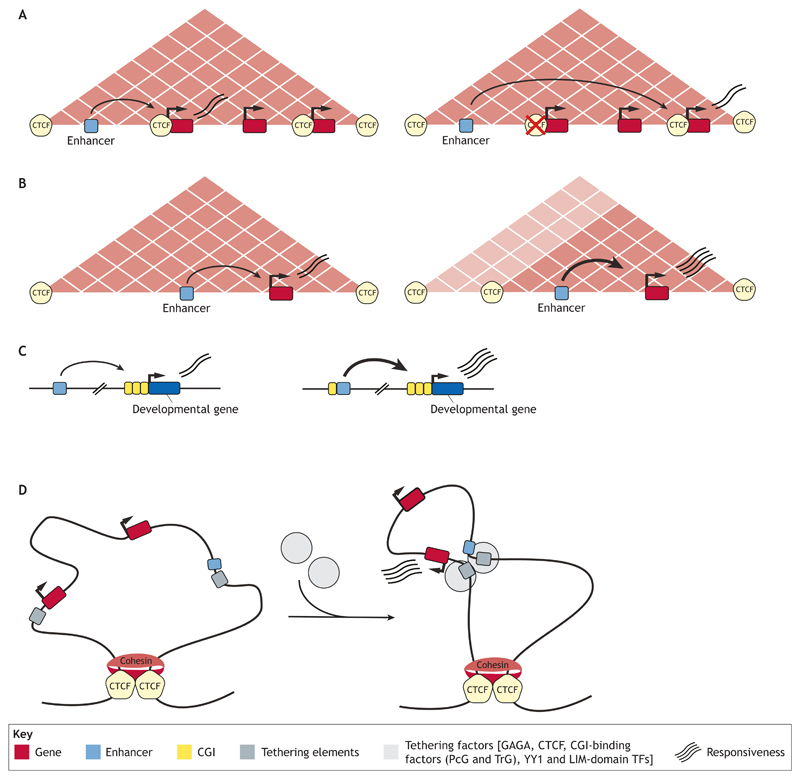
Fig. 3. CTCF-binding sites, CpG islands and tethering factors can modulate enhancer-gene communication in 3D space.
(A) The presence of a CTCF-binding site (CBS) can determine promoter choice by an enhancer. (B) The presence of a CBS can also favor the formation of smaller contact domains, leading to strong target gene induction. (C) CpG islands (CGIs) can boost the regulatory activity of distal developmental enhancers by conferring a permissive topological configuration that increases the responsiveness of target genes with CGI-associated promoters. (D) Schematic diagram illustrating the topological and regulatory role of tethering factors. Homotypic or heterotypic interactions between tethering elements facilitate physical communication between enhancers and their target gene promoters. This topological configuration might favor specific cis-activation of target genes.
Fig. 4
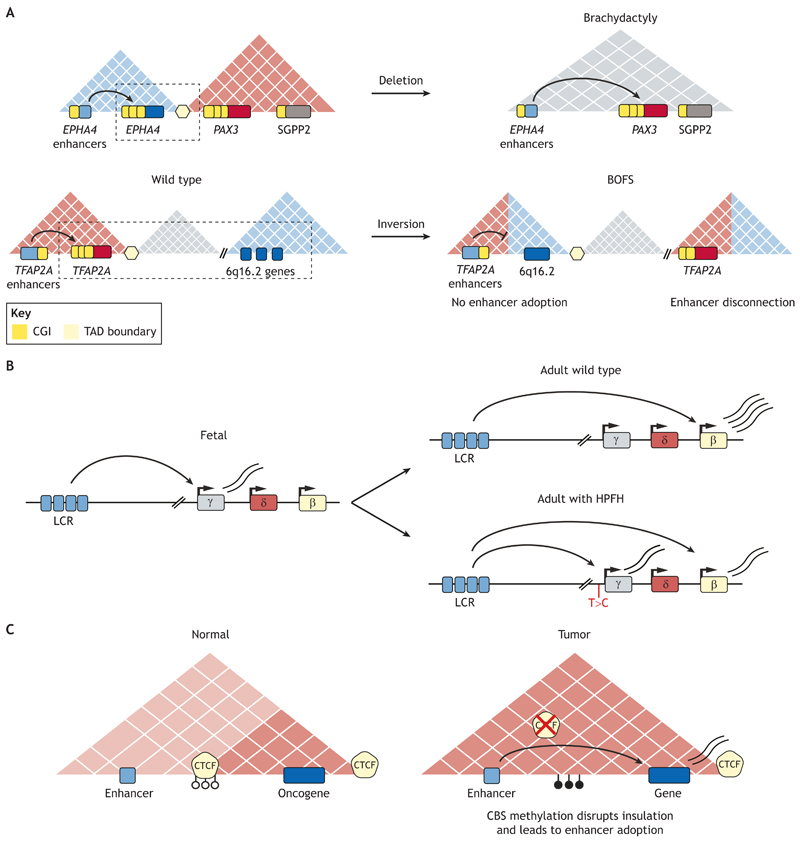
Fig. 4. The disruption of enhancer specificity can lead to human diseases.
(A) Structural variants (SVs) can rearrange genes and enhancers into different TADs, which in some cases can lead to either enhancer adoption or enhancer disconnection. Top panel: a deletion spanning a TAD boundary between the EPHA4-TAD and the PAX3-TAD is found in families with brachydactyly (Lupiáñez et al., 2015). As a result of this deletion, enhancers that are active in the developing limb and control EPHA4 expression in this tissue establish ectopic interactions with PAX3 and strongly induce its expression in the limb (i.e. enhancer adoption), a tissue in which this developmental gene is normally inactive. The SGGP2 gene, which is also located in the PAX3-TAD, does not respond to the EPHA4 enhancers. Bottom panel: an inversion that spans several TAD boundaries leads to TAD shuffling. The inversion places one of the TFAP2A alleles into a novel TAD and impairs its normal expression in neural crest cells due to physical disconnection from its cognate enhancers. The reduced expression of TFAP2A in neural crest cells leads to TFAP2A haploinsufficiency, which ultimately results in craniofacial abnormalities associated with the branchio-oculo-facial syndrome (BOFS). Moreover, this inversion also places novel genes originally found within the 6q16.2 locus in proximity to TFAP2A neural crest enhancers within a shuffled TAD. Importantly, none of the 6q16.2 genes is responsive to the TFAP2A neural crest enhancers (i.e. there is no enhancer adoption in neural crest cells) (Laugsch et al., 2019). (B) Individuals with hereditary persistence of fetal hemoglobin (HPFH) possess a single nucleotide polymorphism (SNP; T>C) at the γ-globin promoter, which increases its affinity for the locus control region (LCR). Consequently, this leads to persistent γ-globin expression in adulthood (Wienert et al., 2015). (C) Oncogenes can become overexpressed in tumor cells through the aberrant methylation of CTCF-binding sites (CBSs). Hypermethylation of CBSs can abrogate CTCF binding, which in turn can result in loss of insulation and ectopic communication between enhancers and responsive oncogenes (Flavahan et al., 2019). Pale-blue squares represent enhancers; dark-blue and red squares represent genes.

References

    1. Akalin A, Fredman D, Arner E, Dong X, Bryne JC, Suzuki H, Daub CO, Hayashizaki Y, Lenhard B. Transcriptional features of genomic regulatory blocks. Genome Biol. 2009;10:R38. doi: 10.1186/gb-2009-10-4-r38. - DOI - PMC - PubMed
    1. Akbari OS, Bae E, Johnsen H, Villaluz A, Wong D, Drewell RA. A novel promoter-tethering element regulates enhancer-driven gene expression at the bithorax complex in the Drosophila embryo. Development. 2007;135:123–131. doi: 10.1242/dev.010744. - DOI - PMC - PubMed
    1. Akhtar W, Pindyurin AV, De Jong J, Pagie L, Ten Hoeve J, Berns A, Wessels LFA, Van Steensel B, Van Lohuizen M. Using TRIP for genome-wide position effect analysis in cultured cells. Nat Protoc. 2014;9:1255–1281. doi: 10.1038/nprot.2014.072. - DOI - PubMed
    1. Amarillo IE, Dipple KM, Quintero-Rivera F. Familial microdeletion of 17q24.3 upstream of SOX9 is associated with isolated pierre robin sequence due to position effect. Am J Med Genet A. 2013;161:1167–1172. doi: 10.1002/ajmg.a.35847. - DOI - PubMed
    1. Andersson R, Sandelin A. Determinants of enhancer and promoter activities of regulatory elements. Nat Rev Genet. 2020;21:71–87. doi: 10.1038/s41576-019-0173-8. - DOI - PubMed

Publication types