


Effects of sulfur amino acid supplementation on broiler chickens exposed to acute and chronic cyclic heat stress
- PMID: 35688032
- PMCID: PMC9189208
- DOI: 10.1016/j.psj.2022.101952
Effects of sulfur amino acid supplementation on broiler chickens exposed to acute and chronic cyclic heat stress
Abstract
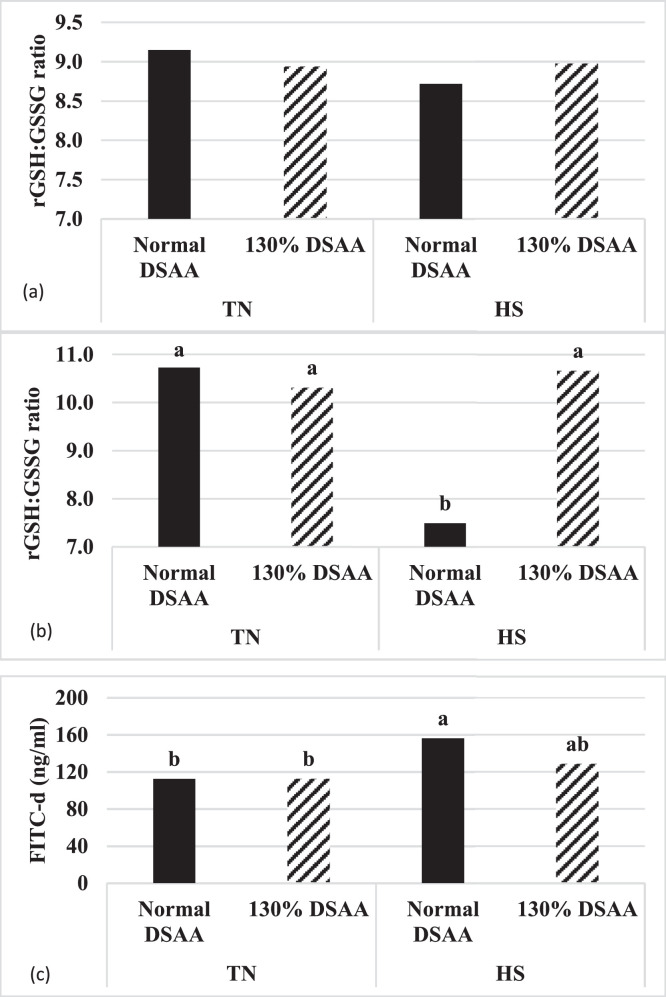
Chronic heat stress can result in oxidative damage from increased reactive oxygen species. One proposed method to alleviate the chronic effects of HS is the supplementation of sulfur amino acids (SAA) which can be metabolized to glutathione, an important antioxidant. Therefore, the objective of this experiment was to determine the effects of dietary SAA content on broiler chickens exposed to HS from 28 to 35 d on broiler performance, body temperature, intestinal permeability, and oxidative status. Four experimental treatments were arranged as a 2 × 2 factorial consisting of HS (6 h at 33.3°C followed by 18 h at 27.8°C from 28 to 35 d of age) and Thermoneutral (TN- 22.2°C continuously from 28 to 35 d) and 2 dietary concentrations of SAA formulated at 100% (0.95, 0.87, and 0.80% for starter, grower, and finisher diets) or 130% SAA (1.24, 1.13, and 1.04% for starter, grower, and finisher diets). A total of 648-day-old, male Ross 708 chicks were placed in 36 pens with 18 chicks/pen and 9 replicates per treatment. Data were analyzed as a 2 × 2 factorial in JMP 14 (P ≤ 0.05). No interaction effects were observed on broiler live performance (P > 0.05). As expected, HS reduced BWG by 92 g and increased FCR by 11 points from 28 to 35 d of age compared to TN, respectively (P ≤ 0.05). The supplementation of SAA had no effect on live performance (P > 0.05). Cloacal temperatures were increased by 1.7, 1.4, and 1.2°C with HS at 28, 31, and 35 d compared to TN, respectively (P ≤ 0.05) and dietary SAA did not alter cloacal temperatures. At 28 d of age, supplementation of SAA to birds exposed to HS interacted as serum FITC-dextran (an indicator of intestinal permeability) was reduced to that of the TN group (P ≤ 0.05). The interaction was lost at 31 d, but HS still increased intestinal permeability (P ≤ 0.05). By 35 d, broilers were able to adapt to the HS conditions and intestinal permeability was unaffected (P > 0.05). Potential oxidative damage was reduced by increased SAA supplementation as indicated by an improvement in the reduced glutathione to oxidized glutathione ratio of 5 and 45 % at 28 (P = 0.08) and 35 d (P ≤ 0.05). These data suggest that intestinal permeability is compromised initially and to at least three d of heat exposure before the bird can adjust. However, oxidative damage in the liver of broilers exposed to HS is more chronic, building over the entire 7 d HS period and increased dietary SAA might have some protective effects on both broiler intestinal permeability and oxidative stress responses to HS.
Keywords: broilers; heat stress; intestinal permeability; oxidative stress; sulfur amino acids.
Copyright © 2022 The Authors. Published by Elsevier Inc. All rights reserved.
Figures
References
-
- Aviagen . Aviagen; Huntsville, AL: 2018. Ross 708 Broiler: Nutrient Specifications.
-
- Baxter M.F., Merino-Guzman R., Latorre J.D., Mahaffey B.D., Yang Y., Teague K.D., Graham L.E., Wolfenden A.D., Hernandez-Velasco X., Bielke L.R., Hargis B.M. Optimizing fluorescein isothiocyanate dextran measurement as a biomarker in a 24-h feed restriction model to induce gut permeability in broiler chickens. Fron. Vet. Sci. 2017;4:56. - PMC - PubMed
-
- Benzie J.F.F. Lipid peroxidation: a review of causes, consequences, measurement and dietary influences. Int. J. Food Sci. Nut. 1996;47:233–261. - PubMed
-
- Chen Y., Li D., Dai Z., Piao X., Wu Z., Wang B., Zhu Y. L-methionine supplementation maintains the integrity and barrier function of the small-intestinal mucosa in post-weaning piglets. Amino Acids. 2014:1131–1142. - PubMed
MeSH terms
Substances
LinkOut - more resources
Full Text Sources
Medical
Research Materials
