. 2022 Jun 10;13(1):3237.
doi: 10.1038/s41467-022-31018-8.

Giant bulk photovoltaic effect driven by the wall-to-wall charge shift in WS2 nanotubes

Affiliations

Giant bulk photovoltaic effect driven by the wall-to-wall charge shift in WS2 nanotubes

Bumseop Kim et al. Nat Commun. .

Abstract

The intrinsic light-matter characteristics of transition-metal dichalcogenides have not only been of great scientific interest but have also provided novel opportunities for the development of advanced optoelectronic devices. Among the family of transition-metal dichalcogenide structures, the one-dimensional nanotube is particularly attractive because it produces a spontaneous photocurrent that is prohibited in its higher-dimensional counterparts. Here, we show that WS2 nanotubes exhibit a giant shift current near the infrared region, amounting to four times the previously reported values in the higher frequency range. The wall-to-wall charge shift constitutes a key advantage of the one-dimensional nanotube geometry, and we consider a Janus-type heteroatomic configuration that can maximize this interwall effect. To assess the nonlinear effect of a strong field and the nonadiabatic effect of atomic motion, we carried out direct real-time integration of the photoinduced current using time-dependent density functional theory. Our findings provide a solid basis for a complete quantum mechanical understanding of the unique light-matter interaction hidden in the geometric characteristics of the reduced dimension.


Conflict of interest statement

The authors declare no competing interests.

Figures
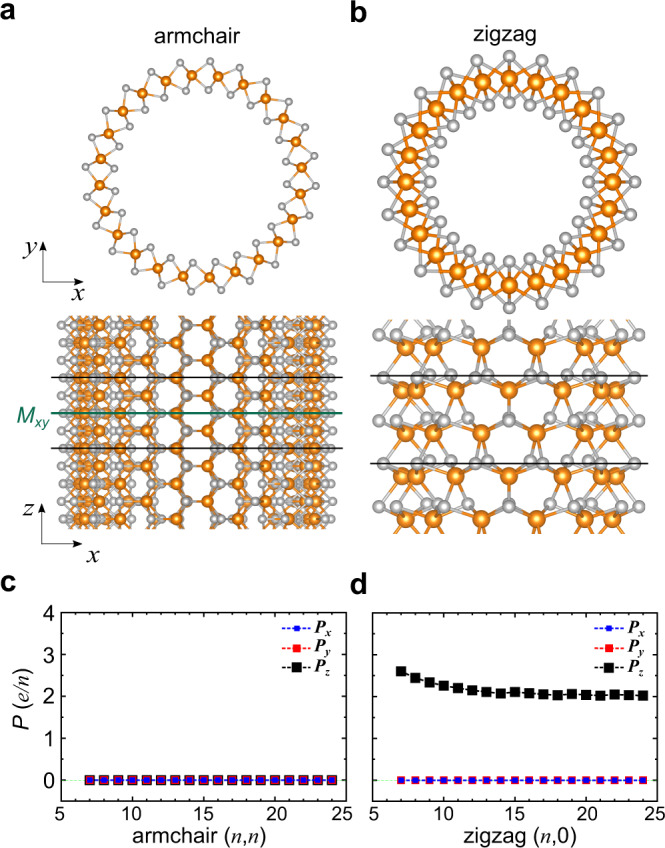
Fig. 1
Fig. 1. Atomic structure and electric polarization of TMD SWNTs.
ab Atomic illustration of armchair and zigzag SWNTs. The armchair SWNT is mirror symmetric (Mxy), whereas the zigzag one is not. The orange and gray spheres represent W and S atoms, respectively. cd Variation of the electric polarization of armchair and zigzag SWNTs with various diameters.
Fig. 2
Fig. 2. Electronic and optoelectronic properties of the zigzag (10,0) SWNT.
a Calculated band structure of the SWNT. b Imaginary parts of the dielectric constants of the SWNT. The inset indicates the cross-section of the zigzag SWNT. c Calculated shift-current spectrum of the SWNT with respect to the frequency of the applied light. d The shift-current-weighted density of states (SDOS) of the SWNT responsible for the shift-current peaks indicated by the black dotted lines (ℏω = 1.0, 1.5, 2.2 eV) in (c). eg Real-space representation of the hole and electron carrier densities of (e) ℏω = 1.0 eV, (f) ℏω = 1.5 eV, and (g) ℏω = 2.2 eV excitations. The carrier density is proportional to the optical absorption of (b).
Fig. 3
Fig. 3. Electronic and optoelectronic properties of the (7,0)@(18,0) DWNT.
a Calculated band structure of the DWNT. The states from the inner (outer) tube are represented by blue (red) lines. b Imaginary parts of the dielectric constants of the individual (7,0) and (18,0) SWNTs, and the DWNT. c Calculated shift-current spectra of the individual (7,0) and the (18,0) SWNTs and the DWNT with respect to the frequency of the applied light. d Shift-current-weighted density of states (SDOS) of the DWNT corresponding to the shift-current peak (ℏω = 1.15 eV) denoted by the orange arrow in (c). Two interwall transitions are labeled as α and β transitions. The states from the inner (outer) tube are represented by blue (red) lines. e Real-space representation of the hole (red) and electron (blue) carrier density of the α and β transitions.
Fig. 4
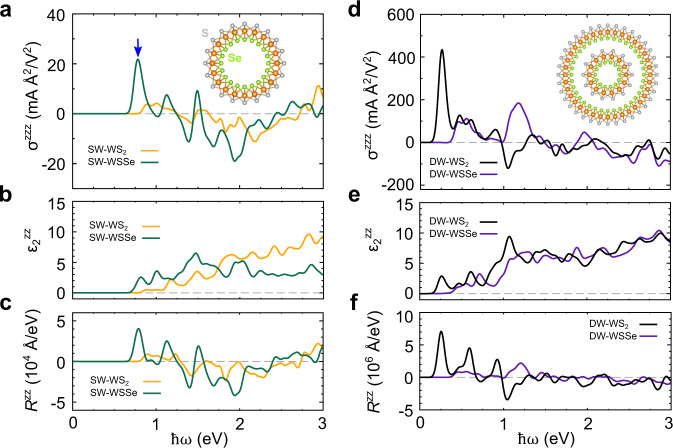
Fig. 4. The photovoltaic effect of Janus-type WSSe nanotubes in comparison with that of WS2 nanotubes.
ac a Calculated shift-current spectra, b imaginary parts of the dielectric constants, and c shift vector of the (10,0) WS2 SWNT (SW-WS2) and a (10,0) WSSe SWNT (SW-WSSe) with respect to the frequency of the applied light. df d Calculated shift-current spectra, e imaginary parts of the dielectric constants, and f shift vector of the (7,0)@(18,0) WS2 DWNT (DW-WS2) and (7,0)@(18,0) WSSe DWNT (DW-WSSe) with respect to the frequency of the applied light.
Fig. 5
Fig. 5. The effect of strong field and atomic motion on the photocurrent of the zigzag (7,0) WS2 SWNT.
a Calculated time-averaged second-order currents created by external fields with an intensity of 6.05 × 1010 W/cm2 and frequencies of ℏω = 0.9 and 1.7 eV. The quantitative definition of Javg is described in the main text. The inset shows the shift-current spectra obtained by the same scheme as the spectra in Fig. 2c. Red and blue dotted vertical lines in the inset indicate ℏω = 0.9 and 1.7 eV, respectively. b Time evolution of the electron/hole-carrier density of states of the SWNT excited by the light frequencies of ℏω = 0.9 and 1.7 eV. The Fermi level is set to zero. c The time-averaged currents normalized by the light intensity (I) for the frequency of ℏω = 0.9 eV, which is defined as J~avg=Javg/I . d The real-time second-order currents normalized by the field intensity, defined as J~event=Jeven/I for the weak (I = 6.05 × 1010 W/cm2) and strong (I = 1.51 × 1012 W/cm2) fields. Here, the contributions are decomposed into that of the zone-center states near Γ (k < 0.007 Å−1) and the other states (k > 0.007 Å−1) states. e Momentum-resolved electron/hole-carrier of the weak (I = 6.05 × 1010 W/cm2) and strong (I = 1.51 × 1012 W/cm2) fields. The maxima of the electron and hole-carrier (MAX and MIN) are represented by dark-blue and dark-red spheres, respectively. f Calculated time-averaged second-order currents (Javg) created by an external field (ℏω = 0.9 eV) with/without atomic motion. The inset is a schematic of the atomic motion of the SWNT caused by the carrier excitation. g Time evolution of the electron/hole-carrier density of states of W atoms, excited by the external field (ℏω = 0.9 eV), with the atomic motions of the Ehrenfest dynamics. The Fermi level is set to zero. h Crystal orbital Hamilton populations (COHPs) of the (7,0) SWNT, characterizing the bonding (+ sign) and antibonding nature (− sign) of the wavefunctions. The initial (bonding) and final (antibonding) states on the transitions are denoted by red and blue vertical lines, respectively. The inset of the partial charge density confirms the bonding and antibonding characters of the initial and final states. i The plane summation of the charge density difference between the excited and the ground states of the SWNT with/without atomic motions.

References

    1. Xia F, Wang H, Xiao D, Dubey M, Ramasubramaniam A. Two-dimensional material nanophotonics. Nat. Photon. 2014;8:899–907. doi: 10.1038/nphoton.2014.271. - DOI
    1. Duan X, Wang C, Pan A, Yu R, Duan X. Two-dimensional transition metal dichalcogenides as atomically thin semiconductors: opportunities and challenges. Chem. Soc. Rev. 2015;44:8859–8876. doi: 10.1039/C5CS00507H. - DOI - PubMed
    1. Mak KF, Shan J. Photonics and optoelectronics of 2D semiconductor transition metal dichalcogenides. Nat. Photon. 2016;10:216–226. doi: 10.1038/nphoton.2015.282. - DOI
    1. Wang G, et al. Colloquium: excitons in atomically thin transition metal dichalcogenides. Rev. Mod. Phys. 2018;90:021001. doi: 10.1103/RevModPhys.90.021001. - DOI
    1. Mak KF, He K, Shan J, Heinz TF. Control of valley polarization in monolayer MoS2 by optical helicity. Nat. Nanotechnol. 2012;7:494–498. doi: 10.1038/nnano.2012.96. - DOI - PubMed