. 2022 Jun 10;13(1):3349.
doi: 10.1038/s41467-022-31082-0.

Parallel ventral hippocampus-lateral septum pathways differentially regulate approach-avoidance conflict

Affiliations

Parallel ventral hippocampus-lateral septum pathways differentially regulate approach-avoidance conflict

Dylan C M Yeates et al. Nat Commun. .

Abstract

The ability to resolve an approach-avoidance conflict is critical to adaptive behavior. The ventral CA3 (vCA3) and CA1 (vCA1) subfields of the ventral hippocampus (vHPC) have been shown to facilitate avoidance and approach behavior, respectively, in the face of motivational conflict, but the neural circuits by which this subfield-specific regulation is implemented is unknown. We demonstrate that two distinct pathways from these subfields to lateral septum (LS) contribute to this divergent control. In Long-Evans rats, chemogenetic inhibition of the vCA3- LS caudodorsal (cd) pathway potentiated approach towards a learned conflict-eliciting stimulus, while inhibition of the vCA1-LS rostroventral (rv) pathway potentiated approach non-specifically. Additionally, vCA3-LScd inhibited animals were less hesitant to explore food during environmental uncertainty, while the vCA1- LSrv inhibited animals took longer to initiate food exploration. These findings suggest that the vHPC influences multiple behavioral systems via differential projections to the LS, which in turn send inhibitory projections to motivational centres of the brain.


Conflict of interest statement

The authors declare no competing interests.

Figures
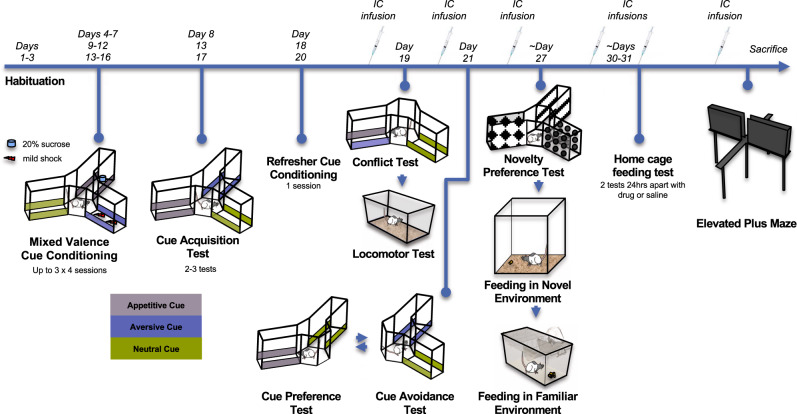
Fig. 1
Fig. 1. Timeline of experiments.
Following surgery, animals were trained in the mixed valence Y-maze task first. Following a successful cue acquisition test, animals received intracranial microinfusions of CNO (1 mM, depicted as IC infusion) and were administered a conflict test and locomotor test. After a refresher conditioning session, animals were infused again, and then administered the appetitive and aversive preference tests. Next, animals were given ~5 days of free feeding, and then food restricted for a novelty detection test, novel environment suppressed feeding (NESF) and the familiar environment suppressed feeding test (FESF), prior to which CNO was microinfused. Following these tests, the animals were given free access to food for 24 h, and were then food restricted again prior to the two free feeding tests, which occurred on successive days. Finally, animals received a final infusion of either CNO or saline, were administered the elevated plus maze, and sacrificed thereafter for brain extraction.
Fig. 2
Fig. 2. Experimental schematic and c-Fos results.
a Diagram of hM4Di transduction in vCA3 and cannulation in LScd, with b representative DREADDs axonal transduction in the LScd (red) and somatic transduction in vCA3, c cannula placements in the LScd restricted to sections +0.7 to +0.2 anterior to bregma, d minimum and maximum DREADDs expression in vCA3 observed in sections -5.20 to -5.80 posterior to bregma. e Diagram of hM4Di transduction in vCA1 and cannulation in LSrv, with f representative DREADDs axonal transduction in LSrv and somatic transduction in vCA1, g cannula placement in the LSrv restricted to sections +1.2 to +0.48 anterior to bregma, and h minimum and maximum DREADDs expression in vCA1, observed in sections -4.80 to -6.72 posterior to bregma i, l Representative images of c-Fos expression in the LScd and LSrv of hM4Di-expressing rats following either saline or CNO infusion. j, k Intracerebral CNO infusions attenuated c-Fos expression in areas of the LS that receive hM4Di positive inputs (Drug x Virus: F(1,38) = 5.17, p = 0.0248; post hoc CA1 hM4Di t7.16 = 3.49, p = 0.0022; post hoc CA3 hM4Di t7.21 = 3.64, p = 0.0228; Region: F(1,38) = 25.73, p = 0.0001) compared to saline controls. EGFP-LScd-CNO n = 5, EGFP -LScd-Saline n = 5, EGFP -LSrv-CNO n = 5, EGFP-LSrv-Saline n = 6. hM4Di-LScd-CNO n = 6, hM4Di-LScd-Saline n = 6, hM4Di-LSrv-CNO n = 7, hM4Di-LSrv-Saline n = 6. c-Fos analyzed by three-way ANOVA, followed by post hoc two-sided t-tests with Bonferroni-Holm correction for multiple comparisons. Data represent mean ± sem. *p < 0.05. * denotes between-subject comparisons. 100 um scale bars for b, f (left), i, l 1 mm scale bar for images b, f (right), c, g. i Cannula track shown by white vertical bar for images in c and d. dHPC dorsal hippocampus, LScd caudodorsal lateral septum, LSrv rostroventral lateral septum, vHPC ventral hippocampus. Source data are provided as a Source Data file.
Fig. 3
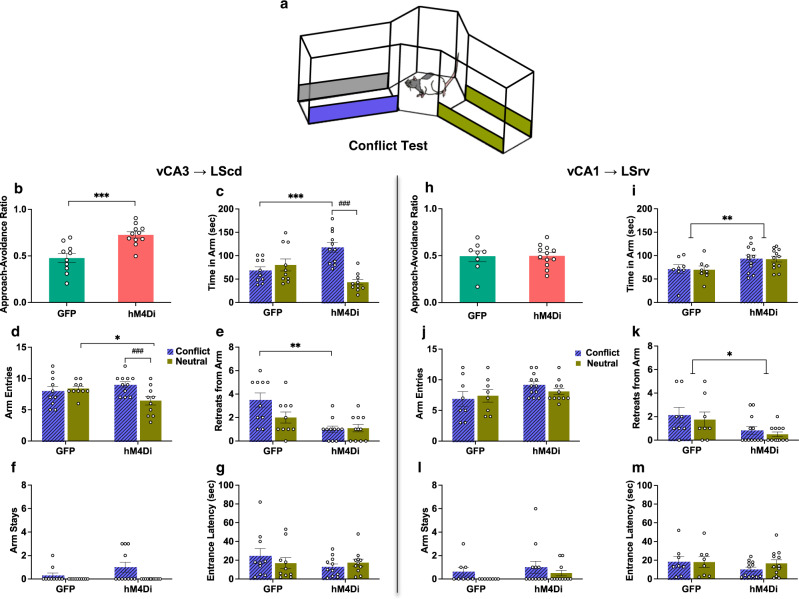
Fig. 3. vCA3 → LScd and vCA1 → LSrv circuit inhibition led to divergent responses during conflict test.
a Schematic of conflict test configuration with grey and blue bars depicting the combined appetitive and aversive cues in one arm, and green bars representing the neural cues in another arm. b, c vCA3 → LScd hM4Di animals showed potentiated approach (t16.18 = 4.17, p = 0.0005) driven by spending more time in the conflict vs. neutral arm, and more conflict arm time than GFP controls (Arm x Virus: F(1,19) = 16.42, p = 0.0004; post hoc arm t10 = 5.74, p = 0.0001; post hoc virus t19 = 3.66, p = 0.0009) d vCA3 → LScd hM4Di animals made more entries into the conflict than neutral, and less neutral arm entries than controls (Arm x Virus: F(1,19) = 8.89, p = 0.0160; post hoc arm t10 = 4.82, p = 0.0001; post hoc virus t19 = 2.44, p = 0.0392), and e retreated less from both arms than the controls (Virus: F(1,19) = 15.76, p = 0.0009; Arm x Virus: F(1,19) = 6.63, p = 0.0723; post hoc virus conflict t12.53 = 3.80, p = 0.0012; post hoc virus neutral t19 = 1.63, p = 0.0944) f Both vCA3 → LScd groups stayed in the conflict more than neutral (Arm: F(1,19) = 6.98, p = 0.0161), and g did not differ in latency to enter the arms (Lowest P: F(1,19) = 1.20, p = 0.2976). h vCA1 → LSrv hM4Di animals had equal approach-avoidance ratios (t11.96 = 0.06, p = 0.9548), i spent more time in both arms compared to controls (Virus: F(1,18) = 10.54, p = 0.0047), j had similar numbers of entries into the maze arms as the EGFP animals (Virus: F(1,18) = 2.46, p = 0.1340), k and fewer retreats (Virus: F(1,18) = 6.10, p = 0.0220). l Both vCA1 → LSrv groups trended toward more conflict arm stays (Arm: F(1,18) = 3.14, p = 0.0935), m and no difference in latency to enter either arm (Lowest P: F(1,18) = 1.86, p = 0.1893). Tests are unpaired two-sided t-tests (b, h) and two-way ANOVAs, followed by post hoc two-sided t-tests with Bonferroni-Holm correction for multiple comparisons (cg, hk). vCA3-hM4Di n = 11, vCA3-GFP n = 10, vCA1-hM4Di n = 12, vCA1-GFP n = 8. Data represent mean ± sem. *p < 0.05, **p < 0.01, ***p < 0.001. * denotes between-subject, and ♯ denotes within-subject comparisons. Source data are provided as a Source Data file.
Fig. 4
Fig. 4. Chemogenetic inhibition of vHPC-LS pathways does not affect conditioned cue preference or avoidance tests.
a, b Diagrams show the configuration of a cue preference test in which animals were allowed to freely explore an arm imbued with appetitive cues (grey bars), and an arm with neutral cues (green bars), and cue avoidance test in which animals were presented with an arm with aversive cues (blue bars) and another arm with neutral cues (green bars). c, d Regardless of pathway targeted or virus type, animals spent more time in the appetitive arm than the neutral arm (vCA3 Arm: F(1,19) = 88.56, p = 0.0001; vCA1 Arm: F(1,15) = 16.22, p = 0.0011; vCA1 Arm x Virus: F(1,15) = 0.85, p = 0.3709), e, f and emitted arm stays exclusively in the appetitive arm (vCA3 Arm: F(1,19) = 14.78, p = 0.0002; vCA1 Arm: F(1,15) = 8.33, p = 0.0113). g vCA3 → LScd groups did not differ in the number of retreats emitted to either arm (Arm: F(1,18) = 2.33, p = 0.1468; Arm x Virus: F(1,18) = 1.04, p = 0.3205), while h vCA1 → LSrv hM4Di animals retreated less from the appetitive arm than their controls (Arm x Virus: F(1,15) = 7.85, p = 0.0112; post hoc virus appetitive t6.60 = 2.62, p = 0.0338). i The vCA3 → LScd groups spent less time in the aversive arm (Arm: F(1,19) = 4.88, p = 0.0395). j vCA1 → LSrv groups both spent less time in the aversive arm (Arm: F(1,15) = 17.33, p = 0.0008). k, l Stays were rarely emitted in either arm, and tended to occur in the neutral rather than the aversive (vCA3 Arm: F(1,19) = 2.11, p = 0.1624; vCA1 Arm: F(1,15) = 5.40, p = 0.02548), m, n All groups were more likely to retreat from the aversive arm than the neutral (vCA3 Arm: F(1,19) = 22.67, p = 0.0002; vCA1 Arm: F(1,15) = 10.15, p = 0.0039). vCA3-hM4Di n = 11, vCA3-GFP n = 10, vCA1-hM4Di n = 11, vCA1-GFP n = 6. Tests are two-way ANOVAs, followed by post hoc two-sided t-tests with Bonferroni-Holm correction for multiple comparisons. Data represent mean ± SEM. *p < 0.05. * denotes between-subject comparisons. Source data are provided as a Source Data file.
Fig. 5
Fig. 5. vHPC → LS circuits exert differential effects on food approach in a novel environment, but not familiar environment.
a NESF test schematic. b vCA3 → LScd hM4Di animals were faster to bite the food pellet in the novel environment (t12 = 5.94, p = 0.0001) and c faster to start feeding (t10 = 2.70, p = 0.0214) compared to GFP controls, d while both groups had similar latencies from bite to feeding (t10 = 0.62, p = 0.5349). e vCA1 → LSrv animals were slower to bite the pellet in the novel environment (t13.7 = 3.45, p = 0.0097) and f slower to start feeding (t12.7 = 3.31, p = 0.0050) compared to GFP controls, while g both groups had similar latencies from bite to feeding (t14 = 0.78, p = 0.4379). h Familiar environment feeding schematic. i, l In familiar environments all groups had similar latencies to bite (vCA3 virus: t12 = 0.62, p = 0.6845; vCA1 virus: t14 = 0.23, p = 0.8168) and start feeding (vCA3 virus: t12 = 1.19, p = 0.2622; vCA1 virus: t14 = 0.31, p = 0.7575), and j, m consumed similar amounts of food in the familiar environment feeding test (vCA3 virus: t12 = 0.06, p = 0.8233; vCA1 virus: t14 = 1.38, p = 0.1691). k No difference between vCA3 → LScd groups, with both consuming more food as time progressed in home cage feeding test (Time Bin: F(3,42) = 90.29, p = 0.0001). n Both vCA1 → LSrv groups consumed more food over time in the home cage feeding test (Time Bin: F(3,48) = 72.05, p = 0.0001) and consumed more food overall after CNO, as compared to saline (Drug: F(1,16) = 5.11, p = 0.0427; Drug x Bin: F(3,48) = 0.6579, p = 0.6494). NESF and FESF: vCA3-hM4Di n = 8, vCA3-GFP n = 6, vCA1-hM4Di n = 10, vCA1-GFP n = 6, unpaired two-sided t-tests with Bonferroni-Holm correction for multiple comparisons. Home cage feeding: vCA3-hM4Di n = 9, vCA3-GFP n = 7, vCA1-hM4Di n = 10, vCA1-GFP n = 8, three-way ANOVAs with Bonferroni-Holm correction for multiple comparisons. Data represent mean ± SEM. *p < 0.05, **p < 0.01. * denotes between-subject comparisons. Source data are provided as a Source Data file.

References

    1. Ito R, Lee ACH. The role of the hippocampus in approach-avoidance conflict decision-making: evidence from rodent and human studies. Behav. Brain Res. 2016;313:345–357. doi: 10.1016/j.bbr.2016.07.039. - DOI - PubMed
    1. Kirlic N, Young J, Aupperle RL. Animal to human translational paradigms relevant for approach avoidance conflict decision making. Behav. Res. Ther. 2017;96:14–29. doi: 10.1016/j.brat.2017.04.010. - DOI - PMC - PubMed
    1. Fricke K, Vogel S. How interindividual differences shape approach-avoidance behavior: relating self-report and diagnostic measures of interindividual differences to behavioral measurements of approach and avoidance. Neurosci. Biobehav. Rev. 2020;111:30–56. doi: 10.1016/j.neubiorev.2020.01.008. - DOI - PubMed
    1. Nguyen D, Schumacher A, Erb S, Ito R. Aberrant approach-avoidance conflict resolution following repeated cocaine pre-exposure. Psychopharmacology. 2015;232:3573–3583. doi: 10.1007/s00213-015-4006-y. - DOI - PubMed
    1. Gray, J. A. & McNaughton, N. The Neuropsychology of Anxiety: An Enquiry into the Functions of the Septo-Hippocampal System (Oxford University Press, 2000). 10.1017/S0140525X00013170.

Publication types

Grants and funding