. 2022 Jun 10;12(1):9635.
doi: 10.1038/s41598-022-14093-1.

A mechano-sensing mechanism for waving in plant roots

Affiliations

A mechano-sensing mechanism for waving in plant roots

Zhenwei Zhang et al. Sci Rep. .

Abstract

Arabidopsis roots grown on inclined agar surfaces exhibit unusual sinusoidal patterns known as root-waving. The origin of these patterns has been ascribed to both genetic and environmental factors. Here we propose a mechano-sensing model for root-waving, based on a combination of friction induced by gravitropism, the elasticity of the root and the anchoring of the root to the agar by thin hairs, and demonstrate its relevance to previously obtained experimental results. We further test the applicability of this model by performing experiments in which we measure the effect of gradually changing the inclination angles of the agar surfaces on the wavelength and other properties of the growing roots. We find that the observed dynamics is different than the dynamics reported in previous works, but that it can still be explained using the same mechano-sensing considerations. This is supported by the fact that a scaling relation derived from the model describes the observed dependence of the wavelength on the tilt angle for a large range of angles. We also compare the prevalence of waving in different plant species and show that it depends on root thickness as predicted by the model. The results indicate that waving can be explained using mechanics and gravitropism alone and that mechanics may play a greater role in root growth and form than was previously considered.


Conflict of interest statement

The authors declare no competing interests.

Figures
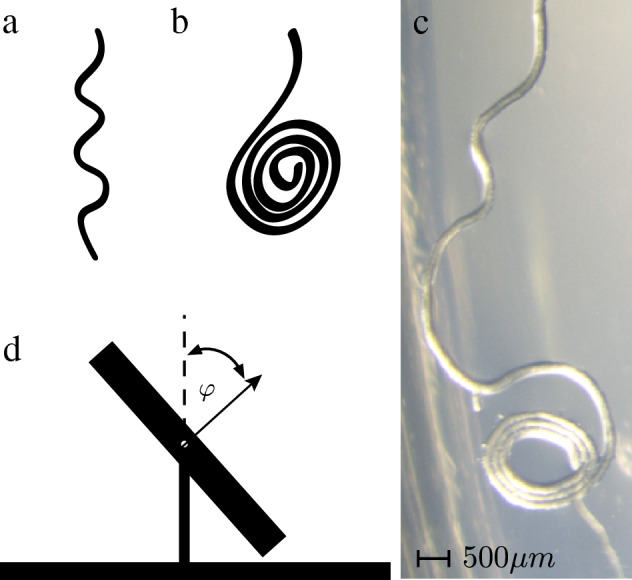
Figure 1
Figure 1
Root waving and coiling: (a) An illustration of root waving. (b) An illustration of root coiling. (c) An image showing an Arabidobsis root transitioning from a waving pattern to a coiling pattern. (d) An illustration of the experimental apparatus containing an agar-covered plastic plate (petri-dish) the normal of which can be set at different angles φ with respect to the vertical. The plate is shown from the side.
Figure 2
Figure 2
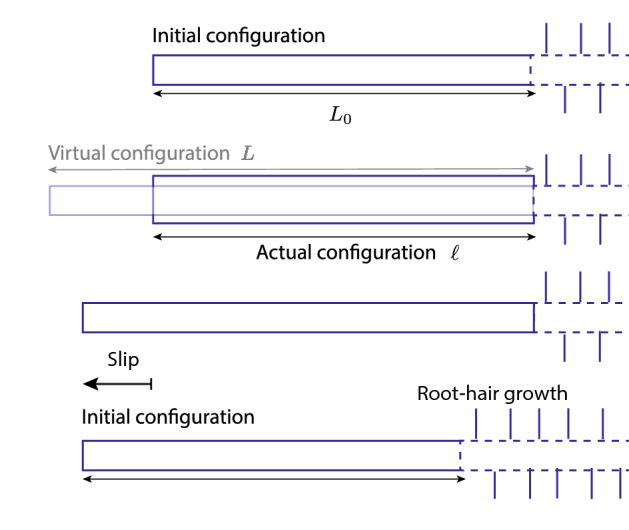
Different stages during stick-grow-slip without buckling. From top to bottom: Initial configuration, virtual (grown) configuration vs the actual configuration, stress release by slip, new initial configuration.
Figure 3
Figure 3
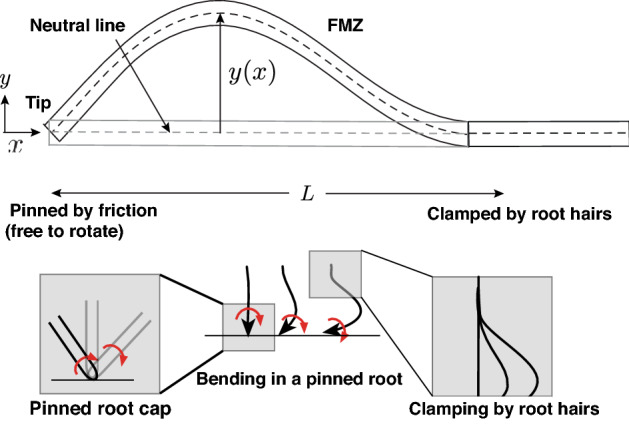
Geometry and boundary conditions: The freely moving zone is modeled as a thin elastic rod subject to a compressive force which arises from the combination of static friction at the tip and growth. On the right, the rod is clamped due to anchoring by root-hairs—it cannot change its position and its angle. On the left the rod is pinned—it can change direction but cannot move. For a large enough compressive force, the FMZ buckles, which allows for growth in the lateral direction, which is assumed to be on the surface of the agar, as is observed in the experiments. In the figure below, we show a possible mechanism for twisting of the FMZ.
Figure 4
Figure 4
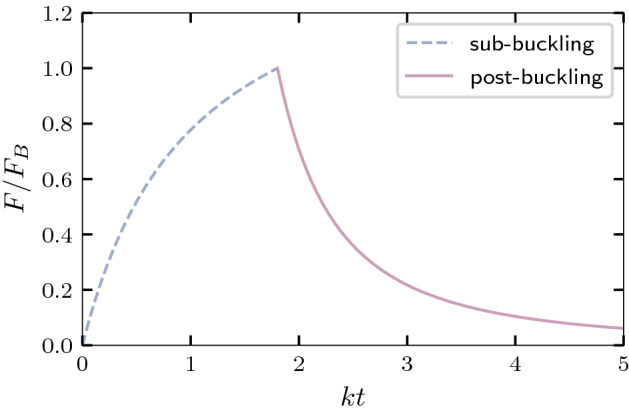
Post-buckling: The force F=Fx2+Fy2 (rescaled by the buckling force FB) before (dashed blue line) and after buckling occurs as a function of kt, without taking into account root hair progression.
Figure 5
Figure 5
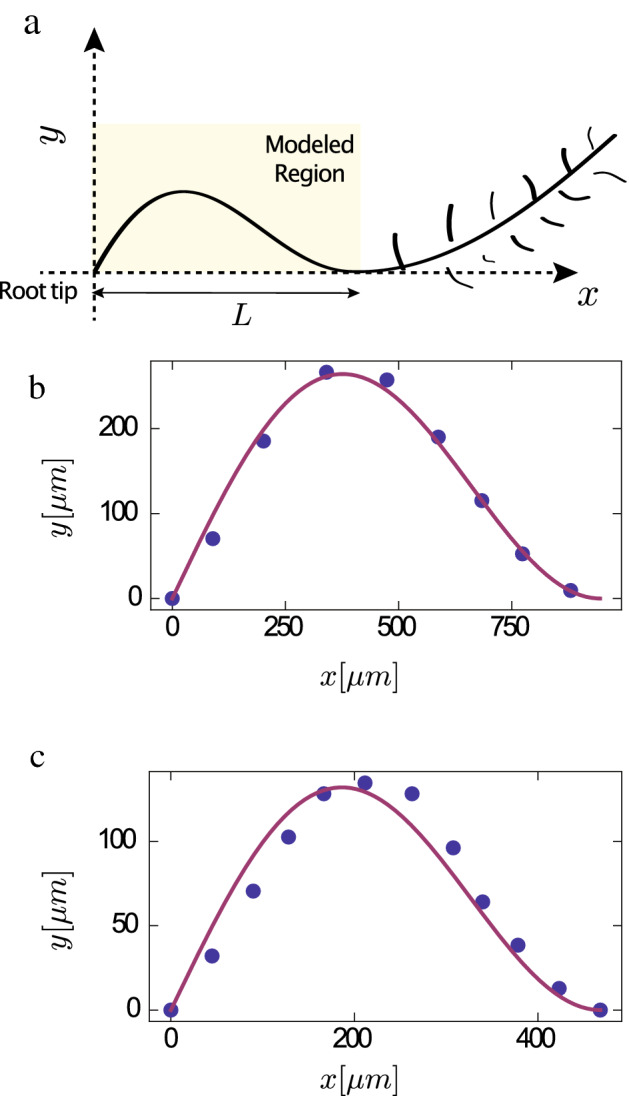
Comparing experiments to theory: (a) An illustration of the region of the root in the experiments of Thompson and Holbrook that is compared to the elastic solution for pinned-clamped boundary conditions (Eq. (9)). (b) Fit of Eq. (9) to points taken from the Supplementary Movie of Ref. at t=10.45 h. The fitting parameter obtained was A=193.9μ m with R2=0.98. (c) Fit of the same equation to points taken from the Supplementary Movie of Ref. at t=13.95 h. The fitting parameter obtained was A=96.71μm with R2=0.938.
Figure 6
Figure 6
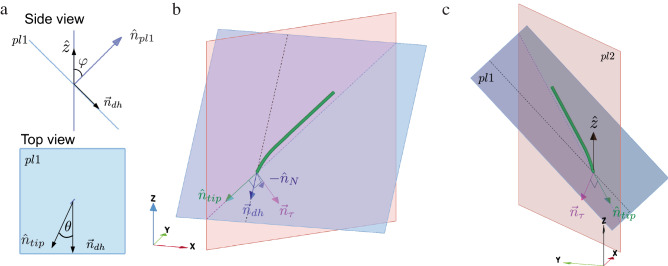
Symmetry breaking: (a) Top: a side-view of the plane representing the substrate plane and its normal vector n^pl1 (in blue). Bottom: top view of pl1 showing the angle θ between n^tip and ndh. (b) The FMZ (green cylindrical object) and the vectors representing the tip direction n^tip, the downhill direction n^dh, the negative to the normal direction -n^N, and the direction at which force is being applied to the gel nτ. The dashed line represents the downhill direction. The bending of the green cylinder represents the bending of the FMZ inside pl2. (c) Same as (b) but from a different viewing angle. Note that the coordinate axes rotate with the different perspectives and are different from the one used in Fig. 3.
Figure 7
Figure 7
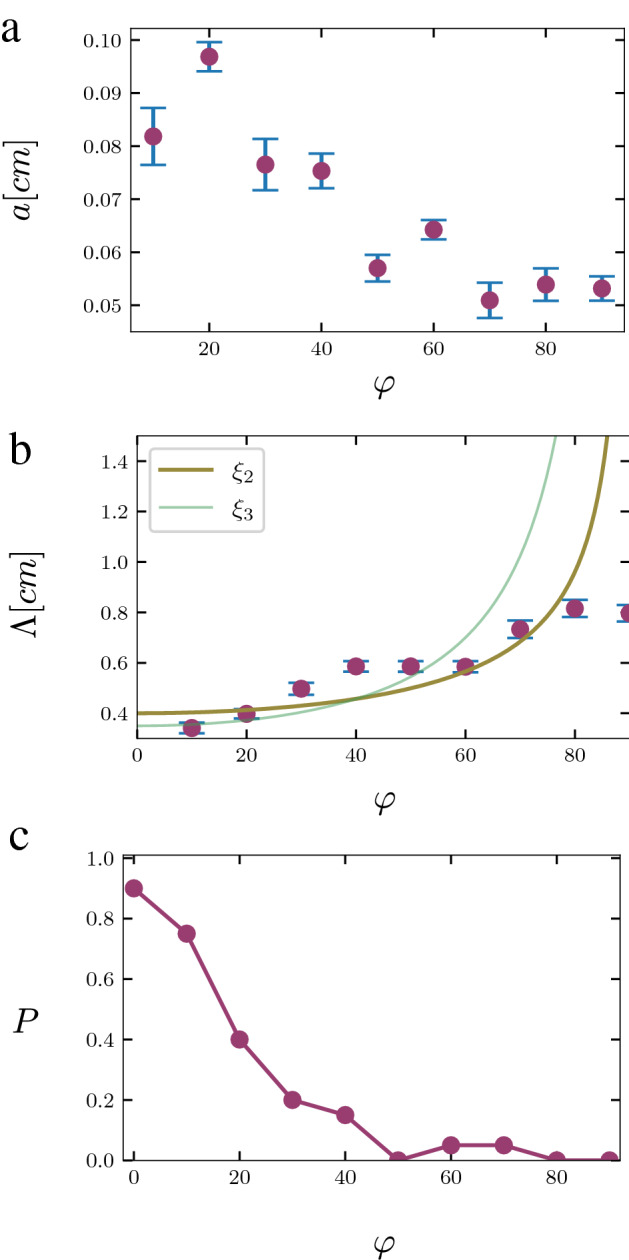
Experimental results: (a) Change in amplitude as a function of tilt angle. (b) Change in wavelength as a function of tilt angle compared to Eq. (18) (thick dark-yellow line) and Eq. ((19)) (thin green line). (c) Probability of a root to form coils as a function of the angle. In all cases the sample size was n=20 and the standard error is represented by vertical lines.
Figure 8
Figure 8
A growth and buckling step giving rise to a circular growth pattern. Each step starts with a buckling event, that causes a small change of angle. This small change of angle is fixed to the gel by the advancing root hairs that causes the free zone to become shorter and “straighter”. However, the FMZ does not become completely straight and when it grows and buckles again, it tends to bend in the same direction in the absence of the symmetry breaking component of the force applied by the root tip.
Figure 9
Figure 9
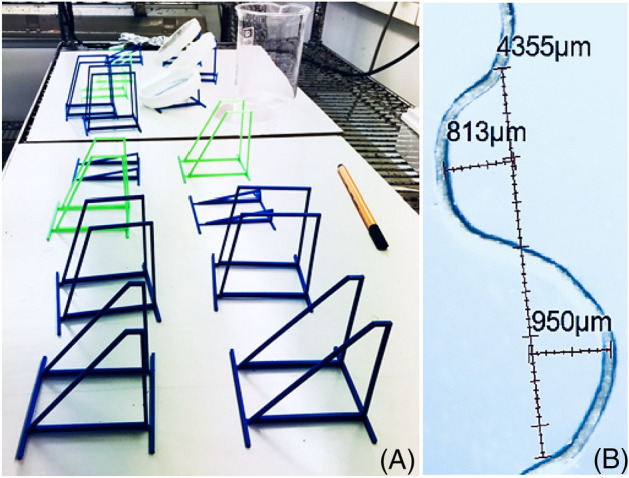
Experimental setup: (A) Growing platforms 3D printed in different inclination angles φ that were used to place plates containing agar surfaces on which the roots were grown. (B) An example of wavelength and amplitude measurements.

References

    1. Thompson, D. On Growth and Form (1942)
    1. Esmon CA, Pedmale UV, Liscum E. Plant tropisms: Providing the power of movement to a sessile organism. Int. J. Dev. Biol. 2004;49:665–674. doi: 10.1387/ijdb.052028ce. - DOI - PubMed
    1. Eapen D, Barroso ML, Ponce G, Campos ME, Cassab GI. Hydrotropism: Root growth responses to water. Trends Plant Sci. 2005;10:44–50. doi: 10.1016/j.tplants.2004.11.004. - DOI - PubMed
    1. Hohm T, Preuten T, Fankhauser C. Phototropism: Translating light into directional growth. Am. J. Bot. 2013;100:47–59. doi: 10.3732/ajb.1200299. - DOI - PubMed
    1. Galvan-Ampudia CS, Julkowska MM, Darwish E, Gandullo J, Korver RA, Brunoud G, Haring MA, Munnik T, Vernoux T, Testerink C. Halotropism is a response of plant roots to avoid a saline environment. Curr. Biol. 2013;23:2044–2050. doi: 10.1016/j.cub.2013.08.042. - DOI - PubMed

Publication types