. 2022 Jun 10;12(1):9650.
doi: 10.1038/s41598-022-13701-4.

E-textile based modular sEMG suit for large area level of effort analysis

Affiliations

E-textile based modular sEMG suit for large area level of effort analysis

Korine A Ohiri et al. Sci Rep. .

Abstract

We present a novel design for an e-textile based surface electromyography (sEMG) suit that incorporates stretchable conductive textiles as electrodes and interconnects within an athletic compression garment. The fabrication and assembly approach is a facile combination of laser cutting and heat-press lamination that provides for rapid prototyping of designs in a typical research environment without need for any specialized textile or garment manufacturing equipment. The materials used are robust to wear, resilient to the high strains encountered in clothing, and can be machine laundered. The suit produces sEMG signal quality comparable to conventional adhesive electrodes, but with improved comfort, longevity, and reusability. The embedded electronics provide signal conditioning, amplification, digitization, and processing power to convert the raw EMG signals to a level-of-effort estimation for flexion and extension of the elbow and knee joints. The approach we detail herein is also expected to be extensible to a variety of other electrophysiological sensors.


Conflict of interest statement

K.O., L.H., M.M., L.C., C.P. and M.B. have filed patent applications on this technology that use principles discussed herein. The other authors declare no competing interests.

Figures
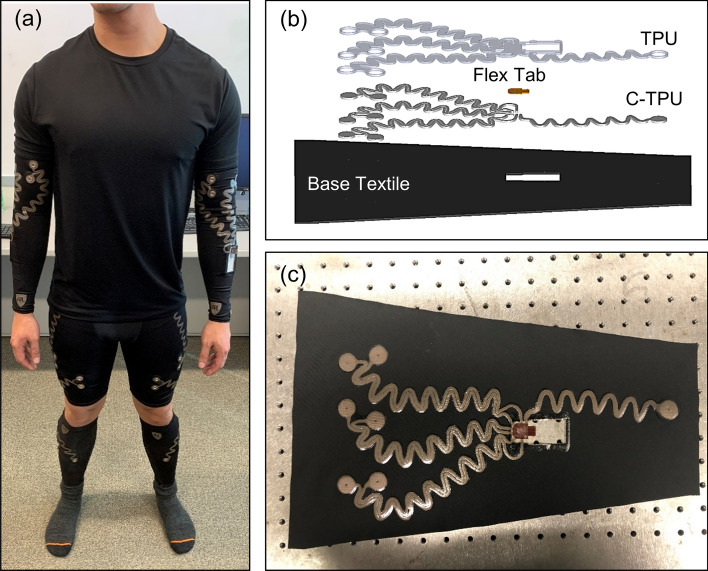
Figure 1
Figure 1
(a) Subject wearing the final sEMG suit showing arm sleeves, shorts, and calf sleeves. Fabrication of top side of the sEMG sleeves showing an (b) exploded view of sleeve stack up and (c) image of the assembled sleeve.
Figure 2
Figure 2
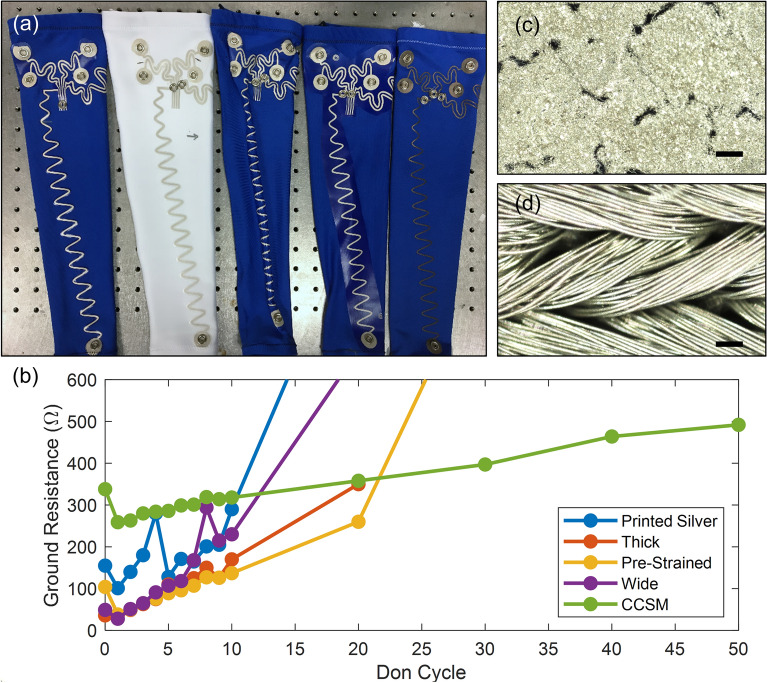
Preliminary don-doff strain testing of completed sleeves showing. (a) Image of sleeves showing the printed silver, thick, pre-strained, wide, and CCSM configurations (from left to right). (b) Ground resistance below 600 Ω versus don cycle. Bright field optical microscope images of (c) printed silver after strain and (d) CCSM under strain. Scale bar represents 100 µm.
Figure 3
Figure 3
Strain cycling results showing the (a) short sine interconnect design, (b) tall sine interconnect design, (c) short nested interconnect design, and (d) tall nested interconnect design. Scale bar represents 2 cm. (e) Resistance versus cycle number at 25% strain over 1000 cycles (n = 3 coupons).
Figure 4
Figure 4
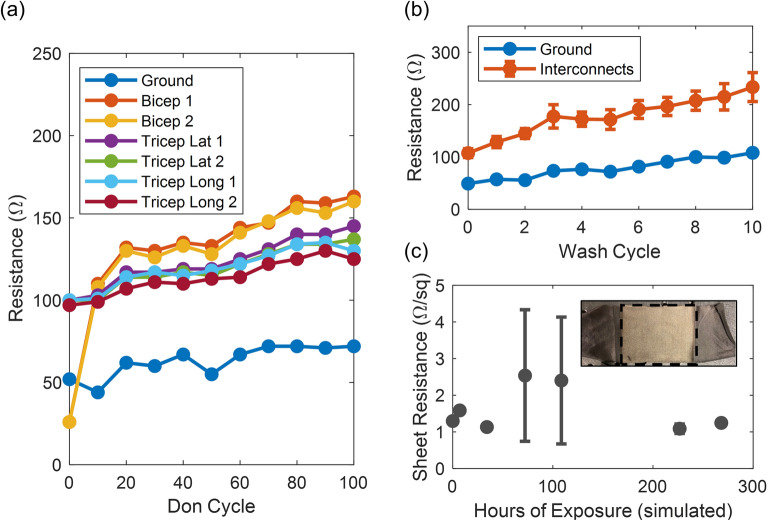
Robustness testing of finalized interconnect geometry showing (a) end to end resistance of CCSM leads for each muscle group versus don-doff cycle, (b) end to end resistance of CCSM leads versus machine laundering cycles (n = 4 electrode interconnects), and (c) sheet resistance of CCSM versus simulated hours of exposure to UV (n = 3 coupons, inset image of sample test coupon with exposed region enclosed).
Figure 5
Figure 5
Characterization of PEDOT:PSS and CCSM electrodes. SEM image of (a) polyester impregnated with PEDOT:PSS and (b) CCSM. (c) Schematic of electrode stack up. (d) Impedance measurements of PEDOT:PSS and CCSM when dry and wet at 1 kHz (n = 2 coupons). Sheet resistance of PEDOT:PSS and CCSM versus (e) cumulative abrasion time (n = 3 coupons) and (f) laundering cycles (n = 5 coupons).
Figure 6
Figure 6
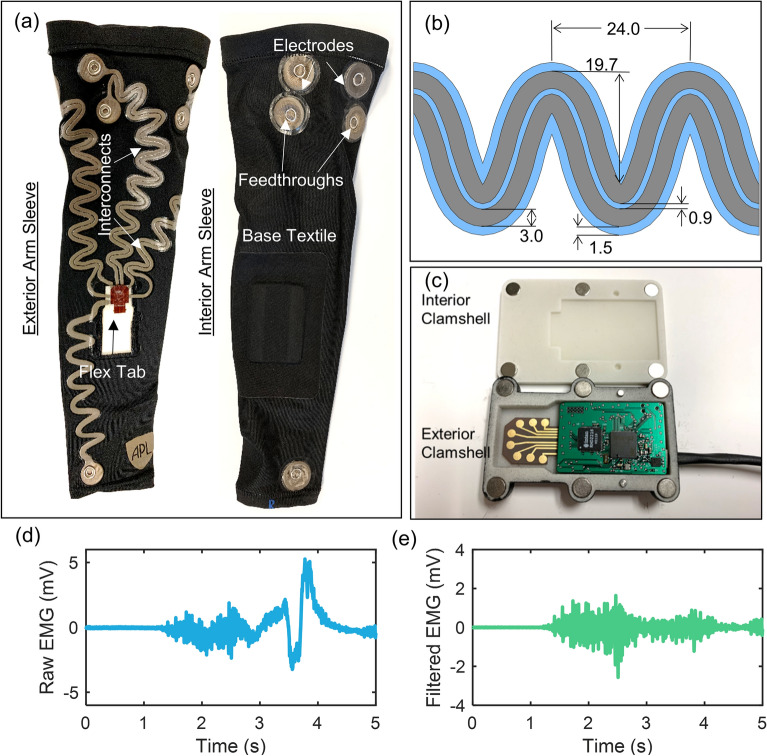
Finalized arm sleeve design showing the (a) labeled image of the interior and exterior of the sleeve, (b) schematic of tall nested interconnect design showing e-textile (gray/dark) and protective TPU (blue/light, dimensions in mm), and (c) image of the flex tab in the optional custom built glass filled nylon enclosure. Exemplar elbow flexion EMG plot from the arm sleeve showing (d) raw data and (e) filtered data.
Figure 7
Figure 7
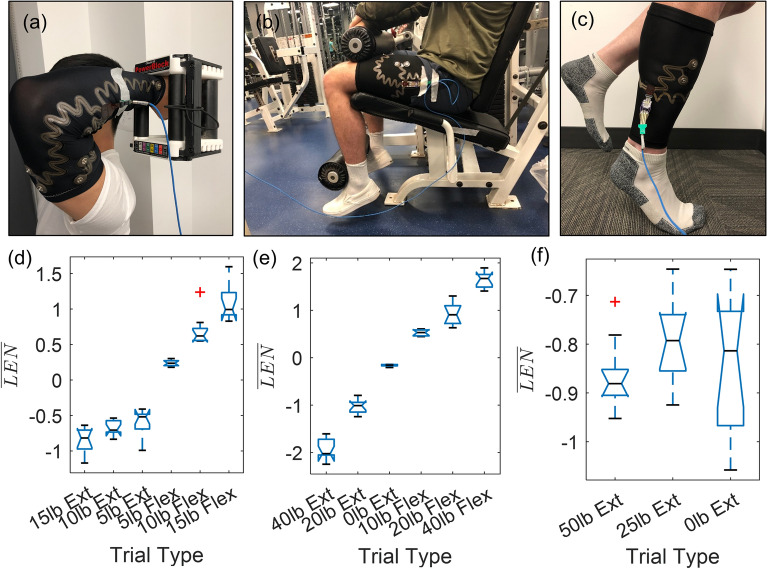
Human subject research testing of sEMG suit with 1 degree of freedom system. Images of experimental set-up for (a) the bicep/tricep (elbow), (b) quadriceps/hamstring (knee), and (c) tibialis anterior/gastrocnemius (ankle) muscle groups (joints). (d,e) Human subject research data showing 1-way ANOVA results for binned level of effort verification for elbow, knee, and ankle extension exercises, respectively (n = 10 trials). Red crosses indicate outliers.
Figure 8
Figure 8
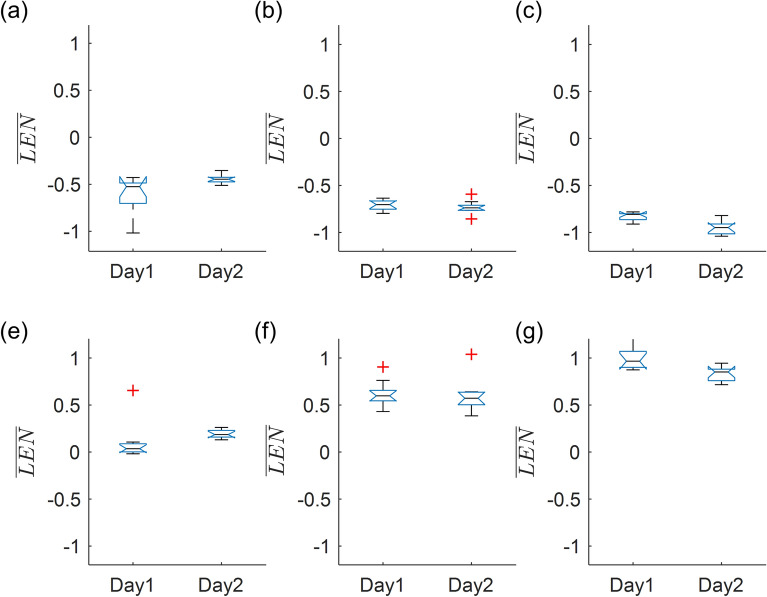
Multi-day comparison of muscle activation during isolated elbow exercises. Red crosses indicate outliers.

References

    1. Samuel OW, et al. Intelligent EMG pattern recognition control method for upper-limb multifunctional prostheses: Advances, current challenges, and future prospects. IEEE Access. 2019;7:10150–10165. doi: 10.1109/ACCESS.2019.2891350. - DOI
    1. Schweisfurth MA, et al. Electrotactile EMG feedback improves the control of prosthesis grasping force. J. Neural Eng. 2016;13:056010. doi: 10.1088/1741-2560/13/5/056010. - DOI - PubMed
    1. Adewuyi AA, Hargrove LJ, Kuiken TA. Evaluating EMG feature and classifier selection for application to partial-hand prosthesis control. Front. Neurorobot. 2016;10:15. doi: 10.3389/fnbot.2016.00015. - DOI - PMC - PubMed
    1. Nyni, K. A. et al. Wireless health monitoring system for ECG, EMG and EEG detecting. in 2017 International Conference on Innovations in Information, Embedded and Communication Systems (ICIIECS) 1–5. 10.1109/ICIIECS.2017.8275879 (2017).
    1. Liu S-H, et al. An EMG patch for the real-time monitoring of muscle-fatigue conditions during exercise. Sensors. 2019;19:3108. doi: 10.3390/s19143108. - DOI - PMC - PubMed

Publication types