


Recommendation on an updated standardization of serum magnesium reference ranges
- PMID: 35689124
- PMCID: PMC9186275
- DOI: 10.1007/s00394-022-02916-w
Recommendation on an updated standardization of serum magnesium reference ranges
Abstract
Purpose: Serum magnesium is the most frequently used laboratory test for evaluating clinical magnesium status. Hypomagnesemia (low magnesium status), which is associated with many chronic diseases, is diagnosed using the serum magnesium reference range. Currently, no international consensus for a magnesemia normal range exists. Two independent groups designated 0.85 mmol/L (2.07 mg/dL; 1.7 mEq/L) as the low cut-off point defining hypomagnesemia. MaGNet discussions revealed differences in serum magnesium reference ranges used by members' hospitals and laboratories, presenting an urgent need for standardization.
Methods: We gathered and compared serum magnesium reference range values from our institutions, hospitals, and colleagues worldwide.
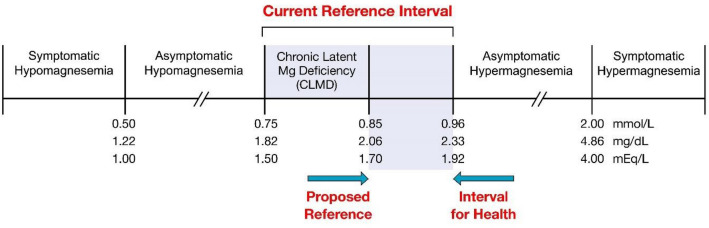
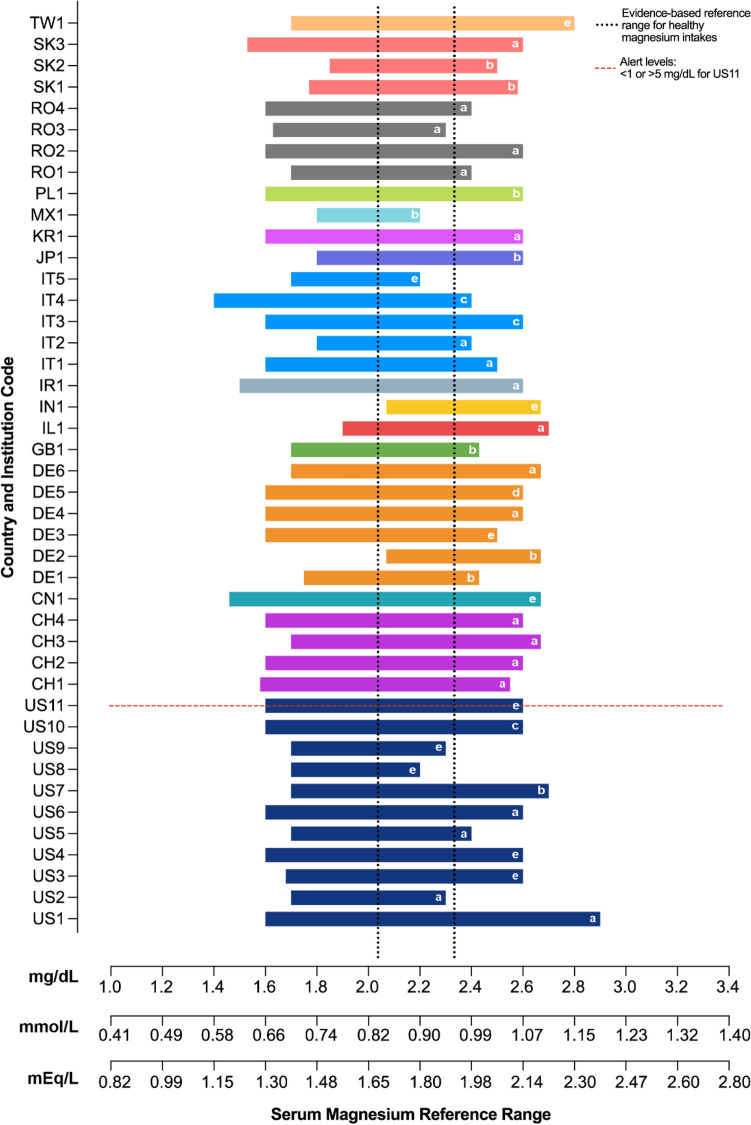
Results: Serum magnesium levels designating "hypomagnesemia" differ widely. Of 43 collected values, only 2 met 0.85 mmol/L as the low cut-off point to define hypomagnesemia. The remainder had lower cut-off values, which may underestimate hypomagnesemia diagnosis in hospital, clinical, and research assessments. Current serum magnesium reference ranges stem from "normal" populations, which unknowingly include persons with chronic latent magnesium deficit (CLMD). Serum magnesium levels of patients with CLMD fall within widely used "normal" ranges, but their magnesium status is too low for long-term health. The lower serum magnesium reference (0.85 mmol/L) proposed specifically prevents the inclusion of patients with CLMD.
Conclusions: Widely varying serum magnesium reference ranges render our use of this important medical tool imprecise, minimizing impacts of low magnesium status or hypomagnesemia as a marker of disease risk. To appropriately diagnose, increase awareness of, and manage magnesium status, it is critical to standardize lower reference values for serum magnesium at 0.85 mmol/L (2.07 mg/dL; 1.7 mEq/L).
Keywords: CLMD; Chronic latent magnesium deficit; Hypomagnesemia; Serum magnesium; Serum magnesium reference range.
© 2022. The Author(s), under exclusive licence to Springer-Verlag GmbH Germany.
Conflict of interest statement
The authors declare that they have no conflict of interest.
Figures
Comment in
-
Comment to "Recommendation on an updated standardization of serum magnesium reference ranges".Eur J Nutr. 2022 Dec;61(8):4231-4233. doi: 10.1007/s00394-022-03004-9. Epub 2022 Sep 27. Eur J Nutr. 2022. PMID: 36168067 No abstract available.
-
Reply to "Recommendation on an updated standardization of serum magnesium reference ranges," Jeroen H.F. de Baaij et al.Eur J Nutr. 2022 Dec;61(8):4235-4237. doi: 10.1007/s00394-022-03005-8. Epub 2022 Oct 7. Eur J Nutr. 2022. PMID: 36207423 No abstract available.
References
-
- Fulop T, Agarwal M, Keri KC (2020) Hypomagnesemia clinical presentation. https://emedicine.medscape.com/article/2038394-clinical. Accessed 13 April 2022
MeSH terms
Substances
LinkOut - more resources
Full Text Sources
Medical
Miscellaneous
