


Corporeal rehabilitation to manage acute stress in critically ill patients
- PMID: 35689146
- PMCID: PMC9187824
- DOI: 10.1186/s13613-022-01019-3
Corporeal rehabilitation to manage acute stress in critically ill patients
Abstract
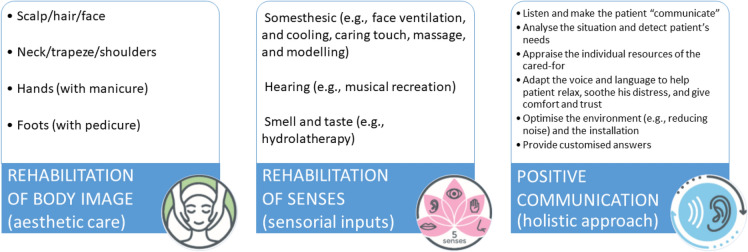
Background: Intensive care unit (ICU) patients often endure discomfort and distress brought about by their medical environment and the subjective experience of their stay. Distress, pain, and loss of control are important predictors of future neuropsychiatric disorders. Depression, anxiety, and post-traumatic stress are common after discharge. We aimed at mitigating acute stress and discomfort via a novel intervention based on body image rehabilitation and rehabilitation of senses performed following a holistic approach guided by positive communication (corporeal rehabilitation care, CRC).
Results: We conducted a prospective observational study on 297 consecutively enrolled patients participating in at least one CRC session. Benefits of CRC were assessed on both subjective analogical scales of stress, pain, and well-being criteria, and objective clinical measures of dyspnea, respiratory rate, and systolic arterial pressure, just after CRC and long after (a median of 72 min later) to estimate its remote effect. Results showed that CRC had a positive effect on all overt measures of distress (acute stress, pain, discomfort) just after CRC and remotely. This beneficial effect was also observed on dyspnea and respiratory rate. Results also showed that best CRC responders had higher baseline values of stress and heart rate and lower baseline values of well-being score, indicating that the care targeted the population most at risk of developing psychological sequelae. Interestingly, a positive CRC response was associated with a better survival even after adjustment for physiologic severity, indicating a potential to identify patients prompt to better respond to other therapeutics and/or rehabilitation.
Conclusion: This study demonstrated the feasibility of an innovative holistic patient-centered care approach and its short-term positive effects on critical parameters that are considered risk factors for post-intensive care syndrome. Further studies are warranted to study long-term benefits for patients, and overall benefits for relatives as well as ICU staff.
Keywords: Corporeal; Intensive care; Rehabilitation; Stress.
© 2022. The Author(s).
Conflict of interest statement
The authors have no conflict of interest to disclose.
Figures


References
-
- Lecomte J. Empathie et ses effets. Elsevier Masson SAS, Paris. EMC Savoirs Soins Infirm. 2010. https://www.em-consulte.com/en/article/262093. Accessed 26 Apr 2020.
LinkOut - more resources
Full Text Sources
