


Outcomes During and After Early Intervention Services for First-Episode Psychosis: Results Over 5 Years From the RAISE-ETP Site-Randomized Trial
- PMID: 35689478
- PMCID: PMC9434430
- DOI: 10.1093/schbul/sbac053
Outcomes During and After Early Intervention Services for First-Episode Psychosis: Results Over 5 Years From the RAISE-ETP Site-Randomized Trial
Abstract
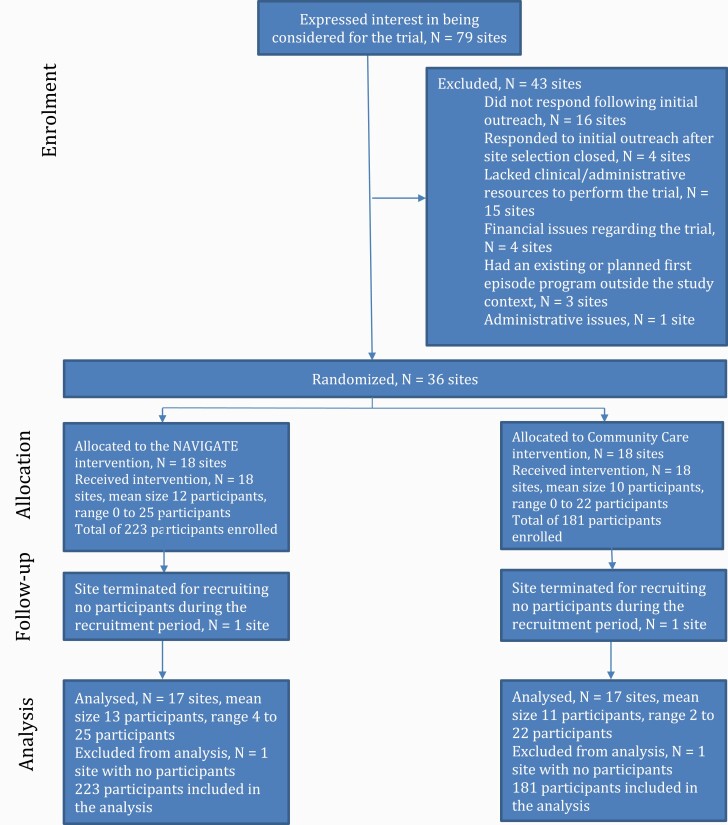
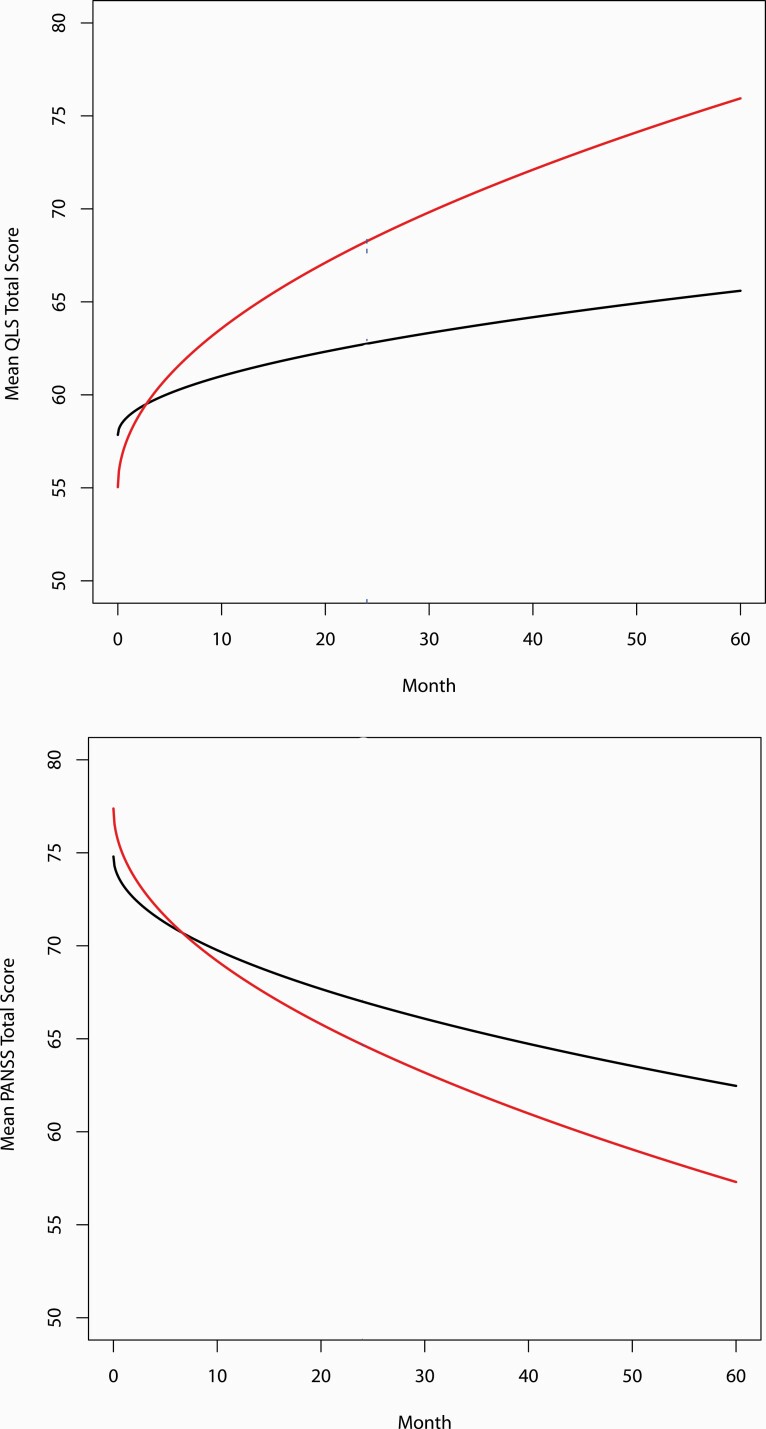
To examine long-term effects of early intervention services (EIS) for first-episode psychosis, we compared Heinrichs-Carpenter Quality of Life (QLS) and Positive and Negative Syndrome Scale (PANSS) scores and inpatient hospitalization days over 5 years with data from the site-randomized RAISE-ETP trial that compared the EIS NAVIGATE (17 sites; 223 participants) and community care (CC) (17 sites; 181 participants). Inclusion criteria were: age 15-40 years; DSM-IV diagnoses of schizophrenia, schizoaffective disorder, schizophreniform disorder, brief psychotic disorder, or psychotic disorder not otherwise specified; first psychotic episode; antipsychotic medication taken for ≤6 months. NAVIGATE-randomized participants could receive NAVIGATE from their study entry date until NAVIGATE ended when the last-enrolled NAVIGATE participant completed 2 years of treatment. Assessments occurred every 6 months. 61% of participants had assessments conducted ≥2 years; 31% at 5 years. Median follow-up length was CC 30 months and NAVIGATE 38 months. Primary analyses assumed data were not-missing-at-random (NMAR); sensitivity analyses assumed data were missing-at-random (MAR). MAR analyses found no significant treatment-by-time interactions for QLS or PANSS. NMAR analyses revealed that NAVIGATE was associated with a 13.14 (95%CI:6.92,19.37) unit QLS and 7.73 (95%CI:2.98,12.47) unit PANSS better improvement and 2.53 (95%CI:0.59,4.47) fewer inpatient days than CC (all comparisons significant). QLS and PANSS effect sizes were 0.856 and 0.70. NAVIGATE opportunity length (mean 33.8 (SD = 5.1) months) was not associated (P = .72) with QLS outcome; duration of untreated psychosis did not moderate (P = .32) differential QLS outcome. While conclusions are limited by the low rate of five-year follow-up, the data support long-term benefit of NAVIGATE compared to community care.
Keywords: coordinated specialty care; early intervention services; first episode psychosis; follow-up; schizophrenia.
© The Author(s) 2022. Published by Oxford University Press on behalf of the Maryland Psychiatric Research Center. All rights reserved. For permissions, please email: journals.permissions@oup.com.
Figures
References
-
- NIMH. Evidence-based treatments for first episode psychosis: components of coordinated specialty care. https://www.nimh.nih.gov/health/topics/schizophrenia/raise/evidence-base.... Accessed June 4, 2019.
-
- Gafoor R, Nitsch D, McCrone P, et al. Effect of early intervention on 5-year outcome in non-affective psychosis. Br J Psychiatry. 2010;196(5):372–376. - PubMed
-
- Bertelsen M, Jeppesen P, Petersen L, et al. Five-year follow-up of a randomized multicenter trial of intensive early intervention vs standard treatment for patients with a first episode of psychotic illness: the OPUS trial. Arch Gen Psychiatry. 2008;65(7):762–771. - PubMed
Publication types
MeSH terms
Substances
Grants and funding
LinkOut - more resources
Full Text Sources
Medical
