. 2022 Jun 11;20(1):267.
doi: 10.1186/s12967-022-03465-w.

Diagnostic potential of a circulating miRNA model associated with therapeutic effect in heart failure

Affiliations

Diagnostic potential of a circulating miRNA model associated with therapeutic effect in heart failure

Lu Qian et al. J Transl Med. .

Abstract

Heart failure (HF), as the leading cause of death, is continuing to increase along with the aging of the general population all over the world. Identification of diagnostic biomarkers for early detection of HF is considered as the most effective way to reduce the risk and mortality. Herein, we collected plasma samples from HF patients (n = 40) before and after medical therapy to determine the change of circulating miRNAs through a quantitative real-time PCR (QRT-PCR)-based miRNA screening analysis. miR-30a-5p and miR-654-5p were identified as the most significantly changed miRNAs in the plasma of patients upon treatment. In consistence, miR-30a-5p showed upregulation and miR-654-5p showed downregulation in the circulation of 30 HF patients, compared to 15 normal controls in the training phase, from which a two-circulating miRNA model was developed for HF diagnosis. Next, we performed the model validation using an independent cohort including 50 HF patients and 30 controls. As high as 98.75% of sensitivity and 95.00% of specificity were achieved. A comparison between the miRNA model and NT-pro BNP in diagnostic accuracy of HF indicated an upward trend of the miRNA model. Moreover, change of the two miRNAs was further verified in association with the therapeutic effect of HF patients, in which miR-30a-5p showed decrease while miR-654-5p showed increase in the plasma of patients after LVAD implantation. In conclusion, the current study not only identified circulating miR-654-5p for the first time as a novel biomarker of HF, but also developed a novel 2-circulating miRNA model with promising potentials for diagnosis and prognosis of HF patients, and in association with therapeutic effects as well.

Keywords: Biomarker; Circulating miRNA; Diagnosis; Heart failure.


Conflict of interest statement

The authors declared no competing interest exists.

Figures
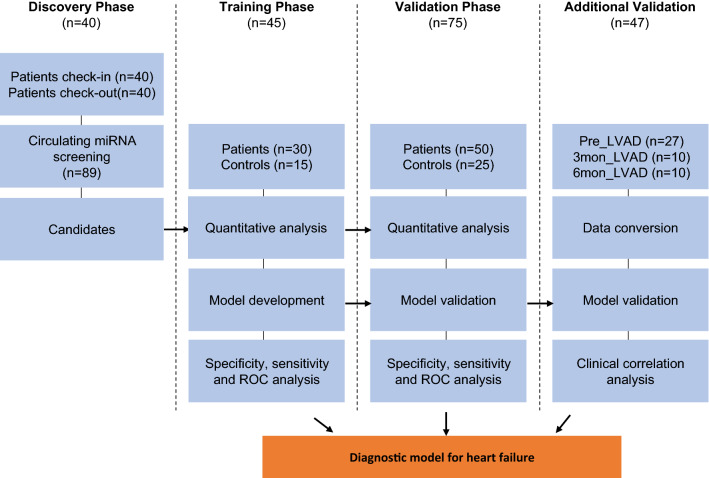
Fig. 1
Fig. 1
Overview of the study design
Fig. 2
Fig. 2
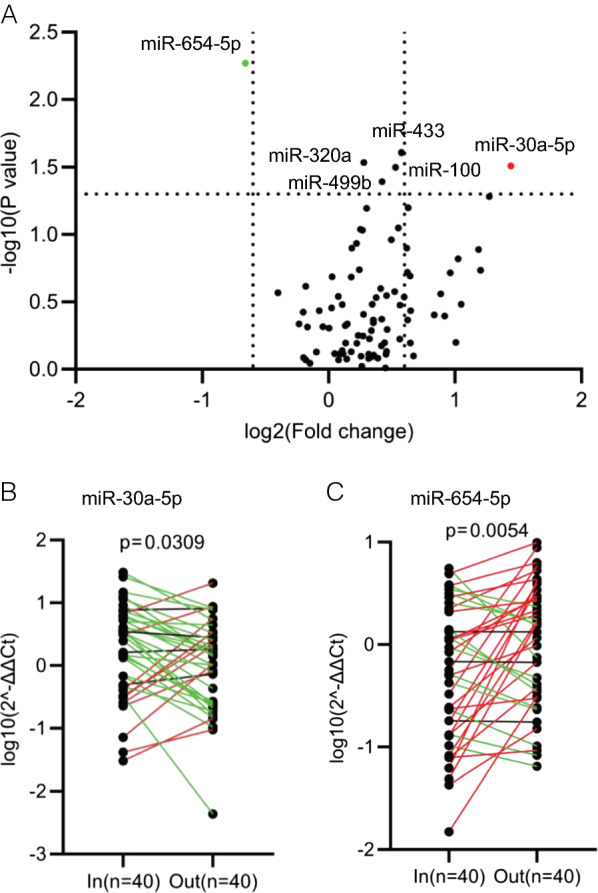
Identification of the medical therapy-associated circulating miRNAs in heart failure (HF) patients. A QRT-PCR based screening of circulating miRNAs in the plasma samples of HF patients (n = 40) before and after medical treatment. Comparisons were made by before treatment vs after treatment. Six miRNAs were identified to be significantly associated with the therapeutic effect, including miR-654-5p with upregulation and miR-30a-5p, 449b, 320a, 433 and 100 with downregulation after treatment. By applying cutoffs with fold change (FC) > 1.5 and p < 0.05, miR-30a-5p and miR-654-5p were screened out as the most significantly changed miRNAs. B, C Expression patterns of miR-30a-5p (B) and miR-654-5p (C) in each inpatient in the discovery cohort with paired plasma samples collected at times of check-in and check-out. Two-tailed p-values were calculated using paired samples t-tests
Fig. 3
Fig. 3
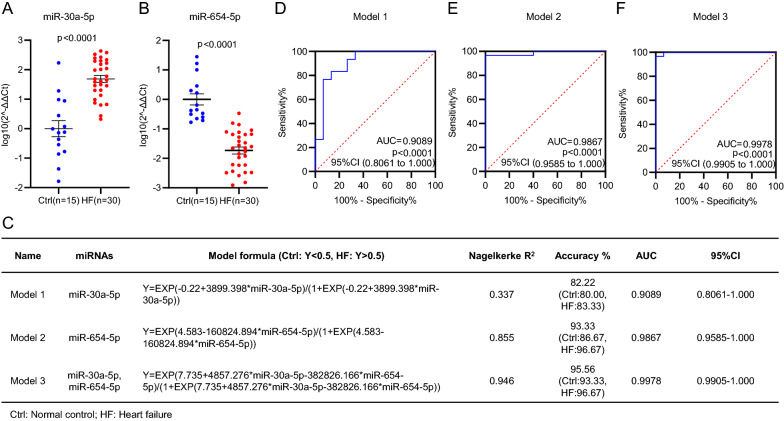
Model development with the circulating miR-30a-5p/miR-654-5p signature in the training cohort. A, B Quantitative analysis of circulating miR-30a-5p (A) and miR-654-5p (B) in the 30 HF patients and 15 normal controls (Ctrl) in the training phase. C Formulas of the miRNA diagnostic models developed using binary logistic regression method. Three models covering miR-30a-5p (model 1) or miR-654-5p (model 1) and both miRNAs (model 3) were developed and displayed, respectively. DF Receiver operating characteristic (ROC) curves of model 1 (D), model 2 (E) and model 3 (F). The values of AUC, 95% CI and p were indicated in the graphs
Fig. 4
Fig. 4
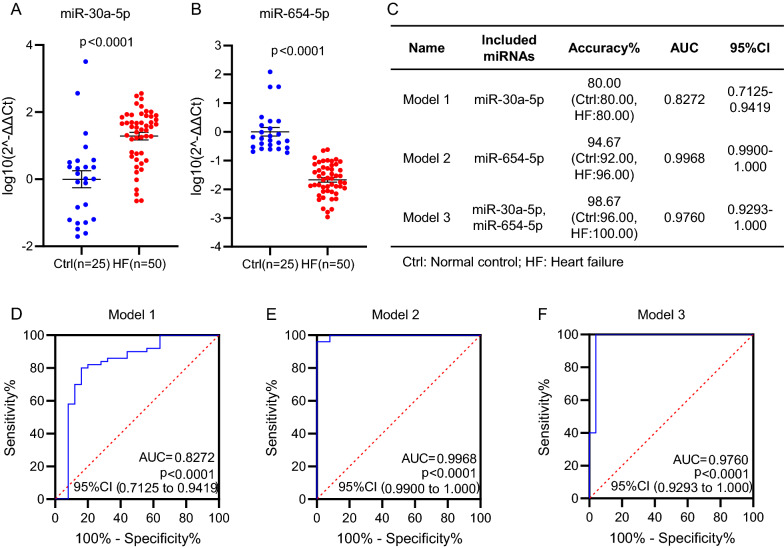
Independent validation of the miRNA models in the validation cohort. A, B Quantitative analysis of circulating miR-30a-5p (A) and miR-654-5p (B) in additional 50 HF patients and 25 controls (Ctrl) in the validation phase. C Diagnostic accuracy, AUC and 95% CI of the three models tested in the subjects of the validation cohort. DF Receiver operating characteristic (ROC) curves of the three models in the validation cohort
Fig. 5
Fig. 5
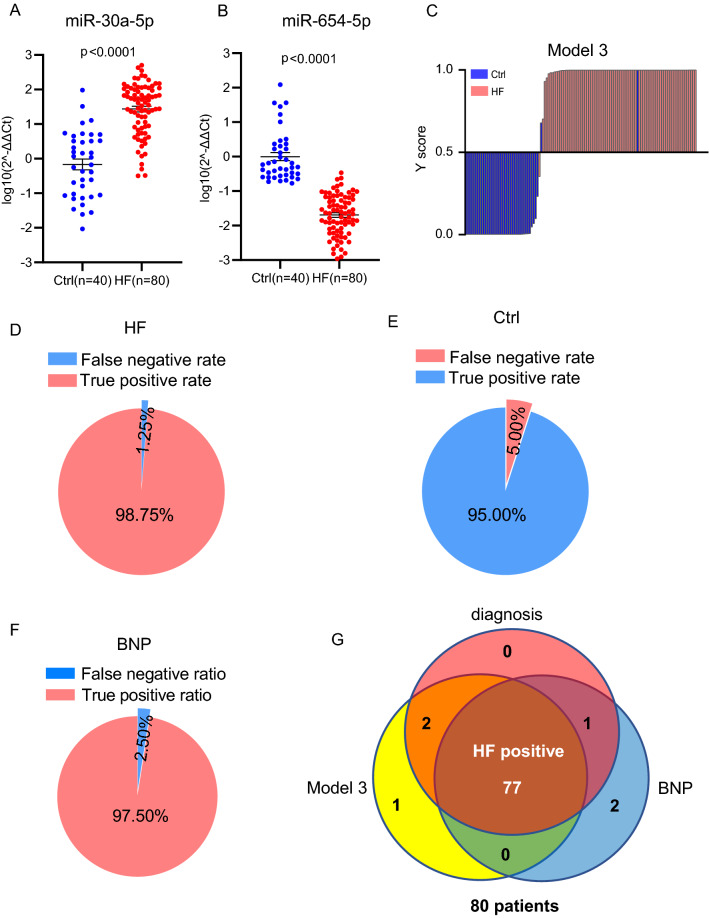
Further validation of the miRNA diagnostic model by combining the two independent clinical cohorts. A, B Expression levels of circulating miR-30a-5p (A) and miR-654-5p (B) in the 80 HF patients and 40 controls (Ctrl) combining the training and validation cohorts. C Y scores distribution plot of model 3 in the all subjects combining the training and validation cohorts. Y scores greater than 0.5 were judged as HF, otherwise as normal. D Pie graph showing the true-positive rate (98.75%) and false negative rate (1.25%) of model 3 in diagnosis of the 80 HF patients. E Pie graph showing the true-negative rate (95.00%) and false positive rate (5.00%) of model 3 tested in the 40 normal controls (Ctrl). F Pie graph showing the true-positive rate (97.50%) and false negative rate (2.50%) of the 80 HF patients by NT-proBNP-based diagnosis. G Venn graph showing overlaps between the clinically diagnosed 80 HF patients, the miRNA model-based model diagnosis and the NT-proBNP-based diagnosis
Fig. 6
Fig. 6
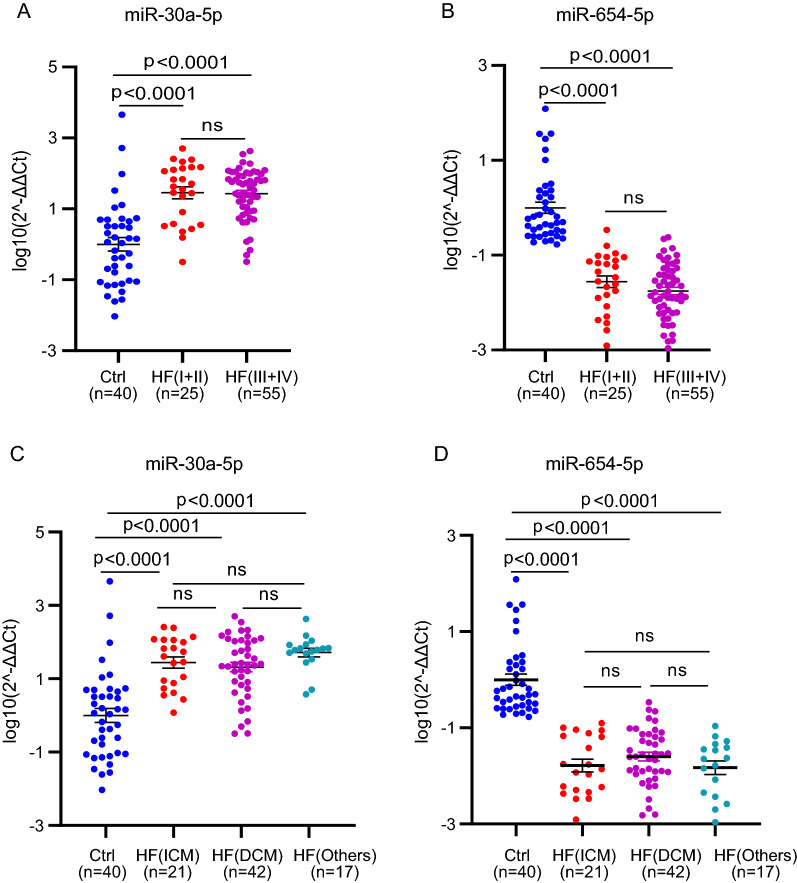
Correlation analysis of the miRNA signature with HF classification and subtypes. A, B Expression levels of circulating miR-30a-5p (A) and miR-654-5p (B) in the 40 controls (Ctrl), 25 patients with NYHA class I and II and 55 patients with NYHA class III and IV. C, D Expression levels of circulating miR-30a-5p (C) and miR-654-5p (D) in the 40 controls (Ctrl), 21 patients with Ischemic cardiomyopathy (ICM), 42 patients with dilated cardiomyopathy (DCM) and 17 patients with other cardiovascular diseases. p < 0.05 was considered as statistically significance. ns means non significant
Fig. 7
Fig. 7
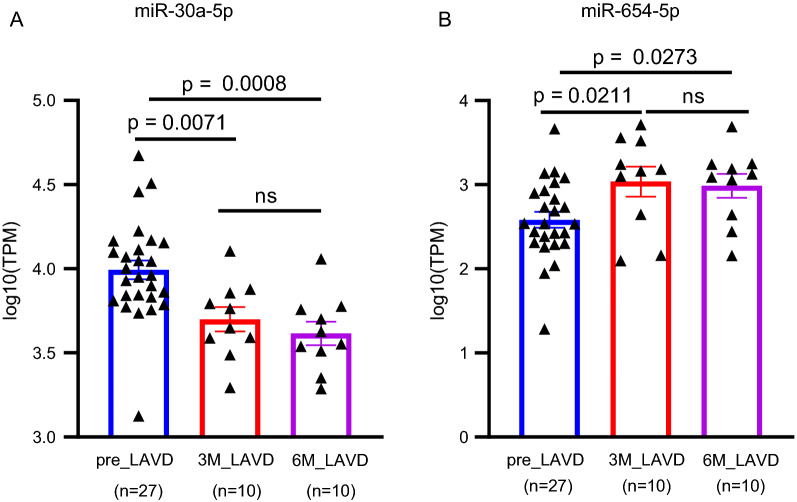
Additional validation of the miRNA signature in association with the therapeutic effect. A, B Expression levels of circulating miR-30a-5p (A) and miR-654-5p (B) in 27 HF patients without LVAD implantation (pre_ LVAD), 10 HF patients with LVAD implantation for 3 months (3M_ LVAD) and 10 HF patients with LVAD implantation for 6 months. The miRNA expression data was obtained from dataset GSE53080. p < 0.05 was considered as statistically significance. ns means non significant
Fig. 8
Fig. 8
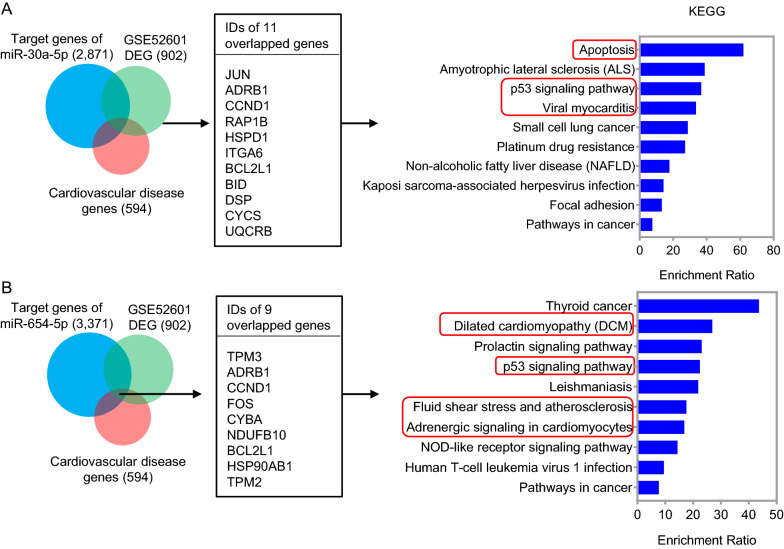
Analysis of the cardiovascular disease-related target genes of miR-30a-5p and miR-654-5p. A 11 target genes of miR-30a-5p were overlapped among 2871 predicted target genes, 594 cardiovascular disease genes and 902 DEGs in HF. B 9 target genes of miR-654-5p were overlapped among 3371 target genes, 594 cardiovascular disease genes and 902 DEGs in HF. KEGG pathway enrichment analysis was applied by using WebGestalt

References

    1. Gedela M, Khan M, Jonsson O. Heart failure. S D Med. 2015;68(9):403–409. - PubMed
    1. Di Palo KE, Barone NJ. Hypertension and heart failure: prevention, targets, and treatment. Heart Fail Clin. 2020;16(1):99–106. doi: 10.1016/j.hfc.2019.09.001. - DOI - PubMed
    1. Salah K, Kok WE, Eurlings LW, Bettencourt P, Pimenta JM, Metra M, et al. A novel discharge risk model for patients hospitalised for acute decompensated heart failure incorporating N-terminal pro-B-type natriuretic peptide levels: a European coLlaboration on acute decompeNsated heart failure: ELAN-HF score. Heart. 2014;100(2):115–125. doi: 10.1136/heartjnl-2013-303632. - DOI - PubMed
    1. Ivey KN, Muth A, Arnold J, King FW, Yeh RF, Fish JE, et al. MicroRNA regulation of cell lineages in mouse and human embryonic stem cells. Cell Stem Cell. 2008;2(3):219–229. doi: 10.1016/j.stem.2008.01.016. - DOI - PMC - PubMed
    1. Takaya T, Ono K, Kawamura T, Takanabe R, Kaichi S, Morimoto T, et al. MicroRNA-1 and MicroRNA-133 in spontaneous myocardial differentiation of mouse embryonic stem cells. Circ J. 2009;73(8):1492–1497. doi: 10.1253/circj.CJ-08-1032. - DOI - PubMed

Publication types