


High-Intensity Exercise and Geometric Indices of Hip Bone Strength in Postmenopausal Women on or off Bone Medication: The MEDEX-OP Randomised Controlled Trial
- PMID: 35690931
- PMCID: PMC9188729
- DOI: 10.1007/s00223-022-00991-z
High-Intensity Exercise and Geometric Indices of Hip Bone Strength in Postmenopausal Women on or off Bone Medication: The MEDEX-OP Randomised Controlled Trial
Abstract
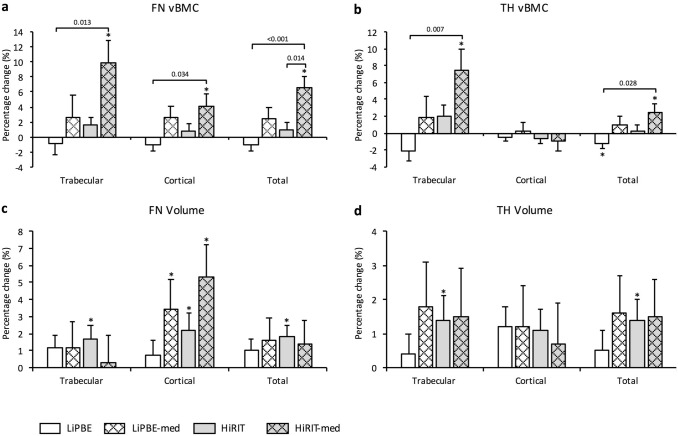
To compare the effects of high-intensity resistance and impact training (HiRIT) to low-intensity, Pilates-based exercise (LiPBE) on proximal femur geometry and explore the influence of antiresorptive medication on those effects. Postmenopausal women with low bone mass, on or off antiresorptive bone medications were randomly allocated, stratified on medication intake, to eight months of twice-weekly, supervised HiRIT (Onero™) or LiPBE (Buff Bones®). 3D hip software was used to analyse proximal femur DXA scans. Outcomes included femoral neck (FN) and total hip (TH), volumetric (e.g. vBMC, vBMD) and geometric (e.g. cortical thickness, cross-sectional area [CSA], section modulus [Z]) indices of bone strength. Data were analysed using analysis of variance. Scans of 102 women were examined: LiPBE, 43; HiRIT, 37; LiPBE-med, 11; HiRIT-med, 11. HiRIT improved TH trabecular vBMC and vBMD (3.1 ± 1.1% versus - 1.2 ± 1.2%, p = 0.008; and 1.5 ± 1.0% versus - 1.6 ± 1.2%, p = 0.042, respectively) and FN and TH total vBMC (2.0 ± 0.8% versus - 0.2 ± 0.7%, p = 0.032; and 0.7 ± 0.4% versus - 0.8 ± 0.6%, p = 0.032, respectively), compared to losses in LiPBE. HiRIT also increased Z while LiPBE did not (p = 0.035). The combination of HiRIT and medication achieved greater improvements in FN total and trabecular vBMD, total BMC, CSA and Z than HiRIT alone. HiRIT improved geometric parameters of proximal femur strength, while LiPBE exercise was largely ineffective. Medication may enhance some HiRIT effects. Findings suggest reduced hip fracture risk in response to HiRIT.Trial registration number ACTRN12617001511325.
Keywords: Antiresorptive medication; Bone structure; Exercise; Hip fracture; Osteoporosis; Postmenopausal women.
© 2022. The Author(s).
Conflict of interest statement
BRB is the director of The Bone Clinic, Brisbane, Queensland, Australia. MK-F, JSY and BKW declare that they have no conflicts of interest.
Figures

References
-
- (1994) Assessment of fracture risk and its application to screening for postmenopausal osteoporosis. Report of a WHO Study Group. World Health Organ Tech Rep Ser 843:1-129 - PubMed
-
- Chapurlat R, Bui M, Sornay-Rendu E, Zebaze R, Delmas PD, Liew D, et al. Deterioration of cortical and trabecular microstructure identifies women with osteopenia or normal bone mineral density at imminent and long-term risk for fragility fracture: a prospective study. J Bone Miner Res. 2020;35:833–844. doi: 10.1002/jbmr.3924. - DOI - PMC - PubMed
-
- Samelson EJ, Broe KE, Xu H, Yang L, Boyd S, Biver E, et al. Cortical and trabecular bone microarchitecture as an independent predictor of incident fracture risk in older women and men in the Bone Microarchitecture International Consortium (BoMIC): a prospective study. Lancet Diabetes Endocrinol. 2019;7:34–43. doi: 10.1016/S2213-8587(18)30308-5. - DOI - PMC - PubMed
Publication types
MeSH terms
Substances
Associated data
LinkOut - more resources
Full Text Sources
Miscellaneous
