


The impact of crowd gatherings on the spread of COVID-19
- PMID: 35691382
- PMCID: PMC9181815
- DOI: 10.1016/j.envres.2022.113604
The impact of crowd gatherings on the spread of COVID-19
Abstract
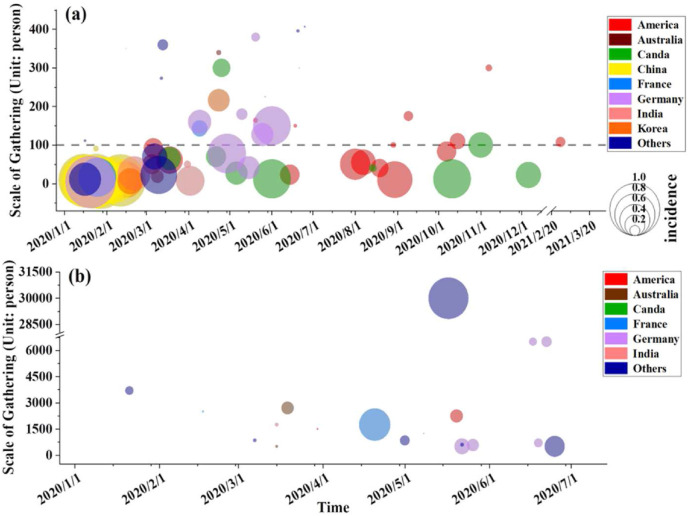
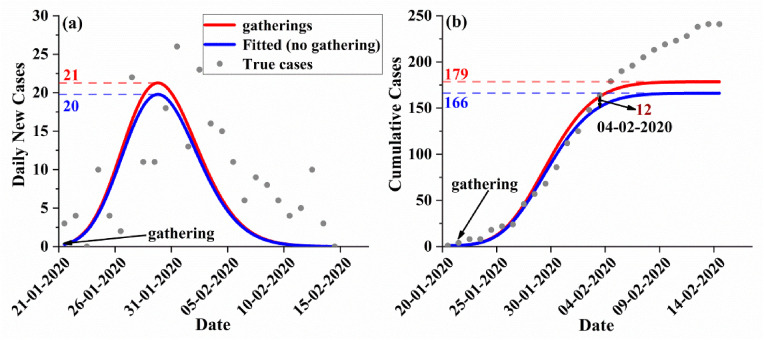
Crowd gatherings are an important cause of COVID-19 outbreaks. However, how the scale, scene and other factors of gatherings affect the spread of the epidemic remains unclear. A total of 184 gathering events worldwide were collected to construct a database, and 99 of them with a clear gathering scale were used for statistical analysis of the impact of these factors on the disease incidence among the crowd in the study. The results showed that the impact of small-scale (less than 100 people) gathering events on the spread of COVID-19 in the city is also not to be underestimated due to their characteristics of more frequent occurrence and less detection and control. In our dataset, 22.22% of small-scale events have an incidence of more than 0.8. In contrast, the incidence of most large-scale events is less than 0.4. Gathering scenes such as "Meal" and "Family" occur in densely populated private or small public places have the highest incidence. We further designed a model of epidemic transmission triggered by crowd gathering events and simulated the impact of crowd gathering events on the overall epidemic situation in the city. The simulation results showed that the number of patients will be drastically reduced if the scale and the density of crowds gathering are halved. It indicated that crowd gatherings should be strictly controlled on a small scale. In addition, it showed that the model well reproduce the epidemic spread after crowd gathering events better than does the original SIER model and could be applied to epidemic prediction after sudden gathering events.
Keywords: COVID-19 pandemic; Epidemic model; Epidemic prediction; Gathering events; Simulation.
Copyright © 2022 The Authors. Published by Elsevier Inc. All rights reserved.
Conflict of interest statement
The authors declare that they have no known competing financial interests or personal relationships that could have appeared to influence the work reported in this paper.
Figures




References
-
- Ahlawat A., Wiedensohler A., Mishra S.K. An overview on the role of relative humidity in airborne transmission of SARS-CoV-2 in indoor environments. Aerosol Air Qual. Res. 2020;20:1856–1861.
Publication types
MeSH terms
LinkOut - more resources
Full Text Sources
Medical
