


Nurses' Knowledge, Practice, and Associated Factors with Enteral Nutrition in Adult Intensive Care Units of Public Hospitals
- PMID: 35693571
- PMCID: PMC9175211
- DOI: 10.4314/ejhs.v32i2.23
Nurses' Knowledge, Practice, and Associated Factors with Enteral Nutrition in Adult Intensive Care Units of Public Hospitals
Abstract
Background: In critically ill patients, enteral nutrition is recommended as a route for nutrient delivery. Nurses' knowledge and practice of enteral nutrition influence patients' clinical outcomes. Therefore, this study sought to assess nurses' knowledge, practice, and associated factors regarding enteral nutrition in adult intensive care unit patients in public hospitals in Addis Ababa, Ethiopia.
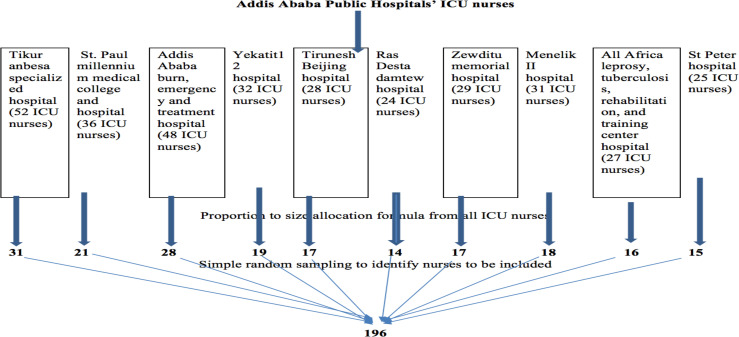
Methods: A cross-sectional study design was used to collect data from 196 nurses working in public hospitals in Addis Ababa from April 11 to April 30, 2020. The data were entered into Epi Data version 3.1 and analyzed with SPSS version 21. The correlation between independent variables and dependent variables was estimated using bivariate and multivariate logistic regression at a 95% confidence level.
Results: The level of inadequate knowledge and poor practice of nurses relating to enteral nutrition was 67.7% and 53.8%, respectively. Bachelor's degree holders were less likely to be knowledgeable (AOR= 0.24, 95% CI: (0.61, 0.93)). Nurses' practice about enteral nutrition was significantly associated with nurses' age (AOR = 0.023, 95 % CI: (0.001,0.52), nurses receiving training on enteral nutrition (AOR = 1.951, 95 % CI: (0.06, 0.60)), and nurses from ICUs having a guideline and protocol on enteral feeding practice (AOR = 3.401, 95 % CI: (1.186, 9.789).
Conclusions: In the study, it was revealed that a substantial proportion of nurses had inadequate knowledge of enteral nutrition and practiced poor enteral nutrition.
Keywords: Adult ICU; Enteral Nutrition; ICU nurse; Knowledge; practice.
© 2022 Tsige Hadera, et al.
Figures
References
-
- Fayazi S, Adineh M, Zahraei Fard S, Farokh Payam H, Ahmadie Batvandy Z. Comparing two methods of enteral nutrition in terms of their complications and the time needed to reach goal calorie in children hospitalized in ICU. International Journal of Pediatrics. 2016;4(7):2119–2130.
-
- Patel J, Kozeniecki M. Permissive underfeeding or standard enteral feeding in critical illness. The New England journal of medicine. 2015;373(12):1173–1174. - PubMed
-
- Malbrain ML. Different techniques to measure intra-abdominal pressure (IAP): time for a critical re-appraisal. Applied physiology in intensive care medicine. 2006:105–119. - PubMed
MeSH terms
LinkOut - more resources
Full Text Sources
Miscellaneous