


Prevention and Treatment of Neuraxial Morphine-Induced Pruritus: A Scoping Review
- PMID: 35694199
- PMCID: PMC9176241
- DOI: 10.2147/JPR.S361225
Prevention and Treatment of Neuraxial Morphine-Induced Pruritus: A Scoping Review
Abstract
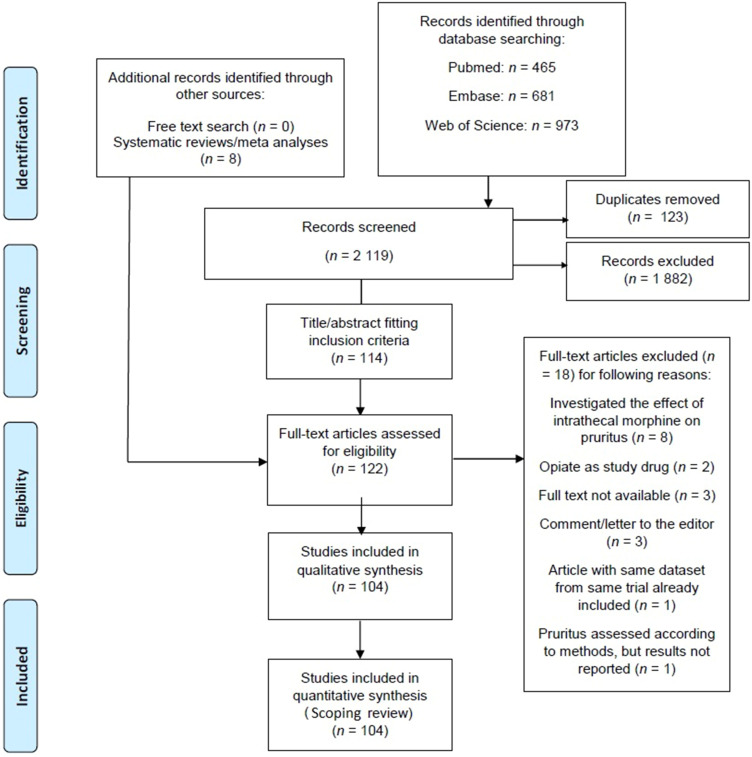
The addition of morphine to neuraxial anaesthesia leads to improved postoperative analgesia and lower opioid consumption, but is often accompanied by pruritus. Studies on preventing or treating pruritus show contradictory results. Our objective was to identify effective drugs for the prevention or treatment of pruritus by a scoping review of clinical trials. A systematic literature search was conducted in PubMed, Embase and Web of Science. We identified clinical trials investigating the prevention or treatment of neuraxial morphine-induced pruritus in adults. Systematic reviews and meta-analyses were screened for eligible studies. One-hundred-and-four articles were included covering 13 pharmacological groups. We conclude that dopamine antagonists, µ-opioid agonist/antagonists and neuraxial or orally administered µ-opioid antagonists prevent pruritus caused by neuraxial morphine regardless of the timing of administration. In the reviewed literature, 5HT3-antagonists prevent neuraxial morphine-induced pruritus when administered before morphine administration. For the treatment of neuraxial morphine-induced pruritus, only nalbuphine appears to be consistently effective. More research is needed to find the most effective doses and the optimal timing of the effective medication.
Keywords: epidural; morphine; prevention; pruritus; spinal; treatment.
© 2022 Becker et al.
Conflict of interest statement
The authors declare no conflicts of interest. The authors have no sources of funding to declare for this manuscript
Figures
References
-
- Koning MV, Teunissen AJW, van der Harst E, Ruijgrok EJ, Stolker RJ. Intrathecal Morphine for Laparoscopic Segmental Colonic Resection as Part of an Enhanced Recovery Protocol: a Randomized Controlled Trial. Reg Anesth Pain Med. 2018;43(2):166–173. doi: 10.1097/AAP.0000000000000703 - DOI - PMC - PubMed
-
- Swaro S, Karan D, Banerjee A. Comparison of Palonosetron, Dexamethasone, and Palonosetron Plus Dexamethasone as Prophylactic Antiemetic and Antipruritic Drug in Patients Receiving Intrathecal Morphine for Lower Segment Cesarean Section. Anesth Essays Res. 2014;12(2):322–327. doi: 10.4103/aer.AER_183_17 - DOI - PMC - PubMed
Publication types
LinkOut - more resources
Full Text Sources
