


Sporotrichosis Caused by Non-Wild Type Sporothrix brasiliensis Strains
- PMID: 35694546
- PMCID: PMC9184675
- DOI: 10.3389/fcimb.2022.893501
Sporotrichosis Caused by Non-Wild Type Sporothrix brasiliensis Strains
Abstract
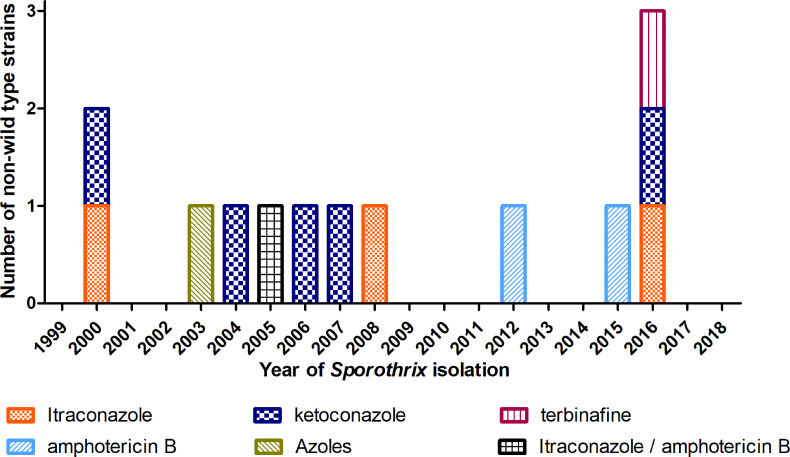
The zoonotic transmission of sporotrichosis due to Sporothrix brasiliensis occurs largely in Rio de Janeiro state, Brazil since the 1990´s. Most patients infected with S. brasiliensis respond well to itraconazole or terbinafine. However, a few patients have a slow response or do not respond to the treatment and develop a chronic infection. The aim of this study was to analyze strains of S. brasiliensis against five different drugs to determine minimal inhibitory concentration distributions, to identify non-wild type strains to any drug evaluated and the clinical aspects of infections caused by them. This study evaluated 100 Sporothrix spp. strains obtained from 1999 to 2018 from the Evandro Chagas National Institute of Infectious Diseases, Fiocruz, which were identified through a polymerase chain reaction using specific primers for species identification. Two-fold serial dilutions of stock solutions of amphotericin B, itraconazole, posaconazole, ketoconazole and terbinafine prepared in dimethyl sulfoxide were performed to obtain working concentrations of antifungal drugs ranging from 0.015 to 8.0 mg/L. The broth microdilution reference method was performed according the M38-A2 CLSI guideline. All strains were identified as S. brasiliensis and thirteen were classified as non-wild type, two of them against different drugs. Non-wild type strains were identified throughout the entire study period. Patients infected by non-wild type strains presented prolonged treatment times, needed increased antifungal doses than those described in the literature and one of them presented a permanent sequel. In addition, three of them, with immunosuppression, died from sporotrichosis. Despite the broad use of antifungal drugs in hyperendemic areas of sporotrichosis, an emergence of non-wild type strains did not occur. The results of in vitro antifungal susceptibility tests should guide sporotrichosis therapy, especially in immunosuppressed patients.
Keywords: Sporothrix brasiliensis; antifungal drugs; antifungal susceptibility; non-wild type strain; sporotrichosis; treatment.
Copyright © 2022 Bernardes-Engemann, Tomki, Rabello, Almeida-Silva, Freitas, Gutierrez-Galhardo, Almeida-Paes and Zancopé-Oliveira.
Conflict of interest statement
The authors declare that the research was conducted in the absence of any commercial or financial relationships that could be construed as a potential conflict of interest.
Figures
References
-
- Almeida-Paes R., Brito-Santos F., Figueiredo-Carvalho M. H. G., Machado A. C. S., Oliveira M. M. E., Pereira S. A., et al. (2017. a). Minimal Inhibitory Concentration Distributions and Epidemiological Cutoff Values of Five Antifungal Agents Against Sporothrix Brasiliensis . Mem. Inst. Oswaldo Cruz 112, 376–381. doi: 10.1590/0074-02760160527 - DOI - PMC - PubMed
-
- Almeida-Paes R., Oliveira M. M. E., Freitas D. F. S., Valle A. C. F., Gutierrez-Galhardo M. C., Zancopé-Oliveira R. M. (2017. b). Refractory Sporotrichosis Due to Sporothrix Brasiliensis in Humans Appears to be Unrelated to In Vivo Resistance. Med. Mycol. 55, 507–517. doi: 10.1093/mmy/myw103 - DOI - PubMed
-
- Alzuguir C. L. C., Pereira S. A., Magalhães M. A. F. M., Almeida-Paes R., Freitas D. F. S., Oliveira L. F. A., et al. (2020). Geo-Epidemiology and Socioeconomic Aspects of Human Sporotrichosis in the Municipality of Duque De Caxias, Rio De Janeiro, Brazil, Between 2007 and 2016. Trans. R. Soc Trop. Med. Hyg. 114, 99–106. doi: 10.1093/trstmh/trz081 - DOI - PubMed
Publication types
MeSH terms
Substances
Supplementary concepts
LinkOut - more resources
Full Text Sources
Miscellaneous
