


Intensity and Duration of Physical Activity and Cardiorespiratory Fitness
- PMID: 35694877
- PMCID: PMC7617045
- DOI: 10.1542/peds.2021-056003
Intensity and Duration of Physical Activity and Cardiorespiratory Fitness
Abstract
Objectives: There is no clear guidance on the intensity and duration of physical activity (PA) that adolescents require to maximise cardiorespiratory fitness (CRF). We aimed to determine the strength of associations between each PA intensity and CRF, independently of other intensities, and the PA duration at each intensity associated with maximal CRF.
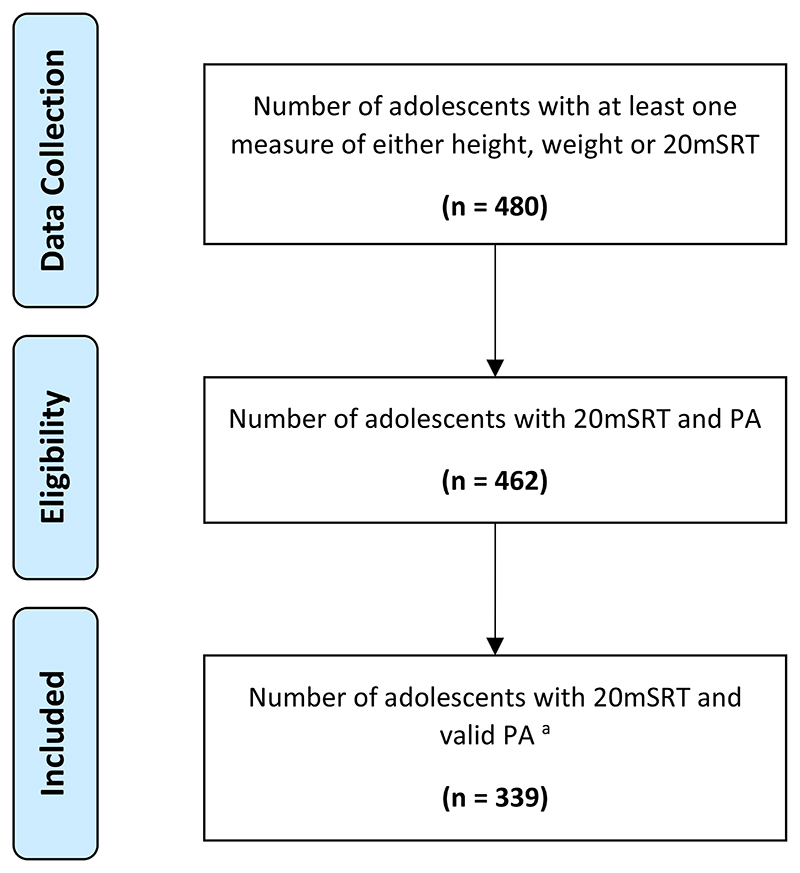
Methods: PA and CRF were assessed in 339 adolescents aged 13 to 14 years by wrist-worn accelerometers and 20-m shuttle runs, respectively. Partial regression modeling was used to construct residualized PA variables at each PA intensity that were uncorrelated with each other. Moving average models were optimally fitted to determine relationships between residualized PA variables and CRF. Threshold regression models determined the duration of PA above which CRF improvement was minimal.
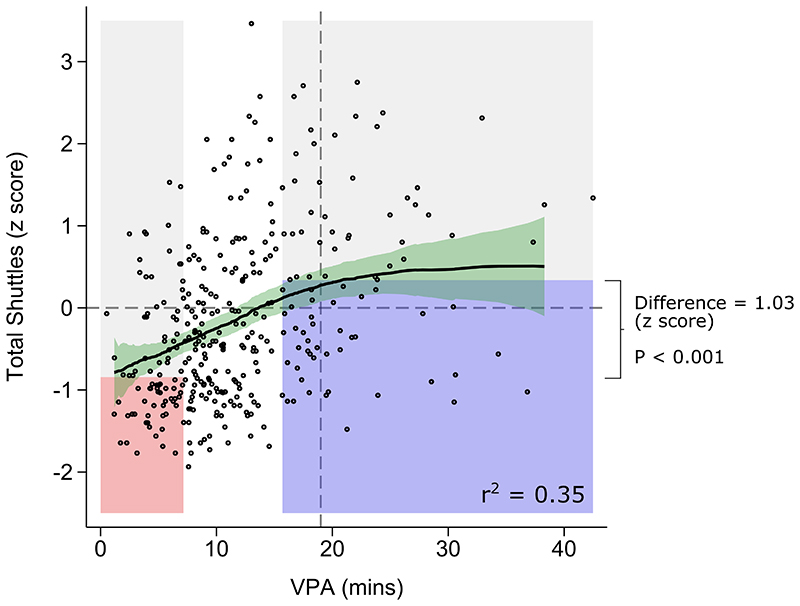
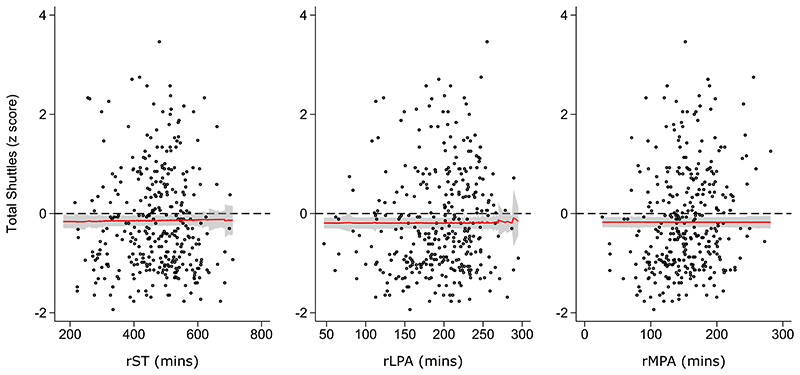
Results: Greater vigorous PA (VPA) was associated with better CRF until about 20 minutes of daily VPA, when the relationship plateaued. Moderate and light PA, and sedentary time were not associated with CRF in partial models. Adolescents performing 14 (range 12-17) minutes of daily VPA had median CRF. Participants in the upper quartile of VPA had 1.03 z-scores higher CRF than those in the lowest quartile (95% confidence interval: 0.75 to 1.30).
Conclusions: Our data suggest that 20 minutes of daily VPA may be best for maximizing CRF in adolescence. As moderate-to-vigorous PA guidelines can be satisfied by only undertaking moderate PA, with no apparent independent benefit, we suggest that future guidelines focus on VPA alone, simplifying public health messaging.
Conflict of interest statement
The authors have indicated they have no financial relationships relevant to this article to disclose.
Figures
Comment in
-
Physical Activity Counseling: New Options and a Lighter Burden.Pediatrics. 2022 Jul 1;150(1):e2022057026. doi: 10.1542/peds.2022-057026. Pediatrics. 2022. PMID: 35694878 No abstract available.
References
-
- McKinney J, Lithwick DJ, Morrison BN, et al. The health benefits of physical activity and cardiorespiratory fitness. B C Med J. 2016;58(3):131–137.
-
- Hemmingsson E, Väisanen D, Andersson G, Wallin P, Ekblom-Bak E. Combinations of BMI and cardiorespiratory fitness categories: trends between 1995 and 2020 and associations with CVD incidence and mortality and all-cause mortality in 471 216 adults. Eur J Prev Cardiol. 2021:zwab169. - PubMed
-
- Biddle SJ, Asare M. Physical activity and mental health in children and adolescents: a review of reviews. Br J Sports Med. 2011;45(11):886–895. - PubMed
Publication types
MeSH terms
Grants and funding
LinkOut - more resources
Full Text Sources
Medical
Research Materials
