


Cyanine Phototruncation Enables Spatiotemporal Cell Labeling
- PMID: 35696546
- PMCID: PMC10523398
- DOI: 10.1021/jacs.2c02962
Cyanine Phototruncation Enables Spatiotemporal Cell Labeling
Abstract
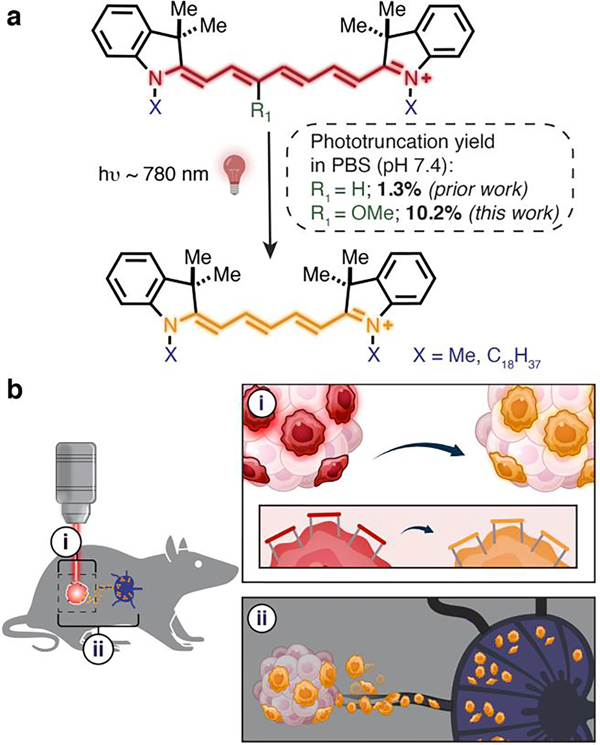
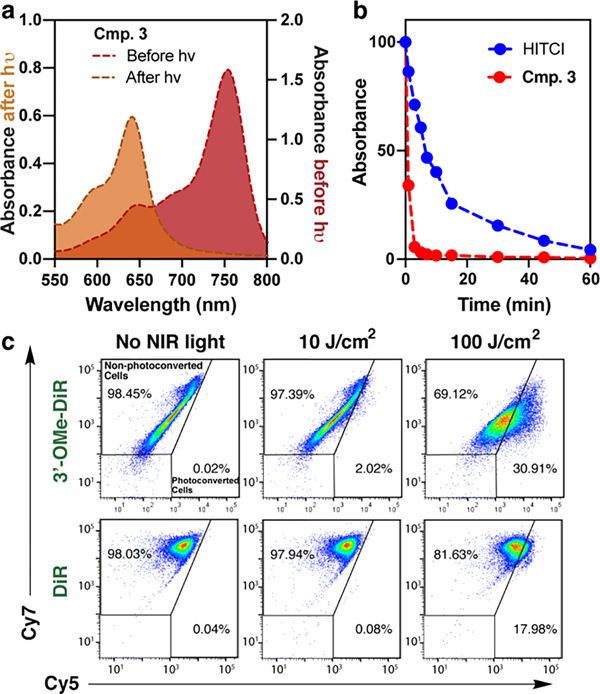
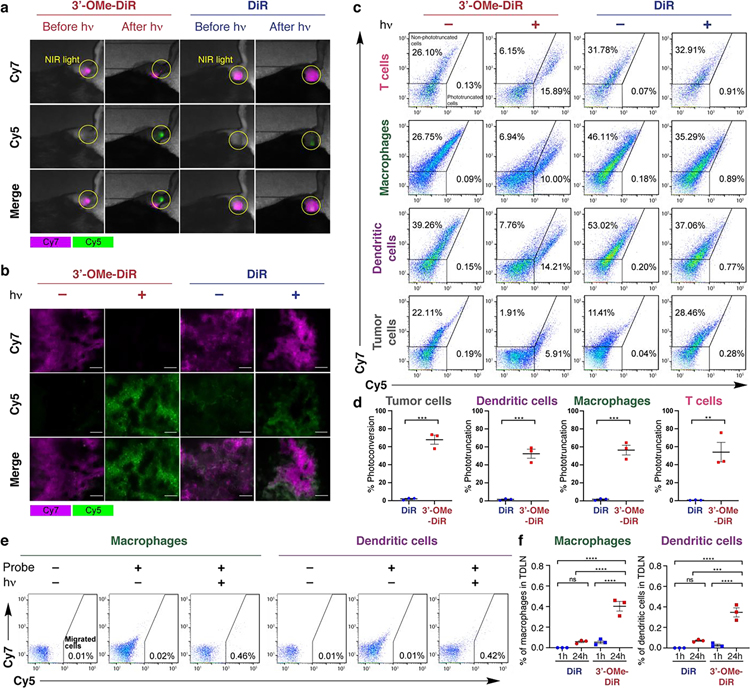
Photoconvertible tracking strategies assess the dynamic migration of cell populations. Here we develop phototruncation-assisted cell tracking (PACT) and apply it to evaluate the migration of immune cells into tumor-draining lymphatics. This method is enabled by a recently discovered cyanine photoconversion reaction that leads to the two-carbon truncation and consequent blue-shift of these commonly used probes. By examining substituent effects on the heptamethine cyanine chromophore, we find that introduction of a single methoxy group increases the yield of the phototruncation reaction in neutral buffer by almost 8-fold. When converted to a membrane-bound cell-tracking variant, this probe can be applied in a series of in vitro and in vivo experiments. These include quantitative, time-dependent measurements of the migration of immune cells from tumors to tumor-draining lymph nodes. Unlike previously reported cellular photoconversion approaches, this method does not require genetic engineering and uses near-infrared (NIR) wavelengths. Overall, PACT provides a straightforward approach to label cell populations with spatiotemporal control.
Figures
References
-
- Luster AD; Alon R; von Andrian UH, Immune cell migration in inflammation: present and future therapeutic targets. Nat. Immunol. 2005, 6 (12), 1182–1190. - PubMed
-
- Marzo AL; Lake RA; Lo D; Sherman L; McWilliam A; Nelson D; Robinson BW; Scott B, Tumor antigens are constitutively presented in the draining lymph nodes. J. Immunol. 1999, 162 (10), 5838–5845. - PubMed
Publication types
MeSH terms
Substances
Grants and funding
LinkOut - more resources
Full Text Sources
Medical
Miscellaneous
