Review
. 2022;35(5):247-265.
doi: 10.1159/000524990. Epub 2022 Jun 13.

The Emerging Therapeutic Targets for Scar Management: Genetic and Epigenetic Landscapes

Affiliations
Review

The Emerging Therapeutic Targets for Scar Management: Genetic and Epigenetic Landscapes

Sara Amjadian et al. Skin Pharmacol Physiol. 2022.

Abstract

Background: Wound healing is a complex process including hemostasis, inflammation, proliferation, and remodeling during which an orchestrated array of biological and molecular events occurs to promote skin regeneration. Abnormalities in each step of the wound healing process lead to reparative rather than regenerative responses, thereby driving the formation of cutaneous scar. Patients suffering from scars represent serious health problems such as contractures, functional and esthetic concerns as well as painful, thick, and itchy complications, which generally decrease the quality of life and impose high medical costs. Therefore, therapies reducing cutaneous scarring are necessary to improve patients' rehabilitation.

Summary: Current approaches to remove scars, including surgical and nonsurgical methods, are not efficient enough, which is in principle due to our limited knowledge about underlying mechanisms of pathological as well as the physiological wound healing process. Thus, therapeutic interventions focused on basic science including genetic and epigenetic knowledge are recently taken into consideration as promising approaches for scar management since they have the potential to provide targeted therapies and improve the conventional treatments as well as present opportunities for combination therapy. In this review, we highlight the recent advances in skin regenerative medicine through genetic and epigenetic approaches to achieve novel insights for the development of safe, efficient, and reproducible therapies and discuss promising approaches for scar management.

Key message: Genetic and epigenetic regulatory switches are promising targets for scar management, provided the associated challenges are to be addressed.

Keywords: Hypertrophic scar; MicroRNA; Noncoding RNAs; Scar-promoting genes; Wound healing.


Conflict of interest statement

The authors have no conflict of interest.

Figures
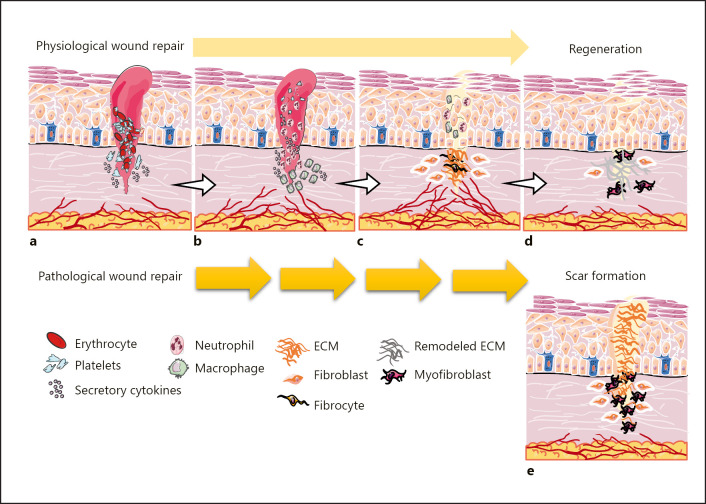
Fig. 1
Fig. 1
The cutaneous wound healing process, a regenerative or reparative response. The skin tissue response following injuries in gestation and injured fetal tissues is regeneration via a physiological wound healing process including four stages. a In the hemostasis phase, platelets are involved in the formation of the blood clot and the release of cytokines required in the inflammatory cell recruitment. b In the inflammation stage, neutrophils and macrophages are activated to phagocytosis of pathogens and damaged cells. Moreover, neutrophils secrete cytokines increasing the severity of inflammatory responses and macrophages facilitate the transition from inflammation to proliferation. c In the proliferation phase, reepithelialization leads to the covered wound surface, the vascular network is restored, and the provisional matrix is replaced with the granular tissue. d In the remodeling, stage fibroblasts differentiate into myofibroblasts, and collagen type III fibers are replaced with collagen type I fibers. e Any abnormalities which are leading to delayed repair or enhanced cell responses propel the wounds to pathological or reparative healing accompanied by cutaneous scar formation which is happened in human adults.
Fig. 2
Fig. 2
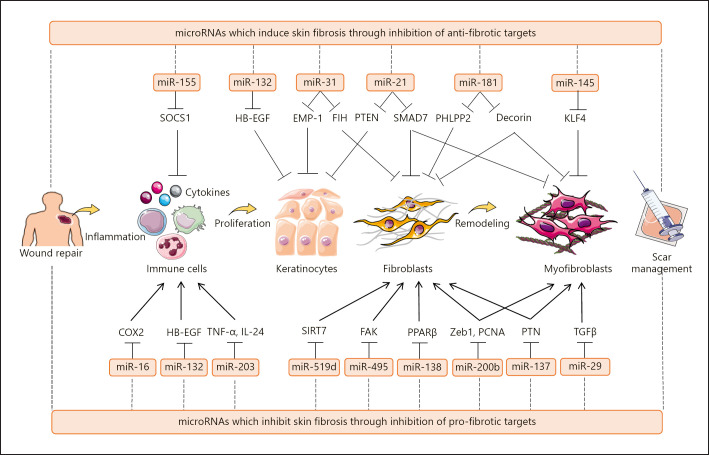
MicroRNAs as regulators of cutaneous wound healing and scar formation. MicroRNAs are key epigenetic regulators of wound healing since they can target several genes simultaneously. Dysregulation of the microRNA network in either overexpression of pro-fibrotic microRNAs, such as microRNA-155, microRNA-132, microRNA-31, microRNA-21, microRNA-181, and microRNA-145, or downregulation of anti-fibrotic microRNAs, including microRNA-16, microRNA-203, microRNA-519d, microRNA-495, microRNA-138, microRNA-200b, microRNA-137, and microRNA-29, propels the wounds to heal aberrantly, resulting in excessive cutaneous scarring. Hence, modulating wound repair through microRNAs regulation may be an interesting approach in scar management. Arrows indicate “induction,” and blunt-ended lines indicate “inhibition.”
Fig. 3
Fig. 3
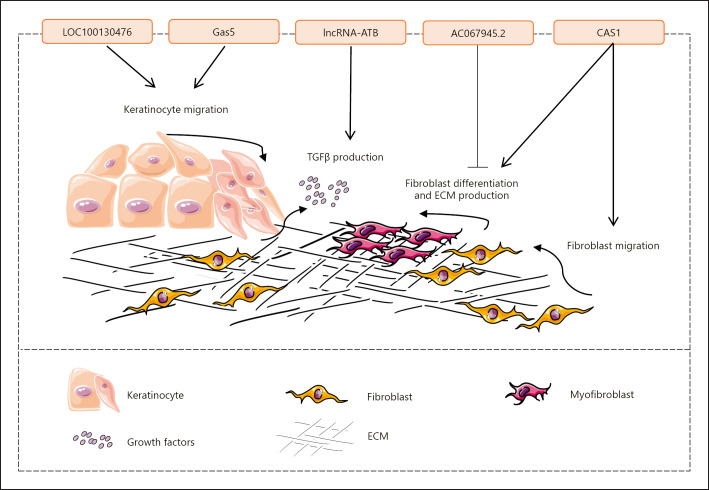
LncRNAs are regulatory RNA molecules involved in wound repair. LncRNAs are believed to regulate different aspects of wound healing. For instance, LOC100130476, Gas5, lncRNA-ATB, AC067945.2, and CAS1 affect wound healing through regulation of keratinocyte migration, growth factor production, fibroblast migration and differentiation, and ECM production. Hence, lncRNAs possess the potential to be manipulated for scar management. Arrows indicate “induction,” and blunt-ended lines indicate “inhibition.”
Fig. 4
Fig. 4
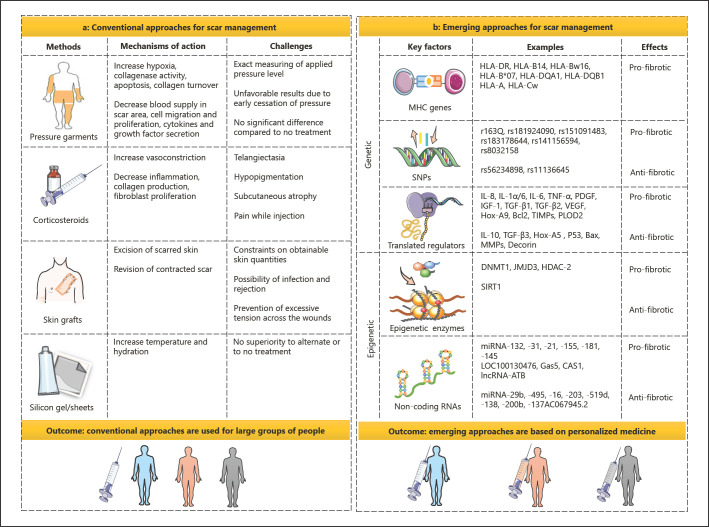
Conventional and emerging therapeutic approaches for scar management. a The conventional approaches for scar management include pressure garments, corticosteroids, skin grafts, and silicone gels and sheets affecting wound healing and scar formation through different mechanisms of action. However, they are not targeted and efficient enough due to associated challenges. Conventional strategies are also used for large groups of people. Therefore, (b) new methods based on the optimization of wound healing procedure in terms of genetic and epigenetic regulations are emerging to diminish or prevent dermal fibrosis. MHCs and SNPs, genes coding for key regulators such as cytokines and growth factors, DNA methylation signatures, histone modification patterns and related enzymes, and noncoding RNAs interact and cooperate as a complex network affecting cell proliferation, differentiation, and ECM synthesis. Deregulation of the genetic and epigenetic network leads to aberrant behavior of different cells driving excessive fibroblast proliferation and differentiation, and consequently cutaneous fibrosis. Thus, these regulators can be identified via genetic and epigenetic screening and targeted using precision medicine strategies for scar management.

References

    1. Landén NX, Li D, Ståhle M. Transition from inflammation to proliferation: a critical step during wound healing. Cell Mol Life Sci. 2016;73((20)):3861–85. - PMC - PubMed
    1. Barrientos S, Stojadinovic O, Golinko MS, Brem H, Tomic-Canic M. Growth factors and cytokines in wound healing. Wound Repair Regen. 2008;16((5)):585–601. - PubMed
    1. Eming SA, Martin P, Tomic-Canic M. Wound repair and regeneration: mechanisms, signaling, and translation. Sci Transl Med. 2014;6((265)):265sr6. - PMC - PubMed
    1. Schultz GS, Wysocki A. Interactions between extracellular matrix and growth factors in wound healing. Wound Repair Regen. 2009;17((2)):153–62. - PubMed
    1. Amini-Nik S, Yousuf Y, Jeschke MG. Scar management in burn injuries using drug delivery and molecular signaling: current treatments and future directions. Adv Drug Deliv Rev. 2018;123:135–54. - PMC - PubMed