Global seroprevalence and sociodemographic characteristics of Borrelia burgdorferi sensu lato in human populations: a systematic review and meta-analysis
- PMID: 35697507
- PMCID: PMC9185477
- DOI: 10.1136/bmjgh-2021-007744
Global seroprevalence and sociodemographic characteristics of Borrelia burgdorferi sensu lato in human populations: a systematic review and meta-analysis
Abstract
Introduction: Borrelia burgdorferi sensu lato (Bb) infection, the most frequent tick-transmitted disease, is distributed worldwide. This study aimed to describe the global seroprevalence and sociodemographic characteristics of Bb in human populations.
Methods: We searched PubMed, Embase, Web of Science and other sources for relevant studies of all study designs through 30 December 2021 with the following keywords: 'Borrelia burgdorferi sensu lato' AND 'infection rate'; and observational studies were included if the results of human Bb antibody seroprevalence surveys were reported, the laboratory serological detection method reported and be published in a peer-reviewed journal. We screened titles/abstracts and full texts of papers and appraised the risk of bias using the Cochrane Collaboration-endorsed Newcastle-Ottawa Quality Assessment Scale. Data were synthesised narratively, stratified by different types of outcomes. We also conducted random effects meta-analysis where we had a minimum of two studies with 95% CIs reported. The study protocol has been registered with PROSPERO (CRD42021261362).
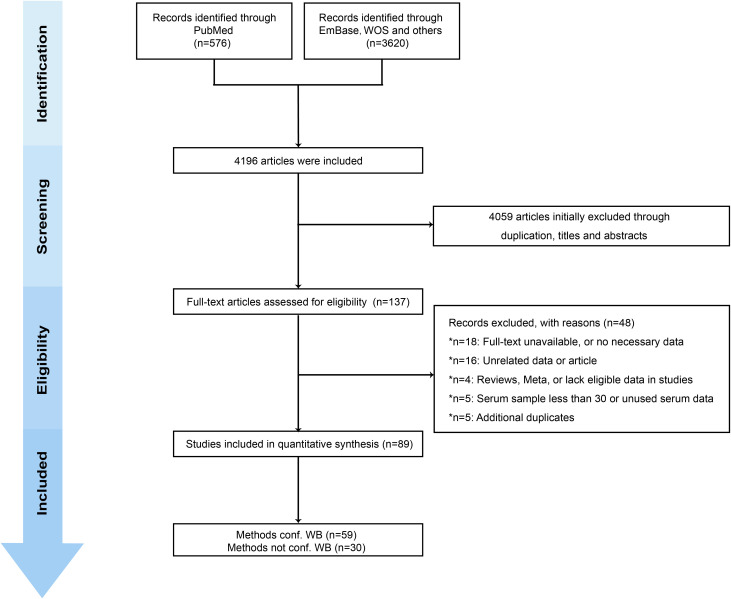
Results: Of 4196 studies, 137 were eligible for full-text screening, and 89 (158 287 individuals) were included in meta-analyses. The reported estimated global Bb seroprevalence was 14.5% (95% CI 12.8% to 16.3%), and the top three regions of Bb seroprevalence were Central Europe (20.7%, 95% CI 13.8% to 28.6%), Eastern Asia (15.9%, 95% CI 6.6% to 28.3%) and Western Europe (13.5%, 95% CI 9.5% to 18.0%). Meta-regression analysis showed that after eliminating confounding risk factors, the methods lacked western blotting (WB) confirmation and increased the risk of false-positive Bb antibody detection compared with the methods using WB confirmation (OR 1.9, 95% CI 1.6 to 2.2). Other factors associated with Bb seropositivity include age ≥50 years (12.6%, 95% CI 8.0% to 18.1%), men (7.8%, 95% CI 4.6% to 11.9%), residence of rural area (8.4%, 95% CI 5.0% to 12.6%) and suffering tick bites (18.8%, 95% CI 10.1% to 29.4%).
Conclusion: The reported estimated global Bb seropositivity is relatively high, with the top three regions as Central Europe, Western Europe and Eastern Asia. Using the WB to confirm Bb serological results could significantly improve the accuracy. More studies are needed to improve the accuracy of global Lyme borreliosis burden estimates.
Prospero registration number: CRD42021261362.
Keywords: cross-sectional survey; descriptive study; epidemiology; infections, diseases, disorders, injuries; medical microbiology.
© Author(s) (or their employer(s)) 2022. Re-use permitted under CC BY-NC. No commercial re-use. See rights and permissions. Published by BMJ.
Conflict of interest statement
Competing interests: None declared.
Figures


References
-
- Joung HA, Ballard ZS, Wu J. Point-of-care serodiagnostic test for early-stage Lyme disease using a multiplexed paper-based immunoassay and machine learning. ACS Nano 2020;14:229–40. - PubMed
Publication types
MeSH terms
LinkOut - more resources
Full Text Sources
Other Literature Sources
Medical