


A systematic review of relationships and sex education outcomes for students with intellectual disability reported in the international literature
- PMID: 35698311
- PMCID: PMC9328360
- DOI: 10.1111/jir.12952
A systematic review of relationships and sex education outcomes for students with intellectual disability reported in the international literature
Abstract
Background: Little is known about how to evaluate relationships and sex education (RSE) delivered to students with intellectual disability and what stakeholders perceive are important outcomes. The present study aimed to systematically review existing studies on outcomes of RSE, as the first step in the development of a core outcome set (COS) for students with intellectual disability.
Method: A systematic literature process included two stages: (1) searching for studies reporting on RSE outcomes for students with intellectual disability and (2) studies reporting on measurement properties (e.g. validity, reliability and responsiveness) of standardised instruments identified in stage 1.
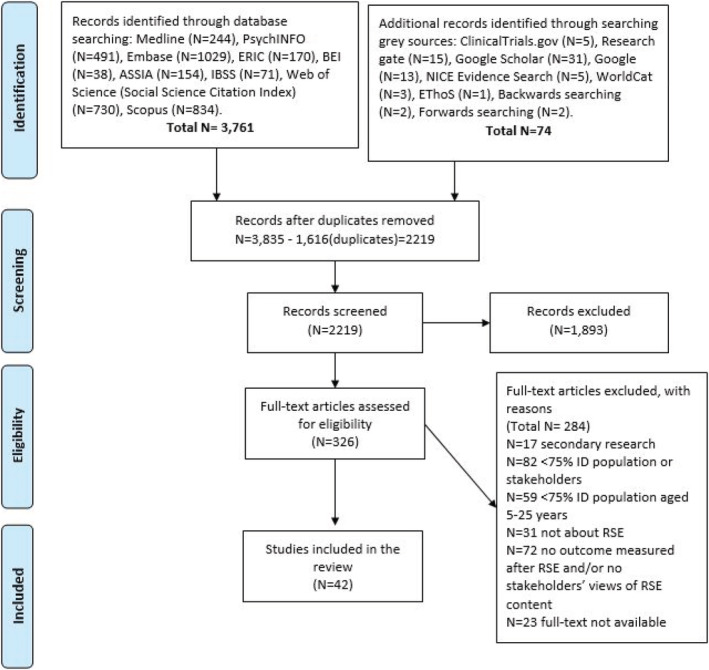
Results: A total of 135 RSE outcomes were extracted from 42 studies: 43 outcomes for students in secondary education and 92 outcomes for students in further education. No RSE outcomes were reported for primary education. Outcomes referred to the human body, hygiene, relationships, sexuality, sex and its consequences, inappropriate and appropriate social and sexual behaviour, keeping safe, emotional vocabulary and positive self-esteem. Outcomes were predominantly knowledge-based, rather than relating to skills and attitudes development. Students with intellectual disability, parents and teachers perceive different RSE outcomes meaningful. Five instruments were used to measure the outcomes, but none have established psychometric properties with this population.
Conclusions: The comprehensive list of RSE outcomes for students with intellectual disability will be used to inform the next steps of a Core Outcome Set needed for RSE evaluations in research and education settings. There is an urgent need to develop standardised instruments validated for students with intellectual disability.
Keywords: Core Outcome Set; intellectual disability; relationships and sex education.
© 2022 The Authors. Journal of Intellectual Disability Research published by MENCAP and International Association of the Scientific Study of Intellectual and Developmental Disabilities and John Wiley & Sons Ltd.
Conflict of interest statement
The authors declare that they have no conflicts of interest.
Figures
References
-
- Aderemi T. J. (2014) Teachers’ perspectives on sexuality and sexuality education of learners with intellectual disabilities in Nigeria. Sexuality and Disability 32, 247–58.
-
- Bleazard A. V. (2010) Sexuality and intellectual disability: perspectives of young women with intellectual disability (Doctoral dissertation. University of Stellenbosch), Stellenbosch.
-
- Bolaños M. C., González M. D., Jiménez M., Ramos M. E. & y Rodríguez M. I. (1994) Carpetas didácticas de educación afectivo‐sexual. Consejería de Educación, Culturatura y Deporte. Gobierno de Canarias, Tenerife.
-
- Box M. & Shawe J. (2014) The experiences of adults with learning disabilities attending a sexuality and relationship group: “I want to get married and have kids.”. Journal of Family Planning and Reproductive Health Care 40, 82–88. - PubMed
-
- Bustard S. (2003) LivingYour Life:The Sex Education and Personal Development Resource for Special Needs Education, revised edn. Brook Publications, London, The Ann Craft Trust U.K.
Additional references
-
- Alfassi M. (2004) Effects of a learner‐centred environment on the academic competence and motivation of students at risk. Learning Environments Research 7, 1–22.
-
- Argaman R. (2003) Predicting factors of sexual abuse in people with Learning Disabilities living in institutions. Tel Aviv University, Tel Aviv, Israel.
-
- Bundock K. E. & Hewitt O. (2017) A review of social skills interventions for adults with autism and intellectual disability. Tizard Learning Disability Review 22, 148–58.
-
- Borawska‐Charko M., Rohleder P. & Finlay W. M. L. (2017) The Sexual Health Knowledge of People with Intellectual Disabilities: a Review. Sexuality Research and Social Policy 14, 393–409.
Publication types
MeSH terms
LinkOut - more resources
Full Text Sources
