


Self-evaluation of social-rank in socially anxious individuals associates with enhanced striatal reward function
- PMID: 35698849
- PMCID: PMC10388315
- DOI: 10.1017/S0033291722001453
Self-evaluation of social-rank in socially anxious individuals associates with enhanced striatal reward function
Abstract
Background: Negative self-views, especially in the domain of power (i.e. social-rank), characterize social anxiety (SA). Neuroimaging studies on self-evaluations in SA have mainly focused on subcortical threat processing systems. Yet, self-evaluation may concurrently invoke diverse affective processing, as motivational systems related to desired self-views may also be activated. To investigate the conflictual nature that may accompany self-evaluation of certain social domains in SA, we examined brain activity related to both threat and reward processing.
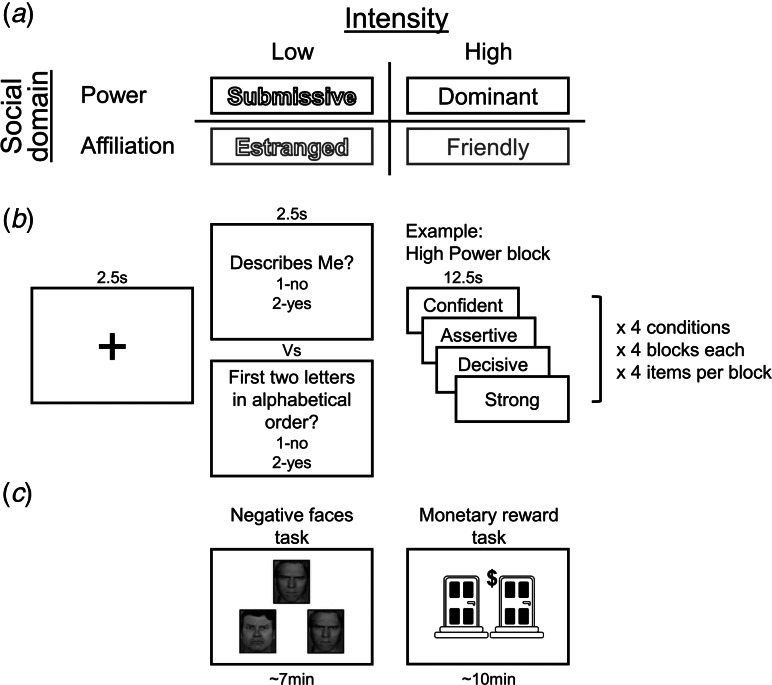
Methods: Participants (N = 74) differing in self-reported SA-severity underwent fMRI while completing a self-evaluation task, wherein they judged the self-descriptiveness of high- v. low-intensity traits in the domains of power and affiliation (i.e. social connectedness). Participants also completed two auxiliary fMRI tasks designated to evoke reward- and threat-related activations in the ventral striatum (VS) and amygdala, respectively. We hypothesized that self-evaluations in SA, particularly in the domain of power, involve aberrant brain activity related to both threat and reward processing.
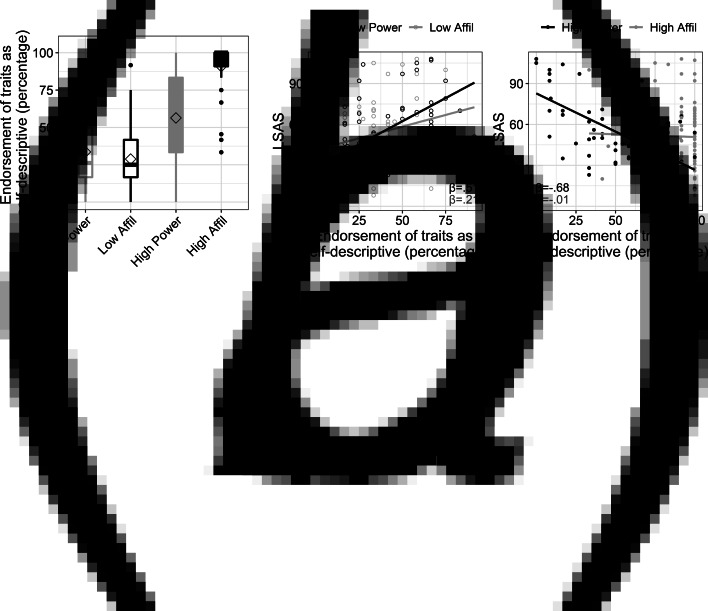
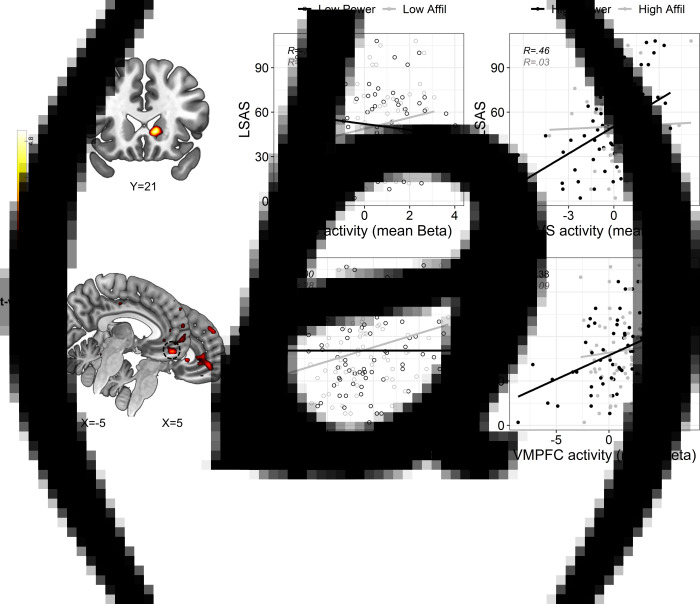
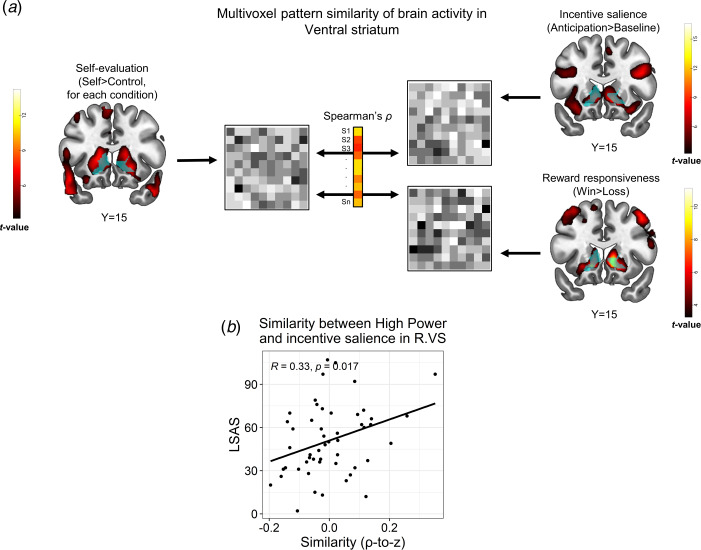
Results: SA-severity was more negatively associated with power than with affiliation self-evaluations. During self-evaluative judgment of high-power (e.g. dominant), SA-severity associated with increased activity in the VS and ventromedial prefrontal cortex. Moreover, SA-severity correlated with higher similarity between brain activity patterns activated by high-power traits and patterns activated by incentive salience (i.e. reward anticipation) in the VS during the reward task.
Conclusions: Our findings indicate that self-evaluation of high-power in SA involves excessive striatal reward-related activation, and pinpoint the downregulation of VS-VMPFC activity within such self-evaluative context as a potential neural outcome for therapeutic interventions.
Keywords: Emotion; Reward; Self-evaluation; Social anxiety; fMRI.
Conflict of interest statement
None.
Figures
References
-
- Aderka, I. M., Weisman, O., Shahar, G., & Gilboa-Schechtman, E. (2009). The roles of the social rank and attachment systems in social anxiety. Personality and Individual Differences, 47(4), 284–288. 10.1016/j.paid.2009.03.014. - DOI
-
- Berger, U., Keshet, H., & Gilboa-Schechtman, E. (2017). Self-evaluations in social anxiety: The combined role of explicit and implicit social-rank. Personality and Individual Differences, 104, 368–373. 10.1016/j.paid.2016.08.023. - DOI
