


Longitudinal Associations of High-Volume and Vigorous-Intensity Exercise With Hip Fracture Risk in Men
- PMID: 35699286
- PMCID: PMC9544739
- DOI: 10.1002/jbmr.4624
Longitudinal Associations of High-Volume and Vigorous-Intensity Exercise With Hip Fracture Risk in Men
Abstract
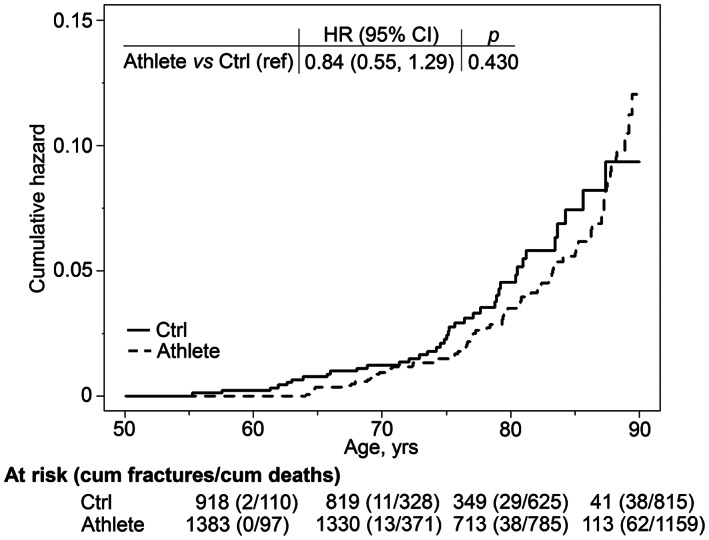
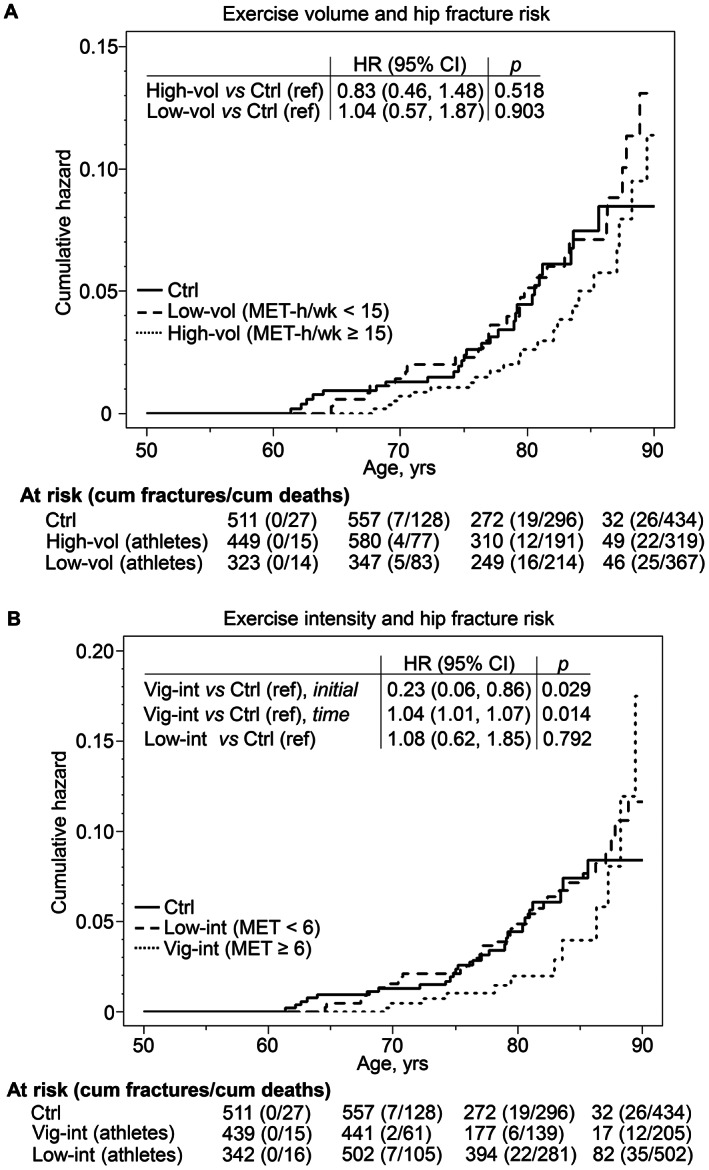
Maintenance of vigorous exercise habits from young to old age is considered protective against hip fractures, but data on fracture risk in lifelong vigorous exercisers are lacking. This longitudinal cohort study examined the hazard of hip fractures in 1844 male former athletes and 1216 population controls and in relation to exercise volume and intensity in later years. Incident hip fractures after age 50 years were identified from hospital discharge register from 1972 to 2015. Exercise and covariate information was obtained from questionnaires administered in 1985, 1995, 2001, and 2008. Analyses were conducted using extended proportional hazards regression model for time-dependent exposures and effects. During the mean ± SD follow-up of 21.6 ± 10.3 years, 62 (3.4%) athletes and 38 (3.1%) controls sustained a hip fracture. Adjusted hazard ratio (HR) indicated no statistically significant difference between athletes and controls (0.84; 95% confidence interval [CI], 0.55-1.29). In subgroup analyses, adjusted HRs for athletes with recent high (≥15 metabolic equivalent hours [MET-h]/week) and low (<15 MET-h/week) exercise volume were 0.83 (95% CI, 0.46-1.48) and 1.04 (95% CI, 0.57-1.87), respectively, compared with controls. The adjusted HR was not statistically significant between athletes with low-intensity exercise (<6 METs) and controls (1.08; 95% CI, 0.62-1.85). Athletes engaging in vigorous-intensity exercise (≥6 METs at least 75 minutes/week) had initially 77% lower hazard rate (adjusted HR 0.23; 95% CI, 0.06-0.86) than controls. However, the HR was time-dependent (adjusted HR 1.04; 95% CI, 1.01-1.07); by age 75 years the HRs for the athletes with vigorous-intensity exercise reached the level of the controls, but after 85 years the HRs for these athletes increased approximately 1.3-fold annually relative to the controls. In conclusion, these data suggest that continuation of vigorous-intensity exercise is associated with lower HR of hip fracture up to old age. © 2022 The Authors. Journal of Bone and Mineral Research published by Wiley Periodicals LLC on behalf of American Society for Bone and Mineral Research (ASBMR).
Keywords: AGING; EXERCISE; FRACTURE PREVENTION; LONGITUDINAL STUDIES; OSTEOPOROSIS.
© 2022 The Authors. Journal of Bone and Mineral Research published by Wiley Periodicals LLC on behalf of American Society for Bone and Mineral Research (ASBMR).
Conflict of interest statement
All authors state that they have no conflicts of interest.
Figures
References
-
- Moayyeri A, Besson H, Luben RN, Wareham NJ, Khaw KT. The association between physical activity in different domains of life and risk of osteoporotic fractures. Bone. 2010;47(3):693‐700. - PubMed
-
- Stattin K, Michaelsson K, Larsson SC, Wolk A, Byberg L. Leisure‐time physical activity and risk of fracture: a cohort study of 66,940 men and women. J Bone Miner Res. 2017;32(8):1599‐1606. - PubMed
-
- Moayyeri A. The association between physical activity and osteoporotic fractures: a review of the evidence and implications for future research. Ann Epidemiol. 2008;18(11):827‐835. - PubMed
-
- Morseth B, Ahmed LA, Bjornerem A, et al. Leisure time physical activity and risk of non‐vertebral fracture in men and women aged 55 years and older: the Tromso study. Eur J Epidemiol. 2012;27(6):463‐471. - PubMed
-
- Jaglal SB, Kreiger N, Darlington G. Past and recent physical activity and risk of hip fracture. Am J Epidemiol. 1993;138(2):107‐118. - PubMed
Publication types
MeSH terms
Grants and funding
LinkOut - more resources
Full Text Sources
Medical
Miscellaneous
