


Iron overload disorders
- PMID: 35699322
- PMCID: PMC9315134
- DOI: 10.1002/hep4.2012
Iron overload disorders
Abstract
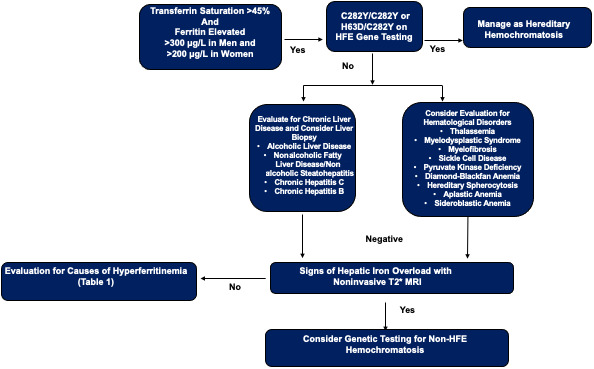
Iron overload disorders represent a variety of conditions that lead to increased total body iron stores and resultant end-organ damage. An elevated ferritin and transferrin-iron saturation can be commonly encountered in the evaluation of elevated liver enzymes. Confirmatory homeostatic iron regulator (HFE) genetic testing for C282Y and H63D, mutations most encountered in hereditary hemochromatosis, should be pursued in evaluation of hyperferritinemia. Magnetic resonance imaging with quantitative assessment of iron content or liver biopsy (especially if liver disease is a cause of iron overload) should be used as appropriate. A secondary cause for iron overload should be considered if HFE genetic testing is negative for the C282Y homozygous or C282Y/H63D compound heterozygous mutations. Differential diagnosis of secondary iron overload includes hematologic disorders, iatrogenic causes, or chronic liver diseases. More common hematologic disorders include thalassemia syndromes, myelodysplastic syndrome, myelofibrosis, sideroblastic anemias, sickle cell disease, or pyruvate kinase deficiency. If iron overload has been excluded, evaluation for causes of hyperferritinemia should be pursued. Causes of hyperferritinemia include chronic liver disease, malignancy, infections, kidney failure, and rheumatic conditions, such as adult-onset Still's disease or hemophagocytic lymphohistiocytosis. In this review, we describe the diagnostic testing of patients with suspected hereditary hemochromatosis, the evaluation of patients with elevated serum ferritin levels, and signs of secondary overload and treatment options for those with secondary iron overload.
© 2022 The Authors. Hepatology Communications published by Wiley Periodicals LLC on behalf of American Association for the Study of Liver Diseases.
Conflict of interest statement
Kleber Fertrin received honoraria from, consults for, is on the speakers' bureau of, and received grants from Agios Pharmaceuticals; he consults for and received honoraria and research support from Sanofi Genzyme. Kris Kowdley received honoraria and research support from Gilead, HighTide, Mirum, Pliant, Genfit, CymaBay, GSK, Viking, Pfizer, Intercept, NGM Bio, 89Bio, Celgene, BMS, Corcept, Metacrine, Hanmi, Terns, Madrigal, Enanta, and PTG; he is a consultant for Gilead, Intercept, HighTide, Mirum, Genfit, CymaBay; Inipharm, Madrigal, and NGMBio and serves on the speakers' bureau for AbbVie, Gilead, and Intercept. The other authors have nothing to report.
Figures
References
-
- Krishnamurthy P, Xie T, Schuetz JD. The role of transporters in cellular heme and porphyrin homeostasis. Pharmacol Ther. 2007;114(3):345–58. - PubMed
-
- Anderson GJ, Frazer DM, McLaren GD. Iron absorption and metabolism. Curr Opin Gastroenterol. 2009;25(2):129–35. - PubMed
-
- Fleming RE, Ponka P. Iron overload in human disease. N Engl J Med. 2012;366(4):348–59. Erratum in: N Engl J Med. 2012;366(8):771. - PubMed
Publication types
MeSH terms
Substances
LinkOut - more resources
Full Text Sources
Medical
