. 2022 Aug;16(4):906-917.
doi: 10.1007/s12072-022-10354-3. Epub 2022 Jun 14.

A novel epithelial-mesenchymal transition gene signature for the immune status and prognosis of hepatocellular carcinoma

Affiliations

A novel epithelial-mesenchymal transition gene signature for the immune status and prognosis of hepatocellular carcinoma

Yanlong Shi et al. Hepatol Int. 2022 Aug.

Abstract

Background: This study clarified whether EMT-related genes can predict immunotherapy efficacy and overall survival in patients with HCC.

Methods: The RNA-sequencing profiles and patient information of 370 samples were derived from the Cancer Genome Atlas (TCGA) dataset, and EMT-related genes were obtained from the Molecular Signatures database. The signature model was constructed using the least absolute shrinkage and selection operator Cox regression analysis in TCGA cohort. Validation data were obtained from the International Cancer Genome Consortium (ICGC) dataset of patients with HCC. Kaplan-Meier analysis and multivariate Cox analyses were employed to estimate the prognostic value. Immune status and tumor microenvironment were estimated using a single-sample gene set enrichment analysis (ssGSEA). The expression of prognostic genes was verified using qRT-PCR analysis of HCC cell lines.

Results: A signature model was constructed using EMT-related genes to determine HCC prognosis, based on which patients were divided into high-risk and low-risk groups. The risk score, as an independent factor, was related to tumor stage, grade, and immune cells infiltration. The results indicated that the most prognostic genes were highly expressed in the HCC cell lines, but GADD45B was down-regulated. Enrichment analysis suggested that immunoglobulin receptor binding and material metabolism were essential in the prognostic signature.

Conclusion: Our novel prognostic signature model has a vital impact on immune status and prognosis, significantly helping the decision-making related to the diagnosis and treatment of patients with HCC.

Keywords: Bioinformatics; Biomarker; Decision-making; Drug sensitivity; Epithelial–mesenchymal transition; Hepatocellular carcinoma; Immune microenvironment; Model; Overall survival; Prognosis.


Conflict of interest statement

Yanlong Shi, Jingyan Wang, Guo Huang, Jun Zhu, Haokun Jian, Guozhi Xia, Qian Wei, Yuanhai Li and Hongzhu Yu declare that they have no conflict of interest.

Figures
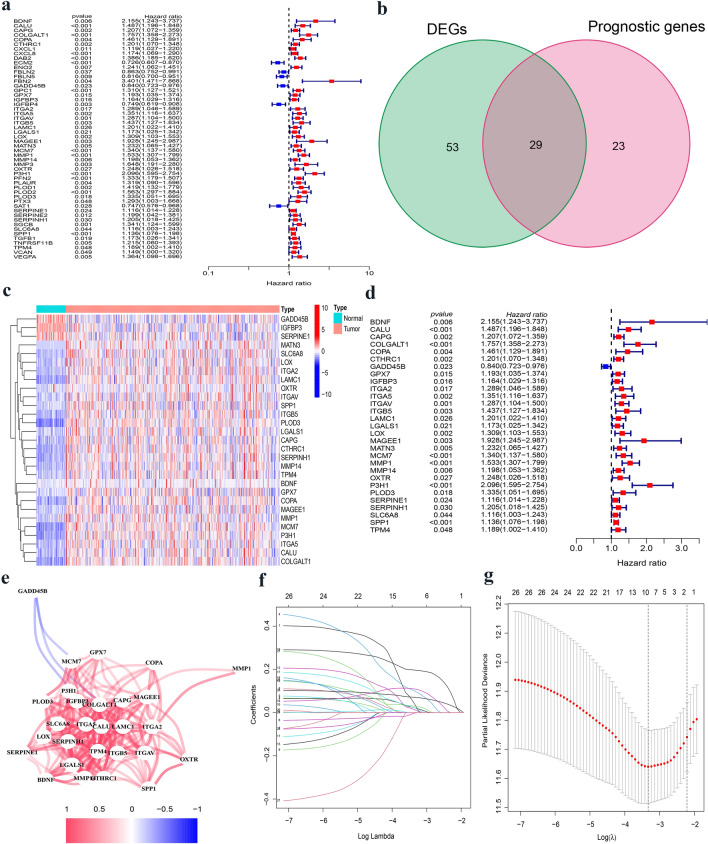
Fig. 1
Fig. 1
Establishment of the EMT-related prognostic signature in the TCGA cohort. a The forest plots showing the association between 52 prognostic genes expression and OS. b Venn diagram to distinguish DEGs between HCC and adjacent normal tissues. c Heatmap of the 29 overlapping genes expression. d Univariate Cox regression analysis of 29 overlapping genes associated with OS. e The correlation network of prognostic genes signature. f LASSO coefficient profiles of 29 prognostic genes of HCC. g LASSO regression with tenfold cross-validation found ten prognostic genes using the minimum λ
Fig. 2
Fig. 2
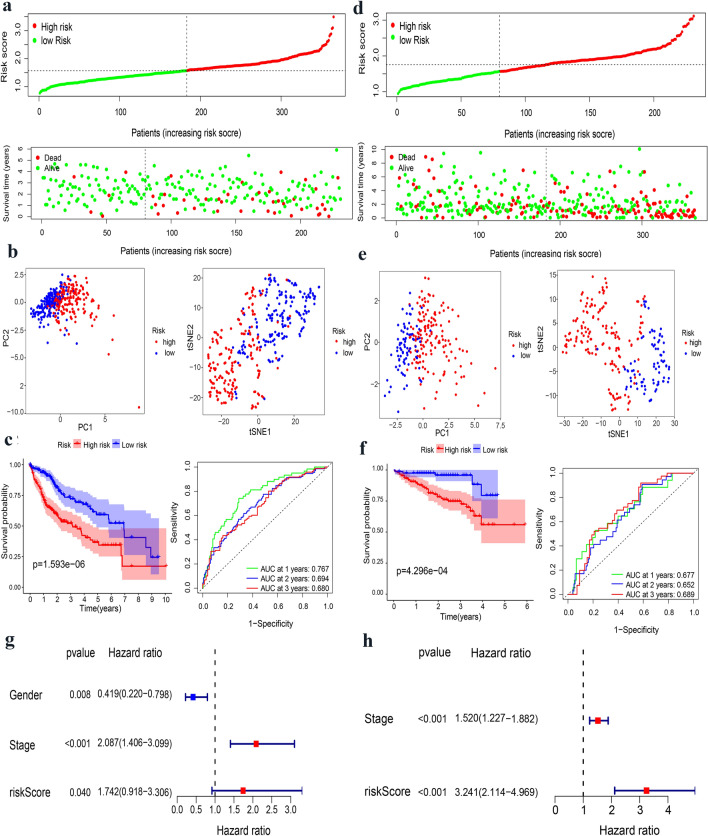
Evaluation and validation of 10-gene signature in TCGA cohort and ICGC cohort. a Analysis of risk score value and distribution, OS status, and heatmap of 10-gene signature model in TCGA cohort. b The PCA plot and t-SNE analysis of risk score in TCGA cohort. c Kaplan–Meier curves and AUC time-dependent ROC curves for OS in TCGA cohort. d Analysis of risk score value and distribution, OS status, and heatmap of 10-gene signature model in ICGC cohort. e The PCA plot and t-SNE analysis of risk score in ICGC cohort. f Kaplan–Meier curves and AUC time-dependent ROC curves for OS in ICGC cohort. g, h Screening of OS-related pathological feature by multivariate Cox regression in TCGA and ICGC cohort
Fig. 3
Fig. 3
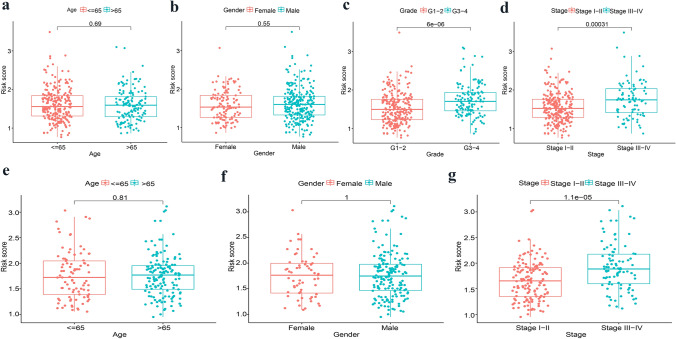
Relationship between risk score and clinicopathologic characteristics. TCGA cohort: a Age. b Gender. c Tumor grade. d Tumor stage. ICGC cohort: e Age. f Gender. g Tumor stage
Fig. 4
Fig. 4
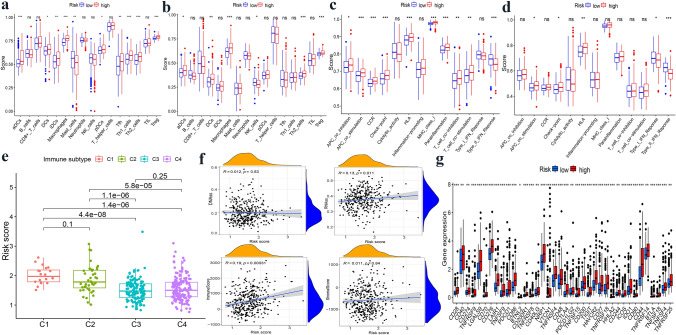
Evaluation immune status, tumor microenvironment, and immune checkpoints of EMT-related prognostic signature. a, b The scores of 16 immune cells and 13 immune-related functions were detected by ssGSEA analysis based on risk groups in TCGA cohort and ICGC cohort. c, d The scores of 16 immune cells and 13 immune-related functions were detected by ssGSEA analysis based on risk groups in TCGA cohort and ICGC cohort. e Risk score of different immune infiltration subtypes. f The correlation between risk score and RNAss, DNAss, Stromal Score, and Immune Score. g Expression of immune checkpoint genes in high- and low-risk groups. *p < 0.05; **p < 0.01; ***p < 0.001
Fig. 5
Fig. 5
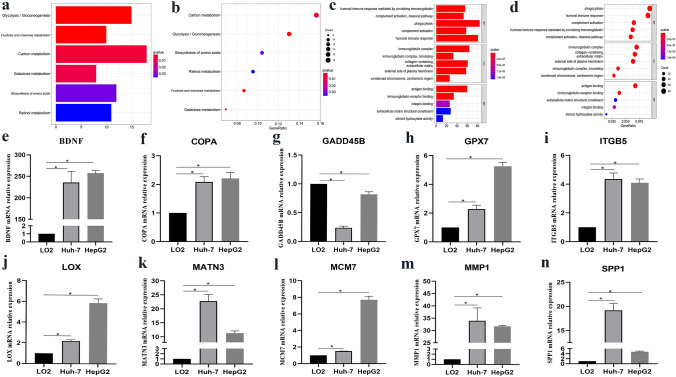
Gene enrichment analysis for high-risk and low-risk groups. a KEGG pathway by barplot. b KEGG pathway by bubble plot. c Gene Ontology by barplot. d Gene Ontology by bubble plot. Verification of the expression of EMT-related prognostic genes mRNA in HCC cell line by qRT-RCR. e BDNF. f COPA. g GADD45B. h GPX7. i ITGB5. j LOX. k MANT3. l MCM7. m MMP1. n SPP1. *p < 0.05

References

    1. Sung H, Ferlay J, Siegel RL, Laversanne M, Soerjomataram I, Jemal A, Bray F. Global Cancer Statistics 2020: GLOBOCAN estimates of incidence and mortality worldwide for 36 cancers in 185 countries. CA Cancer J Clin. 2021;71(3):209–249. doi: 10.3322/caac.21660. - DOI - PubMed
    1. Yang JD, Hainaut P, Gores GJ, Amadou A, Plymoth A, Roberts LR. A global view of hepatocellular carcinoma: trends, risk, prevention and management. Nat Rev Gastroenterol Hepatol. 2019;16(10):589–604. doi: 10.1038/s41575-019-0186-y. - DOI - PMC - PubMed
    1. Jiang Y, Xie J, Han Z, Liu W, Xi S, Huang L, Huang W, Lin T, Zhao L, Hu Y, et al. Immunomarker support vector machine classifier for prediction of gastric cancer survival and adjuvant chemotherapeutic benefit. Clinical cancer research : an official journal of the American Association for Cancer Research. 2018;24(22):5574–5584. doi: 10.1158/1078-0432.CCR-18-0848. - DOI - PubMed
    1. DiStefano JK, Davis B. Diagnostic and prognostic potential of AKR1B10 in human hepatocellular carcinoma. Cancers. 2019;11(4):486. doi: 10.3390/cancers11040486. - DOI - PMC - PubMed
    1. Greenburg G, Hay ED. Epithelia suspended in collagen gels can lose polarity and express characteristics of migrating mesenchymal cells. J Cell Biol. 1982;95(1):333–339. doi: 10.1083/jcb.95.1.333. - DOI - PMC - PubMed

MeSH terms

Substances