


Impact of diabetes on COVID-19 prognosis beyond comorbidity burden: the CORONADO initiative
- PMID: 35701673
- PMCID: PMC9197674
- DOI: 10.1007/s00125-022-05734-1
Impact of diabetes on COVID-19 prognosis beyond comorbidity burden: the CORONADO initiative
Abstract
Aims/hypothesis: Diabetes has been recognised as a pejorative prognostic factor in coronavirus disease 2019 (COVID-19). Since diabetes is typically a disease of advanced age, it remains unclear whether diabetes remains a COVID-19 risk factor beyond advanced age and associated comorbidities. We designed a cohort study that considered age and comorbidities to address this question.
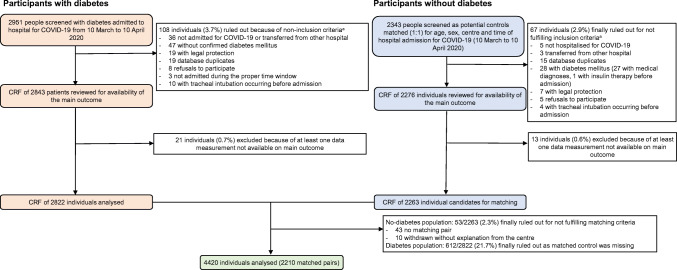
Methods: The Coronavirus SARS-CoV-2 and Diabetes Outcomes (CORONADO) initiative is a French, multicentric, cohort study of individuals with (exposed) and without diabetes (non-exposed) admitted to hospital with COVID-19, with a 1:1 matching on sex, age (±5 years), centre and admission date (10 March 2020 to 10 April 2020). Comorbidity burden was assessed by calculating the updated Charlson comorbidity index (uCCi). A predefined composite primary endpoint combining death and/or invasive mechanical ventilation (IMV), as well as these two components separately, was assessed within 7 and 28 days following hospital admission. We performed multivariable analyses to compare clinical outcomes between patients with and without diabetes.
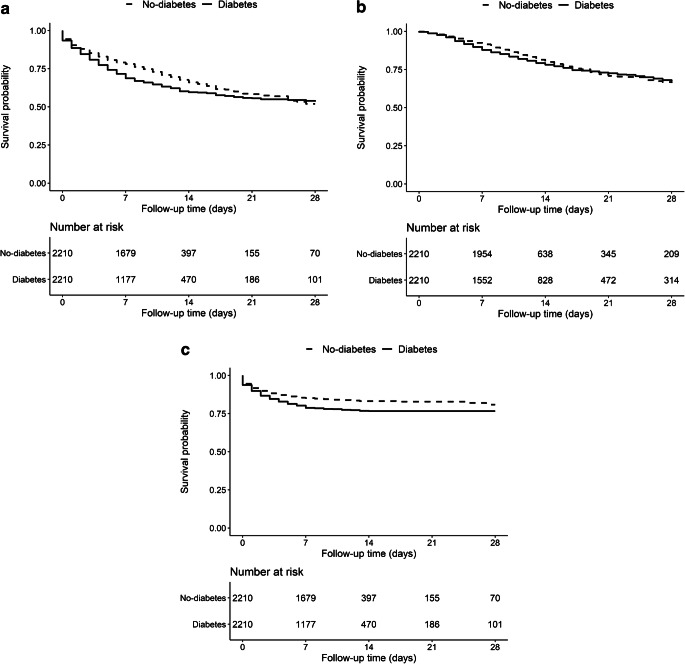
Results: A total of 2210 pairs of participants (diabetes/no-diabetes) were matched on age (mean±SD 69.4±13.2/69.5±13.2 years) and sex (36.3% women). The uCCi was higher in individuals with diabetes. In unadjusted analysis, the primary composite endpoint occurred more frequently in the diabetes group by day 7 (29.0% vs 21.6% in the no-diabetes group; HR 1.43 [95% CI 1.19, 1.72], p<0.001). After multiple adjustments for age, BMI, uCCi, clinical (time between onset of COVID-19 symptoms and dyspnoea) and biological variables (eGFR, aspartate aminotransferase, white cell count, platelet count, C-reactive protein) on admission to hospital, diabetes remained associated with a higher risk of primary composite endpoint within 7 days (adjusted HR 1.42 [95% CI 1.17, 1.72], p<0.001) and 28 days (adjusted HR 1.30 [95% CI 1.09, 1.55], p=0.003), compared with individuals without diabetes. Using the same adjustment model, diabetes was associated with the risk of IMV, but not with risk of death, within 28 days of admission to hospital.
Conclusions/interpretation: Our results demonstrate that diabetes status was associated with a deleterious COVID-19 prognosis irrespective of age and comorbidity status.
Trial registration: ClinicalTrials.gov NCT04324736.
Keywords: COVID-19; Charlson index; Comorbidity; Death; Diabetes; Invasive mechanical ventilation; Prognosis.
© 2022. The Author(s), under exclusive licence to Springer-Verlag GmbH Germany, part of Springer Nature.
Figures
References
Publication types
MeSH terms
Associated data
LinkOut - more resources
Full Text Sources
Medical
Research Materials
Miscellaneous
