. 2022 Jul 29;12(8):jkac146.
doi: 10.1093/g3journal/jkac146.

QTLViewer: an interactive webtool for genetic analysis in the Collaborative Cross and Diversity Outbred mouse populations

Affiliations

QTLViewer: an interactive webtool for genetic analysis in the Collaborative Cross and Diversity Outbred mouse populations

Matthew Vincent et al. G3 (Bethesda). .

Abstract

The Collaborative Cross and the Diversity Outbred mouse populations are related multiparental populations, derived from the same 8 isogenic founder strains. They carry >50 M known genetic variants, which makes them ideal tools for mapping genetic loci that regulate phenotypes, including physiological and molecular traits. Mapping quantitative trait loci requires statistical and computational training, which can present a barrier to access for some researchers. The QTLViewer software allows users to graphically explore Collaborative Cross and Diversity Outbred quantitative trait locus mapping and related analyses performed through the R/qtl2 package. Additionally, the QTLViewer website serves as a repository for published Collaborative Cross and Diversity Outbred studies, increasing the accessibility of these genetic resources to the broader scientific community.

Keywords: GWAS; MPP; QTL mapping; genome-wide association studies; multiparental populations; quantitative trait loci mapping.


Figures

Fig. 1.
Fig. 1.
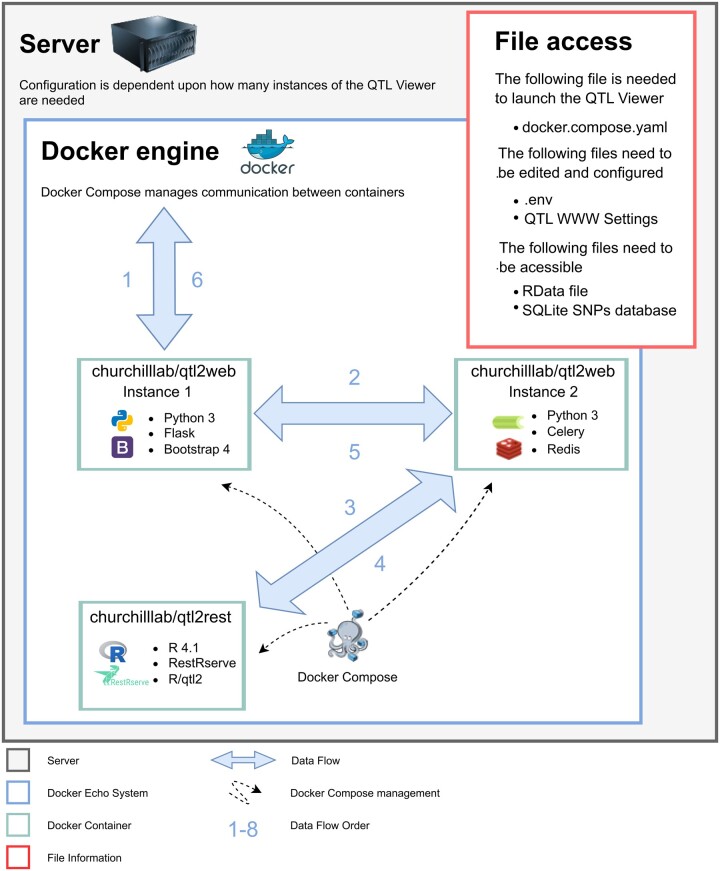
Diagram of QTLViewer data flow. (1) URL is parsed and, if not an API call, returns requested information (Flask is used as the web application framework and Bootstrap 4 as the interface framework). (2) If the requested URL is an API call, the tool either returns a cached version if found or proceeds to call the API (Celery is used as a distributed task queue). (3) R/RestRserve package routes the URL to the correct R method to be performed. (4) A compressed JSON object is returned and if the HTTP request creates several QTL API calls, Redis will store the intermediate result from each call until all of them are finished. (5) Results are cached, and data is returned to Flask/Python. (6) The request is complete. The headers are checked and, if the response needs to be compressed, Flask will compress the data and send to the end-user. The front-end user interface is now responsible for rendering the data.
Fig. 2.
Fig. 2.
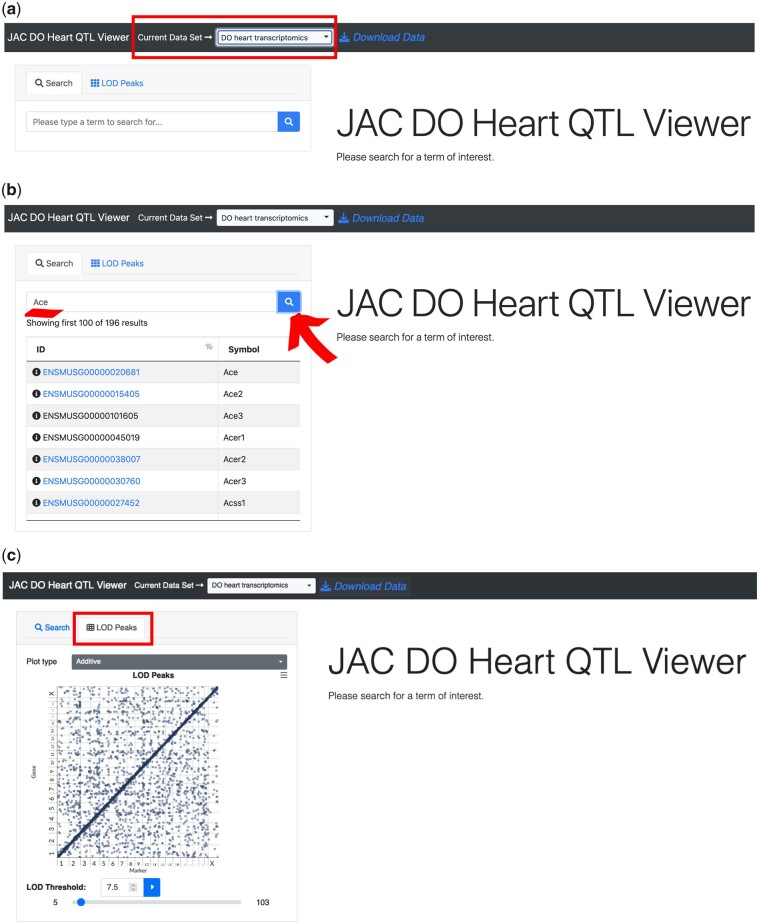
Navigating datasets in the QTLViewer. The QTLViewer page for a project provides access to multiple datasets which can be explored by changing the option on “Current Data Set.” In the screenshot, the aging DO heart transcriptomics data is selected (a). Within this specific dataset, it is possible to search for specific traits. For example, in the transcriptome dataset, the genes Ace and Ace2 are available, but not Ace3 (b). Switching to the “Lod Peaks” mode, visualizes a genome-wide transcriptome map with marker IDs on the x-axis and gene position on the y-axis, which is a common plot type to summarize all the eQTLs in the data according to a specified LOD threshold (c).
Fig. 3.
Fig. 3.
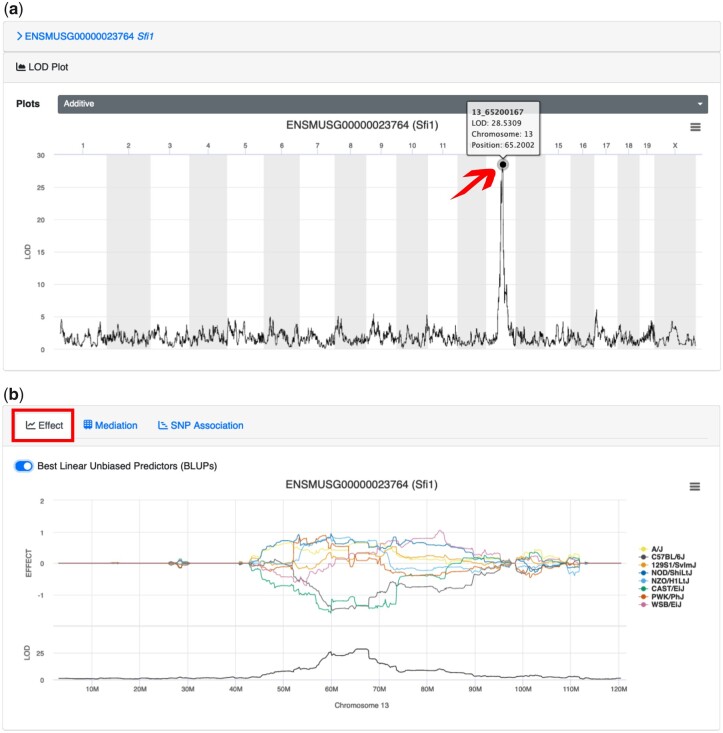
Genome-wide LOD and founder allele effects plots. Searching for specific traits or clicking on interesting QTLs on the transcriptome map reveals the genome-wide LOD plot with genome position across chromosomes on the x-axis and LOD scores on the y-axis (a). This plot reveals a strong eQTL on chromosome 13 at 65 Mb for the gene Sfi1, which is a distal eQTL because Sfi1 is encoded on chromosome 11. By clicking on the “Effect” function and then clicking back on the locus of interest produces a founder allele effects plot at the locus (b). The allele effects plot has genomic position in Mb on the x-axis and the estimated allele effects (top) and LOD scores (bottom) on the y-axis. The peak on chromosome 13 for the gene Sfi1 is driven by lower expression from the CAST/EiJ and C57BL/6J alleles compared to higher expression from the other 6 alleles.
Fig. 4.
Fig. 4.
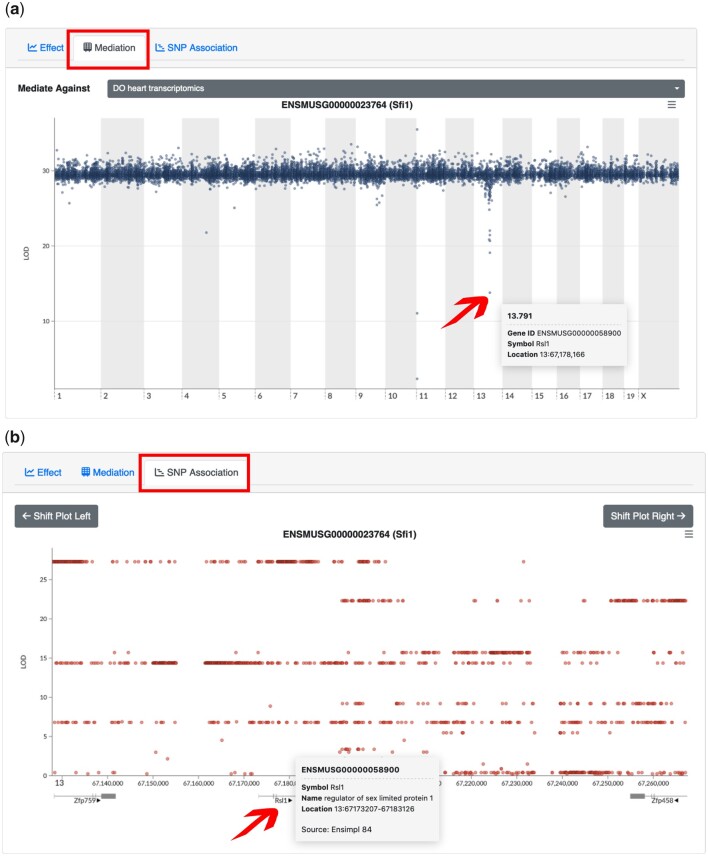
Mediation and SNP association plots. a) Mediation analysis can be performed on QTL of interest to identify candidate mediators as long as the QTL’s trait and the mediators are observed for the same mice (for the DO specifically) or for the same strains. The mediation plot shows genomic position across chromosomes on the x-axis and conditional LOD scores on the y-axis. By mediating the distant eQTL of Sfi1 on chromosome 13 through the DO heart transcriptomics data, the gene Rsl1 on chromosome 13 at 67 Mb is identified as a candidate mediator, which matches the eQTL position. We also see candidate mediators on chromosome 11. The one with the lowest LOD score is the gene Sfi1 itself and the other is a gene model (Gm11400) that is likely on LD with Sfi1. b) An SNP association scan can be performed in the QTL region by clicking on the “SNP Association” button. The SNP association plot shows genomic position in bp on the x-axis and LOD scores on the y-axis. Annotated genes are overlayed below the x-axis. Variant association in the CC and DO reveals haplotypes shelves of variants in strong LD with each other. Additional information on variants or genes can be accessed by hovering the cursor over the dot or gene track.
Fig. 5.
Fig. 5.
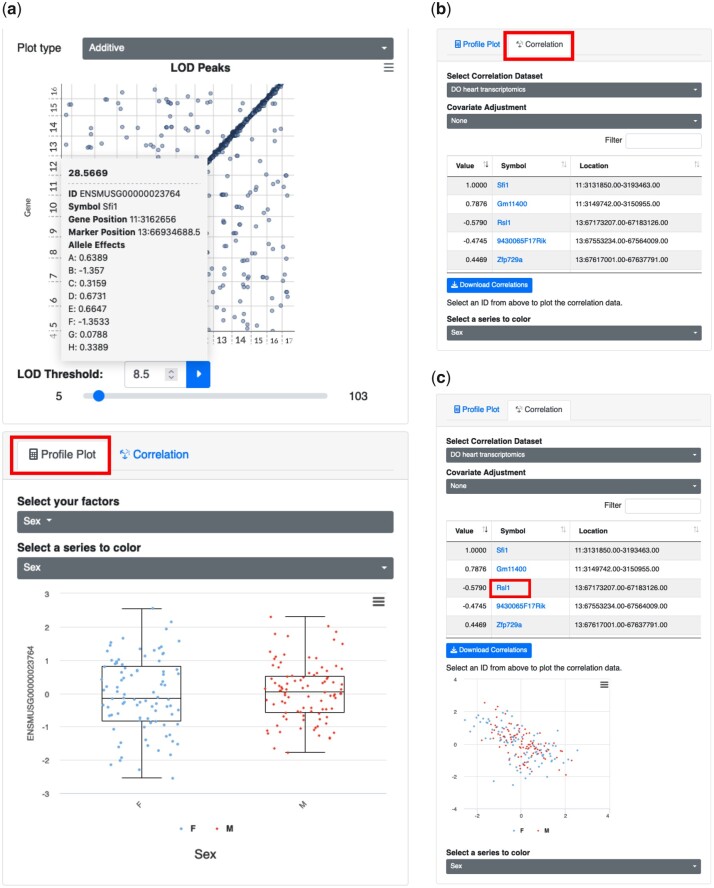
Plots for relating traits and covariates. After searching for a specific trait or selecting one based on its QTL, QTLViewer can visualize the trait’s profile according to covariates in the data with “Profile Plot.” After clicking on the point corresponding to the gene Sfi1 on the LOD peaks plots, QTLViewer outputs the normalized expression of the Sfi1 (y-axis) categorized by sex (x-axis) as boxplots (a). Additionally, QTLViewer can display the correlation of a trait of interest with all the other elements of the data using the “Correlation” tab (b). The correlation data can also be downloaded locally by the user. All the elements on the correlation table are clickable. Clicking on “Rsl1” will generate a scatter plot between this gene and Sfi1, which illustrates the negative correlation between these 2 genes (c). Sfi1 is negatively correlated with its mediator Rsl1, suggesting that Rsl1 expression inhibits Sfi1 expression.
Fig. 6.
Fig. 6.
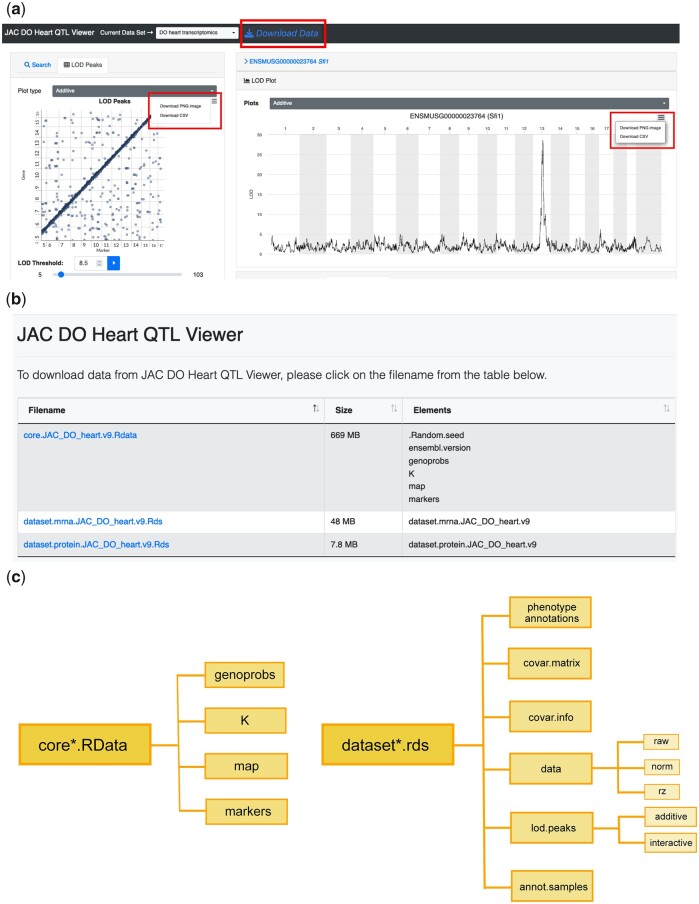
Figures and data download from QTLViewer. All plots generated by QTLViewer can be downloaded by clicking on the top right button in the application window (a). In addition to the figures, the processed data used as input to all analyses can be downloaded as R data files by clicking on “Download Data” (a). When using this option, users will be directed to a different webpage listing different components of the data for download (b). This includes a core RData object containing all information necessary for mapping, such as genotype probabilities, kinship matrix, and genomic map, and RDS files containing trait information, such as transcriptome (“dataset.mrna”) and proteome (“dataset.protein”) data. These RDS files are nested lists containing phenotype annotations, a matrix of covariates used for the QTL mapping (“covar.matrix”), information about the covariates (“covar.info”), trait data matrices, QTL mapping results (“lod.peaks”), and sample annotations (“annot.samples”) (c). With gene expression data, “dataset.mrna” is a list with different forms of data as matrices, including the raw counts (raw) the normalized data (norm), and inverse normal transformed data (rz) (c). The QTL mapping results “lod.peaks” is a list with QTL result tables from standard additive scans and potentially factor-interactive QTL scans (c).

References

    1. Abu Toamih Atamni H, Nashef A, Iraqi FA.. The Collaborative Cross mouse model for dissecting genetic susceptibility to infectious diseases. Mamm Genome. 2018;29(7–8):471–487. - PubMed
    1. Al-Barghouthi BM, Mesner LD, Calabrese GM, Brooks D, Tommasini SM, Bouxsein ML, Horowitz MC, Rosen CJ, Nguyen K, Haddox S, et al Systems genetics in diversity outbred mice inform BMD GWAS and identify determinants of bone strength. Nat Commun. 2021;12(1):3408. - PMC - PubMed
    1. Aylor DL, Valdar W, Foulds-Mathes W, Buus RJ, Verdugo RA, Baric RS, Ferris MT, Frelinger JA, Heise M, Frieman MB, et al. Genetic analysis of complex traits in the emerging Collaborative Cross. Genome Res. 2011;21(8):1213–1222. - PMC - PubMed
    1. Bostock M, Ogievetsky V, Heer J.. D3 data-driven documents. IEEE Trans Vis Comput Graph. 2011;17(12):2301–2309. - PubMed
    1. Broman KW, Gatti DM, Simecek P, Furlotte NA, Prins P, Sen Ś, Yandell BS, Churchill GA.. R/qtl2: software for mapping quantitative trait loci with high-dimensional data and multiparent populations. Genetics. 2019;211(2):495–502. - PMC - PubMed

Publication types

LinkOut - more resources