Chapare Hemorrhagic Fever and Virus Detection in Rodents in Bolivia in 2019
- PMID: 35704480
- PMCID: PMC10245337
- DOI: 10.1056/NEJMoa2110339
Chapare Hemorrhagic Fever and Virus Detection in Rodents in Bolivia in 2019
Abstract
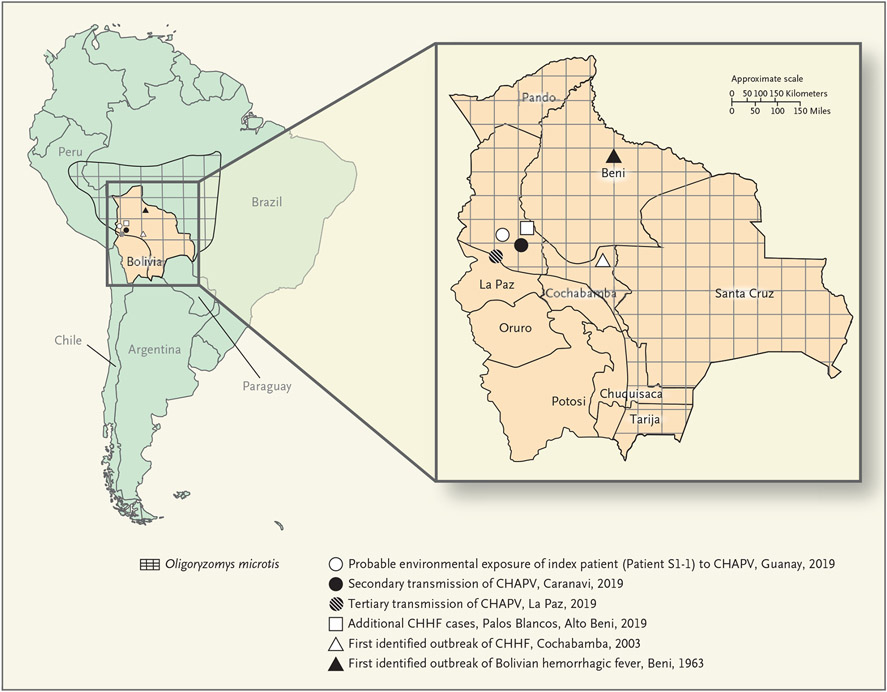
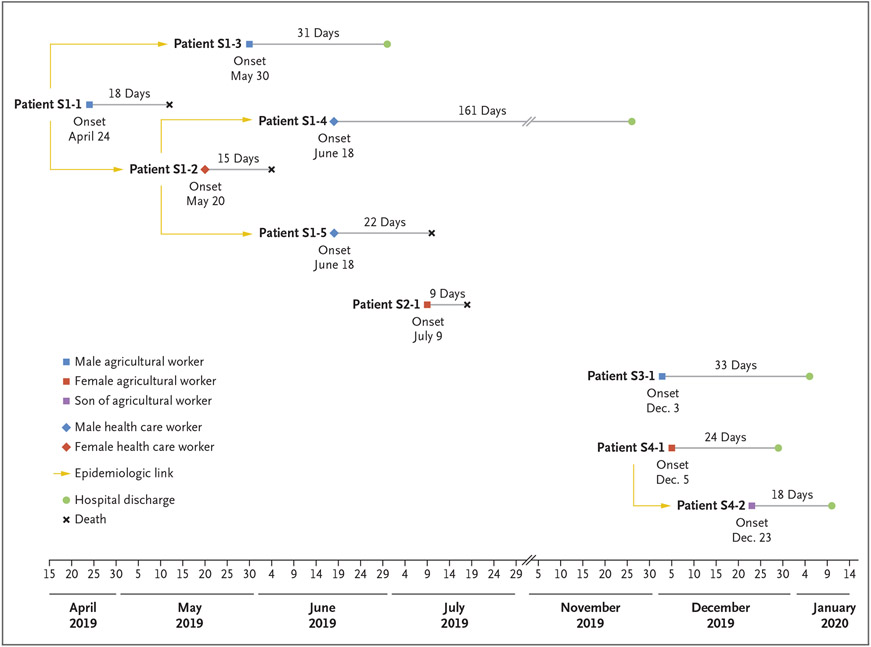
Background: In June 2019, the Bolivian Ministry of Health reported a cluster of cases of hemorrhagic fever that started in the municipality of Caranavi and expanded to La Paz. The cause of these cases was unknown.
Methods: We obtained samples for next-generation sequencing and virus isolation. Human and rodent specimens were tested by means of virus-specific real-time quantitative reverse-transcriptase-polymerase-chain-reaction assays, next-generation sequencing, and virus isolation.
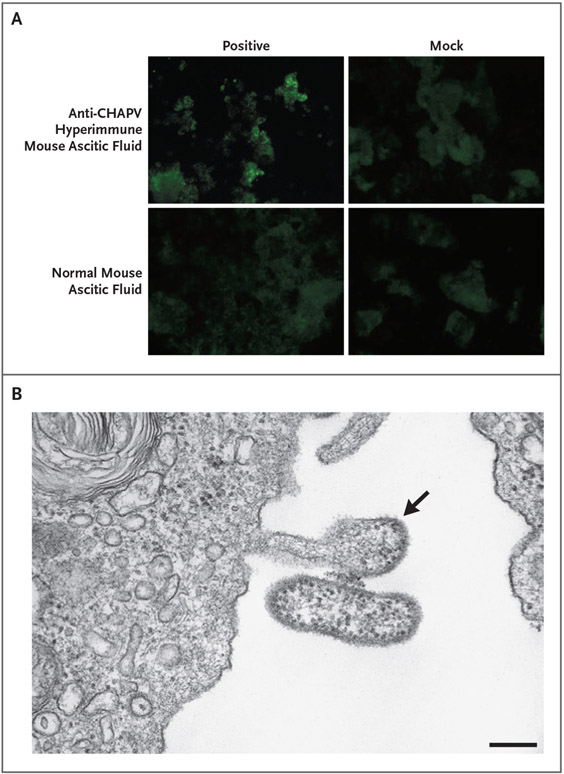
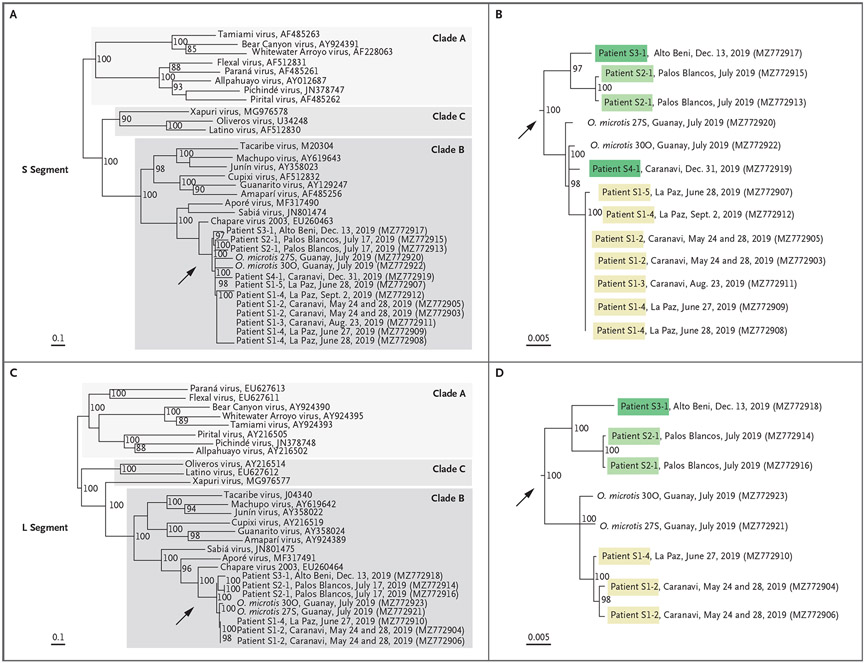
Results: Nine cases of hemorrhagic fever were identified; four of the patients with this illness died. The etiologic agent was identified as Mammarenavirus Chapare mammarenavirus, or Chapare virus (CHAPV), which causes Chapare hemorrhagic fever (CHHF). Probable nosocomial transmission among health care workers was identified. Some patients with CHHF had neurologic manifestations, and those who survived had a prolonged recovery period. CHAPV RNA was detected in a variety of human body fluids (including blood; urine; nasopharyngeal, oropharyngeal, and bronchoalveolar-lavage fluid; conjunctiva; and semen) and in specimens obtained from captured small-eared pygmy rice rats (Oligoryzomys microtis). In survivors of CHHF, viral RNA was detected up to 170 days after symptom onset; CHAPV was isolated from a semen sample obtained 86 days after symptom onset.
Conclusions: M. Chapare mammarenavirus was identified as the etiologic agent of CHHF. Both spillover from a zoonotic reservoir and possible person-to-person transmission were identified. This virus was detected in a rodent species, O. microtis. (Funded by the Bolivian Ministry of Health and others.).
Copyright © 2022 Massachusetts Medical Society.
Figures
References
-
- Radoshitzky SR, Kuhn JH, Jahrling PB, Bavari S. Hemorrhagic fever-causing mammarenaviruses. In: Bozue J, ed. Medical aspects of biological warfare. Fort Sam Houston, TX: Borden Institute, 2018:517–45.
-
- Buchmeier MJ, de la Torre JC, Peters CJ. Arenaviridae. In: Knipe DM, Howley PM, eds. Fields virology. 6th ed. Philadelphia: Lippincott Williams & Wilkins, 2013:1283–303.
-
- Maes P, Alkhovsky SV, Bào Y, et al. Taxonomy of the family Arenaviridae and the order Bunyavirales: update 2018. Arch Virol 2018;163:2295–310. - PubMed
-
- Peters CJ, Kuehne RW, Mercado RR, Le Bow RH, Spertzel RO, Webb PA. Hemorrhagic fever in Cochabamba, Bolivia, 1971. Am J Epidemiol 1974;99:425–33. - PubMed
-
- Bolivian hemorrhagic fever — El Beni Department, Bolivia, 1994. MMWR Morb Mortal Wkly Rep 1994;43:943–6. - PubMed
MeSH terms
Substances
Grants and funding
LinkOut - more resources
Full Text Sources
Molecular Biology Databases