


The Impact of BRCA1- and BRCA2 Mutations on Ovarian Reserve Status
- PMID: 35705781
- PMCID: PMC9810575
- DOI: 10.1007/s43032-022-00997-w
The Impact of BRCA1- and BRCA2 Mutations on Ovarian Reserve Status
Abstract
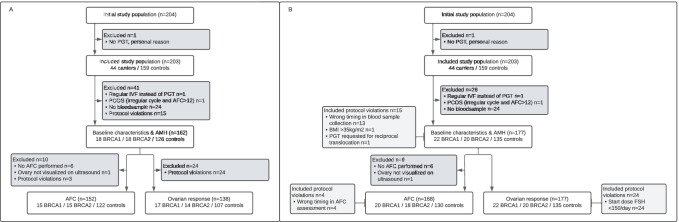
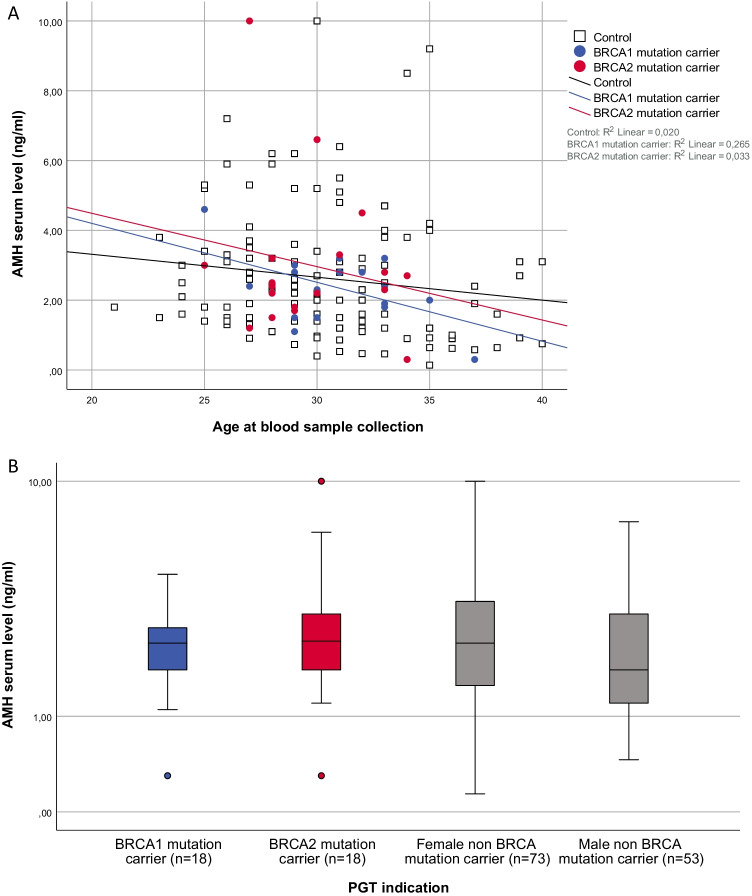
This study aimed to investigate whether female BRCA1- and BRCA2 mutation carriers have a reduced ovarian reserve status, based on serum anti-Mullerian hormone (AMH) levels, antral follicle count (AFC) and ovarian response to ovarian hyperstimulation. A prospective, multinational cohort study was performed between October 2014 and December 2019. Normo-ovulatory women, aged 18-41 years old, applying for their first PGT-cycle for reason of a BRCA mutation (cases) or other genetic diseases unrelated to ovarian reserve (controls), were asked to participate. All participants underwent a ICSI-PGT cycle with a long-agonist protocol for controlled ovarian hyperstimulation. Linear and logistic regression models were used to compare AMH, AFC and ovarian response in cases and controls. Sensitivity analyses were conducted on BRCA1- and BRCA2 mutation carrier subgroups. Thirty-six BRCA mutation carriers (18 BRCA1- and 18 BRCA2 mutation carriers) and 126 controls, with mean female age 30.4 years, were included in the primary analysis. Unadjusted median AMH serum levels (IQR) were 2.40 (1.80-3.00) ng/ml in BRCA mutation carriers and 2.15 (1.30-3.40) ng/ml in controls (p = 0.45), median AFC (IQR) was 15.0 (10.8-20.3) and 14.5 (9.0-20.0), p = 0.54, respectively. Low response rate was 22.6% among BRCA mutation carriers and 9.3% among controls, p = 0.06. Median number of retrieved oocytes was 9 (6-14) in carriers and 10 (7-13) in controls, p = 0.36. No substantial differences were observed between BRCA1- and BRCA2 mutation carriers. Based on several biomarkers, no meaningful differences in ovarian reserve status were observed in female BRCA mutation carriers compared to controls in the context of ICSI-PGT treatment.
Keywords: Anti-Müllerian hormone; BRCA gene mutations; BRCA1; BRCA2; Ovarian reserve; Ovarian response.
© 2022. The Author(s).
Conflict of interest statement
KD, TvT, ME, EL, IH, RG, WV, KL and AB have nothing to disclose. FB is a Member of the external advisory board for Merck Serono and has received grants and personal fees outside the submitted work. MG declares that the Center for Reproductive Medicine, Amsterdam UMC (location VUMC) has received several research and educational grants from Guerbet, Merck and Ferring, not related to the presented work.
Figures
References
Publication types
MeSH terms
Substances
Associated data
LinkOut - more resources
Full Text Sources
Miscellaneous
