


Care engagement with healthcare providers and symptom management self-efficacy in women living with HIV in China: secondary analysis of an intervention study
- PMID: 35705934
- PMCID: PMC9199138
- DOI: 10.1186/s12889-022-13573-3
Care engagement with healthcare providers and symptom management self-efficacy in women living with HIV in China: secondary analysis of an intervention study
Abstract
Background: Symptom management self-efficacy is a prerequisite for individuals to fully manage their symptoms. The literature reports associations between engagement with healthcare providers (HCPs), internalized stigma, and types of self-efficacy other than symptom management. However, the factors of symptom management self-efficacy are not well understood. This study aimed to investigate the relationship among engagement with HCPs, internalized stigma, and HIV symptom management self-efficacy in Chinese women living with HIV (WLWH).
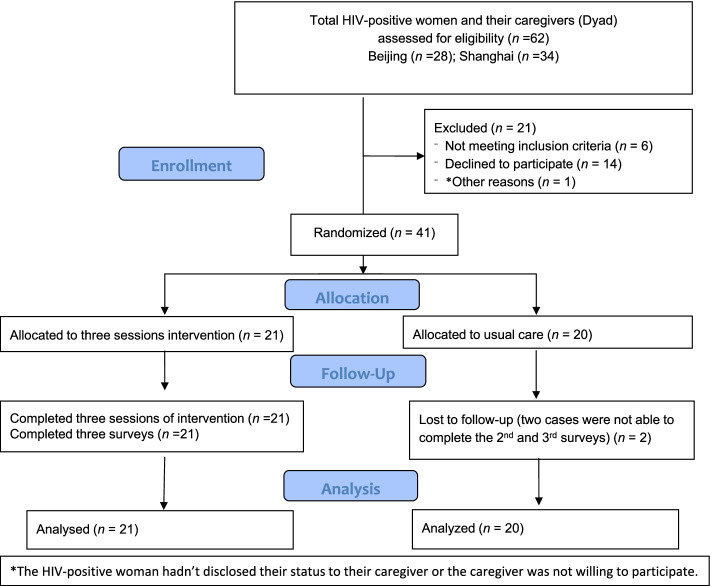
Methods: This current analysis was part of the original randomized control trial, we used data collected from 41 women living with HIV (WLWH) assigned to an intervention arm or a control arm from Shanghai and Beijing, China, at baseline, Week 4 and Week 12. The CONSORT checklist was used. The study was registered in the Clinical Trial Registry (#NCT03049332) on 10/02/2017.
Results: The results demonstrate that HCPs should increase engagement with WLWH when providing care, thereby improving their symptom management self-efficacy. The results suggested that participants' engagement with HCPs was significantly positively correlated with their HIV symptom management self-efficacy in the latter two time points. Internalized stigma was significantly negatively correlated with HIV symptom management self-efficacy only at the 4-week follow-up.
Conclusions: This study demonstrated the positive effect of engagement with HCPs on WLWHs' symptom management self-efficacy as well as the negative effect of internalized stigma on symptom management self-efficacy. Future research can further test the relationship between the three key concepts, as well as explore interventions to decrease internalized stigma.
Keywords: HIV; Healthcare providers; Self-efficacy; Stigma; Symptom management; Women.
© 2022. The Author(s).
Conflict of interest statement
None.
References
-
- National center for AIDS/STD Control and Prevention CCfDcaP. Update on the AIDS/STD epidemic in China, The third quarter of 2018. China CDC. http://www.chinaaids.cn/xxgx/yqxx/201811/t20181123_197488.htm. Accessed 16 Sept 2021.
-
- Sun W, Wu M, Qu P, Lu C, Wang L. Psychological well-being of people living with HIV/AIDS under the new epidemic characteristics in China and the risk factors: a population-based study. Int J Infect Dis. 2014;28:147–52. 10.1016/j.ijid.2014.07.010. - PubMed
