


Transparency of AI in Healthcare as a Multilayered System of Accountabilities: Between Legal Requirements and Technical Limitations
- PMID: 35707765
- PMCID: PMC9189302
- DOI: 10.3389/frai.2022.879603
Transparency of AI in Healthcare as a Multilayered System of Accountabilities: Between Legal Requirements and Technical Limitations
Abstract
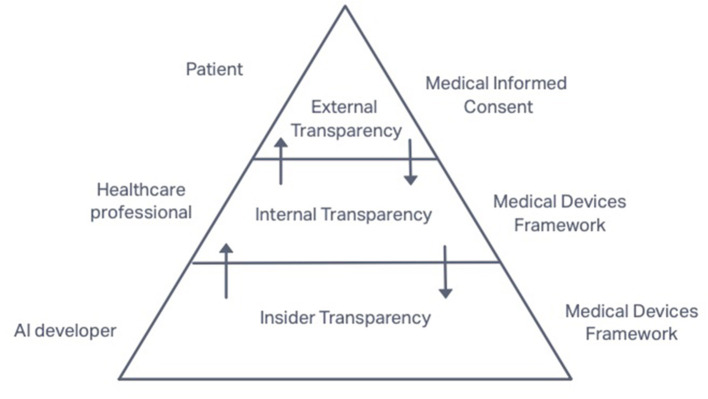
The lack of transparency is one of the artificial intelligence (AI)'s fundamental challenges, but the concept of transparency might be even more opaque than AI itself. Researchers in different fields who attempt to provide the solutions to improve AI's transparency articulate different but neighboring concepts that include, besides transparency, explainability and interpretability. Yet, there is no common taxonomy neither within one field (such as data science) nor between different fields (law and data science). In certain areas like healthcare, the requirements of transparency are crucial since the decisions directly affect people's lives. In this paper, we suggest an interdisciplinary vision on how to tackle the issue of AI's transparency in healthcare, and we propose a single point of reference for both legal scholars and data scientists on transparency and related concepts. Based on the analysis of the European Union (EU) legislation and literature in computer science, we submit that transparency shall be considered the "way of thinking" and umbrella concept characterizing the process of AI's development and use. Transparency shall be achieved through a set of measures such as interpretability and explainability, communication, auditability, traceability, information provision, record-keeping, data governance and management, and documentation. This approach to deal with transparency is of general nature, but transparency measures shall be always contextualized. By analyzing transparency in the healthcare context, we submit that it shall be viewed as a system of accountabilities of involved subjects (AI developers, healthcare professionals, and patients) distributed at different layers (insider, internal, and external layers, respectively). The transparency-related accountabilities shall be built-in into the existing accountability picture which justifies the need to investigate the relevant legal frameworks. These frameworks correspond to different layers of the transparency system. The requirement of informed medical consent correlates to the external layer of transparency and the Medical Devices Framework is relevant to the insider and internal layers. We investigate the said frameworks to inform AI developers on what is already expected from them with regards to transparency. We also discover the gaps in the existing legislative frameworks concerning AI's transparency in healthcare and suggest the solutions to fill them in.
Keywords: accountability; artificial intelligence (AI); explainability; healthcare; informed medical consent; interpretability; medical devices; transparency.
Copyright © 2022 Kiseleva, Kotzinos and De Hert.
Conflict of interest statement
The authors declare that the research was conducted in the absence of any commercial or financial relationships that could be construed as a potential conflict of interest.
Figures
References
-
- Adadi A., Berrada M. (2018). Peeking inside the black-box: a survey on explainable artificial intelligence (XAI). IEEE Access 6, 52138–52160. 10.1109/ACCESS.2018.2870052 - DOI
-
- AI Central (2021). Data Science Institute, American College of Radiology, Database of the FDA Approved AI-based Medical Devices. Available online at: https://aicentral.acrdsi.org
-
- AI HLEG (2019). Ethics Guidelines for Trustworthy AI. [ebook] Brussels: European Commission.
-
- Astromské K., Peičius E., Astromskis P. (2021). Ethical and legal challenges of informed consent applying artificial intelligence in medical diagnostic consultations. AI and SOCIETY 36, 509–520 10.1007/s00146-020-01008-9 - DOI
Publication types
LinkOut - more resources
Full Text Sources
