


Cerebellar contribution to threat probability in a SCA6 mouse model
- PMID: 35708512
- PMCID: PMC9652111
- DOI: 10.1093/hmg/ddac135
Cerebellar contribution to threat probability in a SCA6 mouse model
Abstract
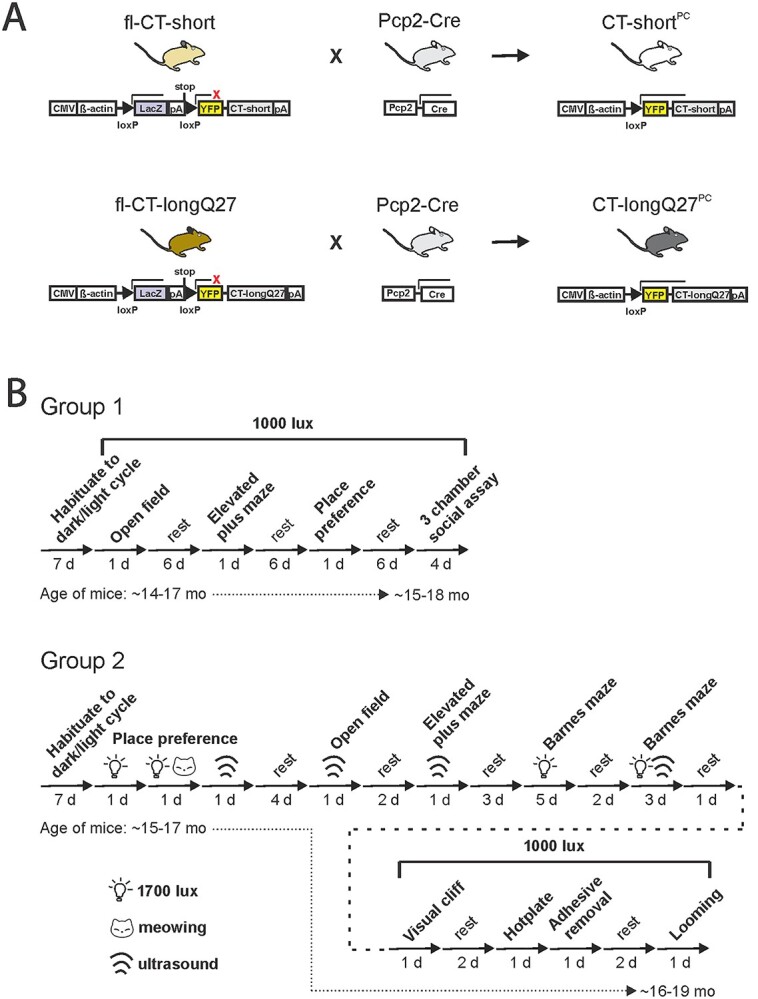
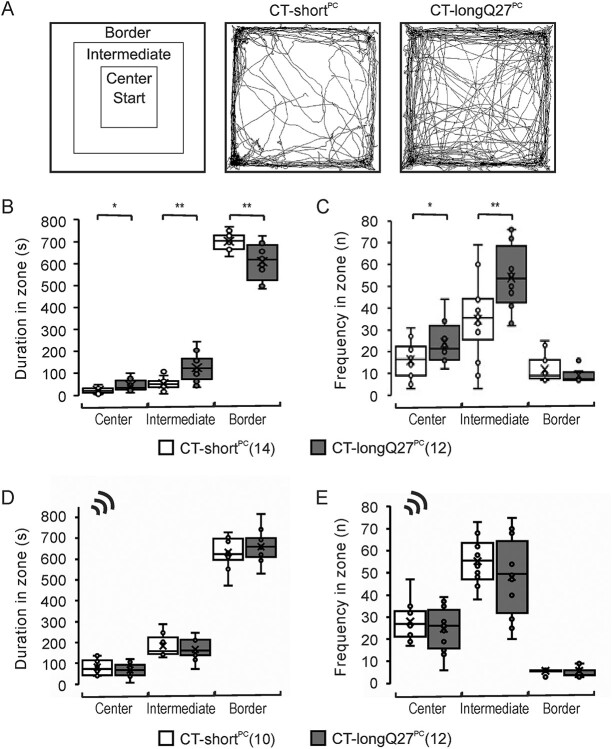
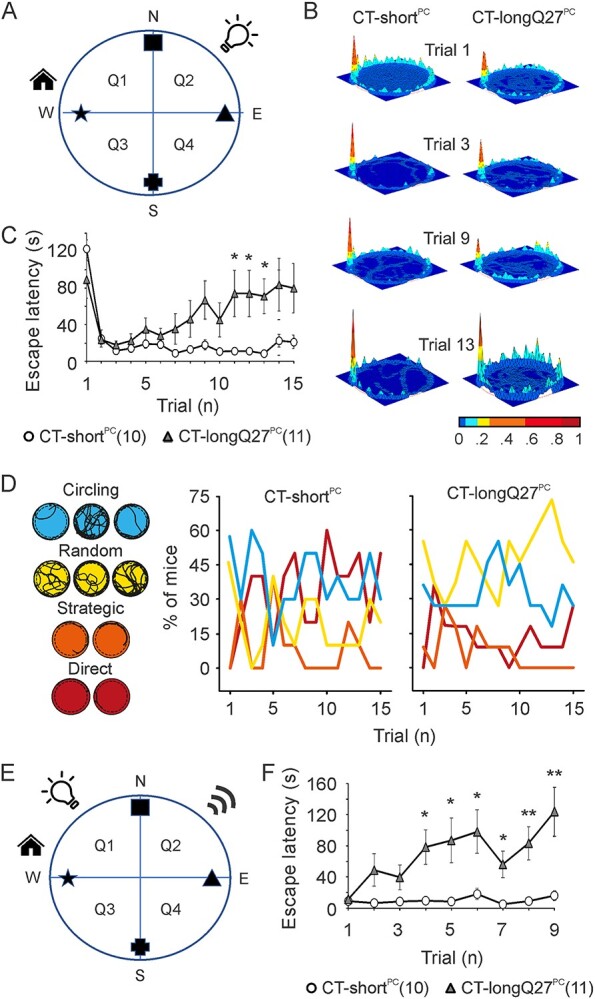
Fear and anxiety have proven to be essential during the evolutionary process. However, the mechanisms involved in recognizing and categorizing threat probability (i.e. low to high) to elicit the appropriate defensive behavior are yet to be determined. In this study, we investigated the cerebellar contribution in evoking appropriate defensive escape behavior using a purely cerebellar, neurodegenerative mouse model for spinocerebellar ataxia type 6 which is caused by an expanded CAG repeat in exon 47 of the P/Q type calcium channel α1A subunit. These mice overexpress the carboxy terminus (CT) of the P/Q type calcium channel containing an expanded 27 CAG repeat specifically in cerebellar Purkinje cells (CT-longQ27PC). We found that our CT-longQ27PC mice exhibit anxiolytic behavior in the open field, elevated plus maze and light/dark place preference tests, which could be recovered with more threatening conditions such as brighter lighting, meowing sounds and an ultrasound repellent. Their innate fear to find safety in the Barnes maze and visual cliff tests was also diminished with subsequent trials, which could be partially recovered with an ultrasound repellent in the Barnes maze. However, under higher threat conditions such as in the light/dark place preference with ultrasound repellent and in the looming tests, CT-longQ27PC mice responded with higher defensive escape behaviors as controls. Moreover, CT-longQ27PC mice displayed increased levels of CT-labeled aggregates compared with controls. Together these data suggest that cerebellar degeneration by overexpression of CT-longQ27PC is sufficient to impair defensive escape responses in those mice.
© The Author(s) 2022. Published by Oxford University Press. All rights reserved. For Permissions, please email: journals.permissions@oup.com.
Figures





References
-
- Laing, P.A.F. and Harrison, B.J. (2021) Safety learning and the Pavlovian conditioned inhibition of fear in humans: current state and future directions. Neurosci. Biobehav. Rev., 127, 659–674. - PubMed
-
- Bentz, D. and Schiller, D. (2015) Threat processing: models and mechanisms. Wiley Interdiscip. Rev. Cogn. Sci., 6, 427–439. - PubMed
-
- Clark, S. (1939) Responses following electrical stimulation of the cerebellar cortex in the normal cat. J. Neurophysiol., 2, 19–36.
-
- Chambers, W.J. (1947) Electrical stimulation of the interior of the cerebellum in the cat. Am. J. Anat., 80, 55–94. - PubMed
Publication types
MeSH terms
Substances
LinkOut - more resources
Full Text Sources
Molecular Biology Databases
