Association Between Repeated Exposure to Hurricanes and Mental Health in a Representative Sample of Florida Residents
- PMID: 35708689
- PMCID: PMC9204543
- DOI: 10.1001/jamanetworkopen.2022.17251
Association Between Repeated Exposure to Hurricanes and Mental Health in a Representative Sample of Florida Residents
Abstract
Importance: During the past century, more than 100 catastrophic hurricanes have impacted the Florida coast; climate change will likely be associated with increases in the intensity of future storms. Despite these annual threats to residents, to our knowledge, no longitudinal studies of representative samples at risk of hurricane exposure have examined psychological outcomes associated with repeated exposure.
Objective: To assess psychosocial and mental health outcomes and functional impairment associated with repeated hurricane exposure.
Design, setting, and participants: In this survey study, a demographically representative sample of Florida residents was assessed in the 60 hours prior to Hurricane Irma (wave 1: September 8-11, 2017). A second survey was administered 1 month after Hurricane Irma (wave 2: October 12-29, 2017), and a third survey was administered after Hurricane Michael (wave 3: October 22 to November 6, 2018). Data were analyzed from July 19 to 23, 2021.
Exposure: Hurricanes Irma and Michael.
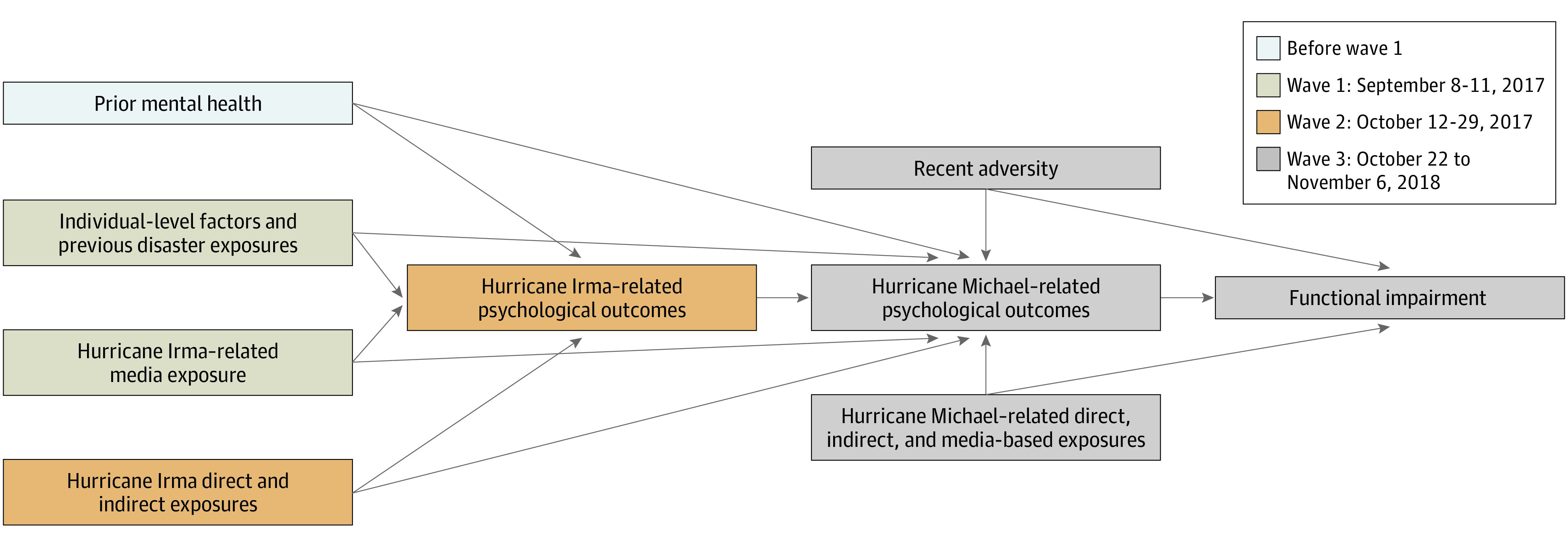
Main outcomes and measures: The main outcomes were posttraumatic stress symptoms (PTSS), global distress, worry about future events (generalized worries), and functional impairment. Path models were used to assess associations of individual-level factors (prior mental health, recent adversity), prior storm exposures (loss and/or injury, evacuation), and direct, indirect, and media-based exposures to hurricanes Irma and Michael with those outcomes. Poststratification weights were applied to facilitate population-based inferences.
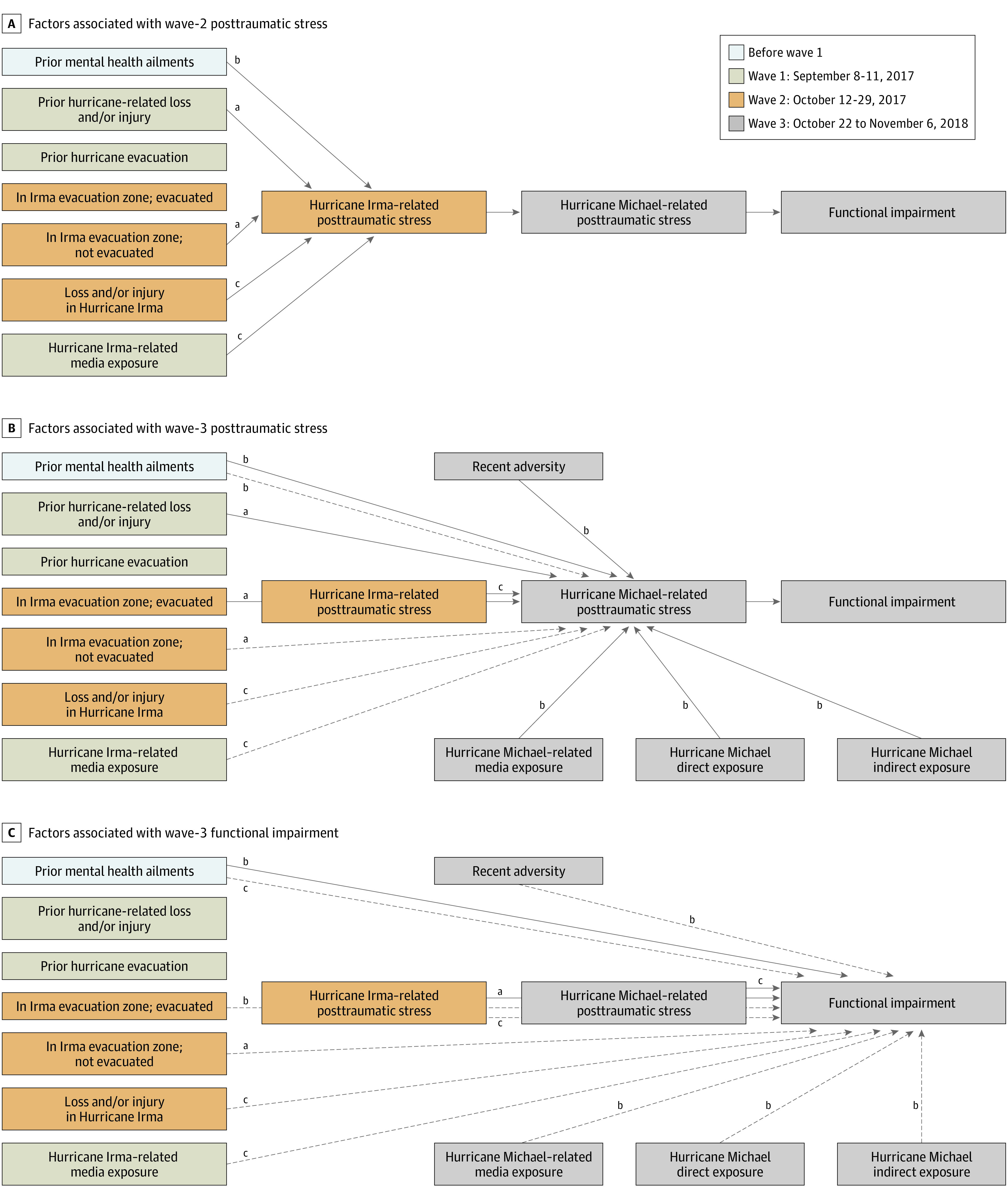
Results: Of 2873 individuals administered the survey in wave 1, 1637 responded (57.0% completion rate) (894 [54.6%, weighted] women; mean [SD] age, 51.31 [17.50] years); 1478 in wave 2 (90.3% retention from wave 1) and 1113 in wave 3 (75.3% retention from wave 2) responded. Prior mental health ailments (b, 0.18; 95% CI, 0.07-0.28), prior hurricane-related loss and/or injury (b, 0.09; 95% CI, 0.02-0.17), hours of Hurricane Irma-related media exposure (b, 0.03; 95% CI, 0.02-0.04), being in an evacuation zone during Hurricane Irma and not evacuating (b, 0.14; 95% CI, 0.02-0.27), and loss and/or injury in Hurricane Irma (b, 0.35; 95% CI, 0.25-0.44) were positively associated with PTSS after Hurricane Irma; most associations persisted and were associated with responses to Hurricane Michael. Prior mental health ailments (b, 0.10; 95% CI, 0.03-0.17), hours of Hurricane Michael-related media exposure (b, 0.01; 95% CI, 0.003-0.02), hurricane Irma-related PTSS (b, 0.42; 95% CI, 0.34-0.50), recent individual-level adversity (b, 0.03; 95% CI, 0.005-0.05), being in an evacuation zone during Hurricane Irma and evacuating (b, 0.10; 95% CI, 0.002-0.19), and direct (b, 0.36; 95% CI, 0.16-0.55) and indirect (b, 0.12; 95% CI, 0.05-0.18) Hurricane Michael-related exposures were directly associated with Hurricane Michael-related PTSS. After Hurricane Michael, prior mental health ailments (b, 0.17; 95% CI, 0.06-0.28), and PTSS related to hurricanes Irma (b, 0.11; 95% CI, 0.001-0.22) and Michael (b, 0.58; 95% CI, 0.47-0.69) were associated with respondents' functional impairment. Analogous analyses using global distress and generalized worries as mediators of functional impairment yielded a similar pattern of results.
Conclusions and relevance: In this survey study, repeated direct, indirect, and media-based exposures to hurricanes were associated with increased mental health symptoms among Florida residents who experienced hurricanes Irma and Michael, suggesting that people were sensitized to respond with more psychological symptoms over time. These results may inform targeted public health intervention efforts for natural disasters.
Conflict of interest statement
Figures
Comment in
-
Cumulative Adverse Mental Health Outcomes After Concurrent Disasters-Social, Scientific, and Policy-Making Implications.JAMA Netw Open. 2022 Jun 1;5(6):e2217260. doi: 10.1001/jamanetworkopen.2022.17260. JAMA Netw Open. 2022. PMID: 35708693 No abstract available.
References
-
- Feng K, Lin N. A reconstruction of Florida traffic flow during Hurricane Irma (2017). arXiv. Preprint posted online July 30, 2018. https://arxiv.org/abs/1807.11177
-
- D’Andrea JM. A brief parametric analysis of catastrophic or disastrous hurricanes that have hit the Florida Keys between 1900 and 2000. Am J Comput Math. 2018;8(1):1-6. doi: 10.4236/ajcm.2018.81001 - DOI
-
- Office for Coastal Management, National Oceanic and Atmospheric Association. Hurricane costs. 2019. Accessed December 2, 2019. https://coast.noaa.gov/states/fast-facts/hurricane-costs.html
-
- Beven JL II, Berg R, Hagen A. National Hurricane Center Tropical Cyclone Report: Hurricane Michael (AL142018). National Weather Service; 2019:111.
-
- Sellnow-Richmond DD, Sellnow TL. The consequences of risk amplification in the evolution of warning messages during slow-moving crises. The Handbook of Applied Communication Research. Vol. 1. Wiley; 2020:443-456.