


A syntax-lexicon trade-off in language production
- PMID: 35709321
- PMCID: PMC9231468
- DOI: 10.1073/pnas.2120203119
A syntax-lexicon trade-off in language production
Abstract
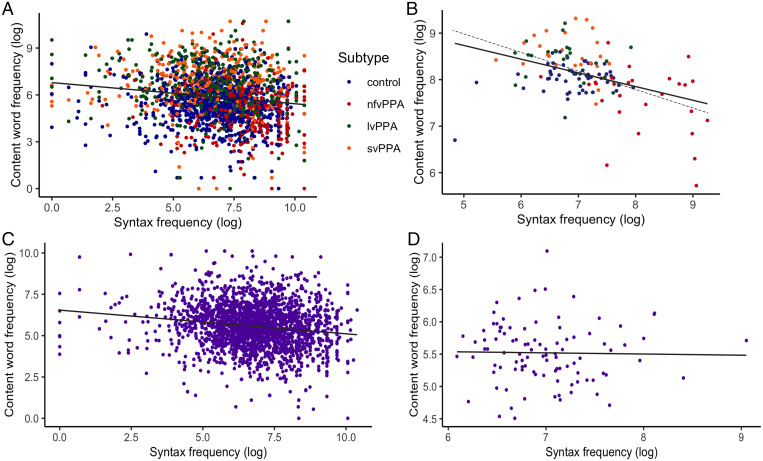
Spoken language production involves selecting and assembling words and syntactic structures to convey one's message. Here we probe this process by analyzing natural language productions of individuals with primary progressive aphasia (PPA) and healthy individuals. Based on prior neuropsychological observations, we hypothesize that patients who have difficulty producing complex syntax might choose semantically richer words to make their meaning clear, whereas patients with lexicosemantic deficits may choose more complex syntax. To evaluate this hypothesis, we first introduce a frequency-based method for characterizing the syntactic complexity of naturally produced utterances. We then show that lexical and syntactic complexity, as measured by their frequencies, are negatively correlated in a large (n = 79) PPA population. We then show that this syntax-lexicon trade-off is also present in the utterances of healthy speakers (n = 99) taking part in a picture description task, suggesting that it may be a general property of the process by which humans turn thoughts into speech.
Keywords: primary progressive aphasia; syntactic complexity; syntax frequency; syntax–lexicon trade-off; word frequency.
Conflict of interest statement
The authors declare no competing interest.
Figures
References
-
- Levelt W. J. M., Speaking: From Intention to Articulation (A Bradford Book, 1989).
-
- Paul H., Prinzipien der sprachgeschichte (M. Niemeyer, 1886).
-
- Wundt W., Völkerpsychologie: Die Sprache (Kröner-Engelmann, 1900).
-
- Bock J. K., Toward a cognitive psychology of syntax: Information processing contributions to sentence formulation. Psychol. Rev. 89, 1–47 (1982).
-
- Levelt W. J., Roelofs A., Meyer A. S., A theory of lexical access in speech production. Behav. Brain Sci. 22, 1–38, discussion 38–75 (1999). - PubMed
