PLACES: Local Data for Better Health
- PMID: 35709356
- PMCID: PMC9258452
- DOI: 10.5888/pcd19.210459
PLACES: Local Data for Better Health
Abstract
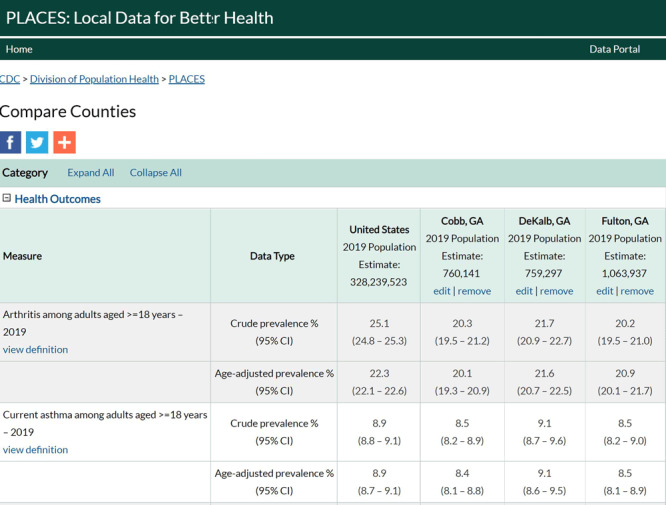
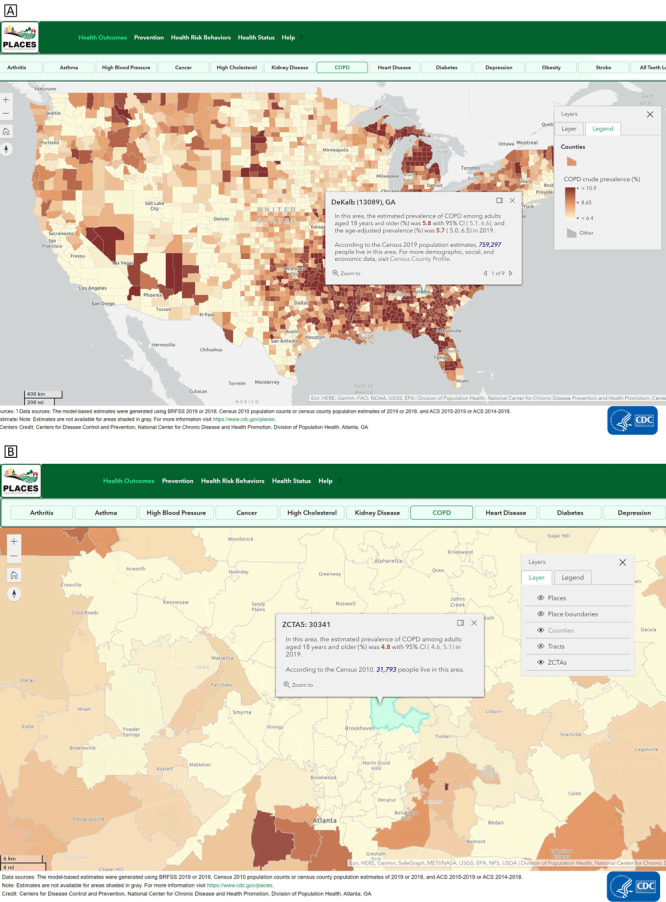
Local-level data on the health of populations are important to inform and drive effective and efficient actions to improve health, but such data are often expensive to collect and thus rare. Population Level Analysis and Community EStimates (PLACES) (www.cdc.gov/places/), a collaboration between the Centers for Disease Control and Prevention (CDC), the Robert Wood Johnson Foundation, and the CDC Foundation, provides model-based estimates for 29 measures among all counties and most incorporated and census-designated places, census tracts, and ZIP Code tabulation areas across the US. PLACES allows local health departments and others to better understand the burden and geographic distribution of chronic disease-related outcomes in their areas regardless of population size and urban-rural status and assists them in planning public health interventions. Online resources allow users to visually explore health estimates geographically, compare estimates, and download data for further use and exploration. By understanding the PLACES overall approach and using the easy-to-use PLACES applications, practitioners, policy makers, and others can enhance their efforts to improve public health, including informing prevention activities, programs, and policies; identifying priority health risk behaviors for action; prioritizing investments to areas with the biggest gaps or inequities; and establishing key health objectives to achieve community health and health equity.
Figures
References
-
- Kochanek KD, Xu J, Arias E. Mortality in the United States, 2019. NCHS Data Brief 2020;(395):1–8. - PubMed
-
- Buttorff C, Ruder T, Bauman M. Multiple chronic conditions in the United States. Santa Monica (CA): RAND Corporation; 2017. https://www.rand.org/pubs/tools/TL221.html. 10.7249/TL221 - DOI
-
- Razzaghi H, Wang Y, Lu H, Marshall KE, Dowling NF, Paz-Bailey G, et al. Estimated county-level prevalence of selected underlying medical conditions associated with increased risk for severe COVID-19 illness — United States, 2018. MMWR Morb Mortal Wkly Rep 2020;69(29):945–50. 10.15585/mmwr.mm6929a1 - DOI - PMC - PubMed
-
- Ko JY, Danielson ML, Town M, Derado G, Greenlund KJ, Kirley PD, et al. ; COVID-NET Surveillance Team. Risk factors for coronavirus disease 2019 (COVID-19)-associated hospitalization: COVID-19-Associated Hospitalization Surveillance Network and Behavioral Risk Factor Surveillance System. Clin Infect Dis 2021;72(11):e695–703. 10.1093/cid/ciaa1419 - DOI - PMC - PubMed
Publication types
MeSH terms
LinkOut - more resources
Full Text Sources
Medical