


REACT: Rapid Evaluation Assessment of Clinical Reasoning Tool
- PMID: 35710662
- PMCID: PMC9202973
- DOI: 10.1007/s11606-022-07513-5
REACT: Rapid Evaluation Assessment of Clinical Reasoning Tool
Abstract
Introduction: Clinical reasoning encompasses the process of data collection, synthesis, and interpretation to generate a working diagnosis and make management decisions. Situated cognition theory suggests that knowledge is relative to contextual factors, and clinical reasoning in urgent situations is framed by pressure of consequential, time-sensitive decision-making for diagnosis and management. These unique aspects of urgent clinical care may limit the effectiveness of traditional tools to assess, teach, and remediate clinical reasoning.
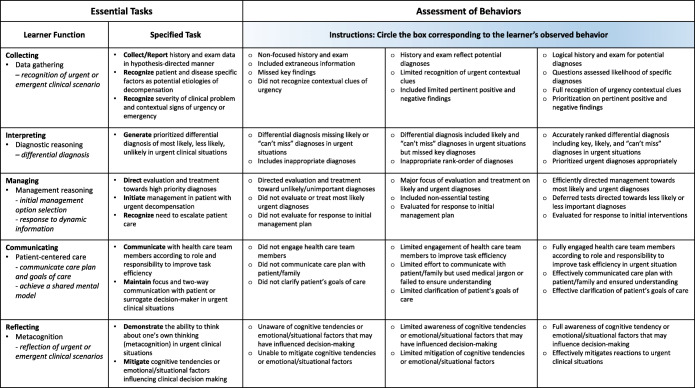
Methods: Using two validated frameworks, a multidisciplinary group of clinicians trained to remediate clinical reasoning and with experience in urgent clinical care encounters designed the novel Rapid Evaluation Assessment of Clinical Reasoning Tool (REACT). REACT is a behaviorally anchored assessment tool scoring five domains used to provide formative feedback to learners evaluating patients during urgent clinical situations. A pilot study was performed to assess fourth-year medical students during simulated urgent clinical scenarios. Learners were scored using REACT by a separate, multidisciplinary group of clinician educators with no additional training in the clinical reasoning process. REACT scores were analyzed for internal consistency across raters and observations.
Results: Overall internal consistency for the 41 patient simulations as measured by Cronbach's alpha was 0.86. A weighted kappa statistic was used to assess the overall score inter-rater reliability. Moderate reliability was observed at 0.56.
Discussion: To our knowledge, REACT is the first tool designed specifically for formative assessment of a learner's clinical reasoning performance during simulated urgent clinical situations. With evidence of reliability and content validity, this tool guides feedback to learners during high-risk urgent clinical scenarios, with the goal of reducing diagnostic and management errors to limit patient harm.
© 2022. The Author(s) under exclusive licence to Society of General Internal Medicine.
Conflict of interest statement
The authors have no conflicts of interest to disclose.
Figures
References
-
- Geoff R, Norman CPMvdV, David I Newble, Diana H.J.M Dolmans, et al. International Handbook of Research in Medical Education. Dordrecht, the Netherlands: Kluwer Academic Publishers, 2002.
MeSH terms
LinkOut - more resources
Full Text Sources
