


Cardiometabolic multimorbidity, genetic risk, and dementia: a prospective cohort study
- PMID: 35711612
- PMCID: PMC9184258
- DOI: 10.1016/S2666-7568(22)00117-9
Cardiometabolic multimorbidity, genetic risk, and dementia: a prospective cohort study
Abstract
Background: Individual cardiometabolic disorders and genetic factors are associated with an increased dementia risk; however, the relationship between dementia and cardiometabolic multimorbidity is unclear. We investigated whether cardiometabolic multimorbidity increases the risk of dementia, regardless of genetic risk, and examined for associated brain structural changes.
Methods: We examined health and genetic data from 203 038 UK Biobank participants of European ancestry, aged 60 years or older without dementia at baseline assessment (2006-10) and followed up until March 31, 2021, in England and Scotland and Feb 28, 2018, in Wales, as well as brain structural data in a nested imaging subsample of 12 236 participants. A cardiometabolic multimorbidity index comprising stroke, diabetes, and myocardial infarction (one point for each), and a polygenic risk score for dementia (with low, intermediate, and high risk groups) were calculated for each participant. The main outcome measures were incident all-cause dementia and brain structural metrics.
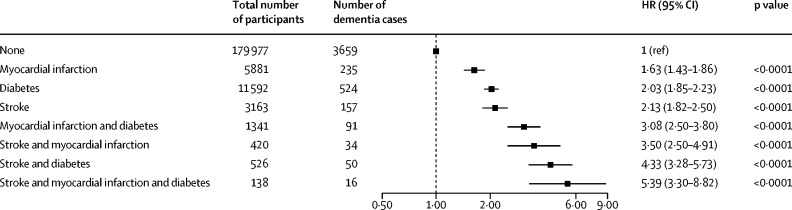
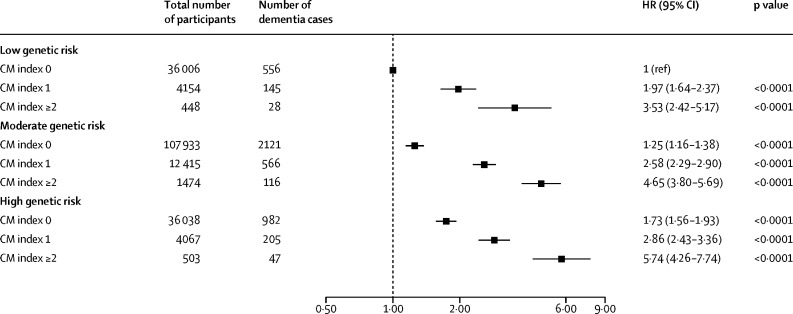
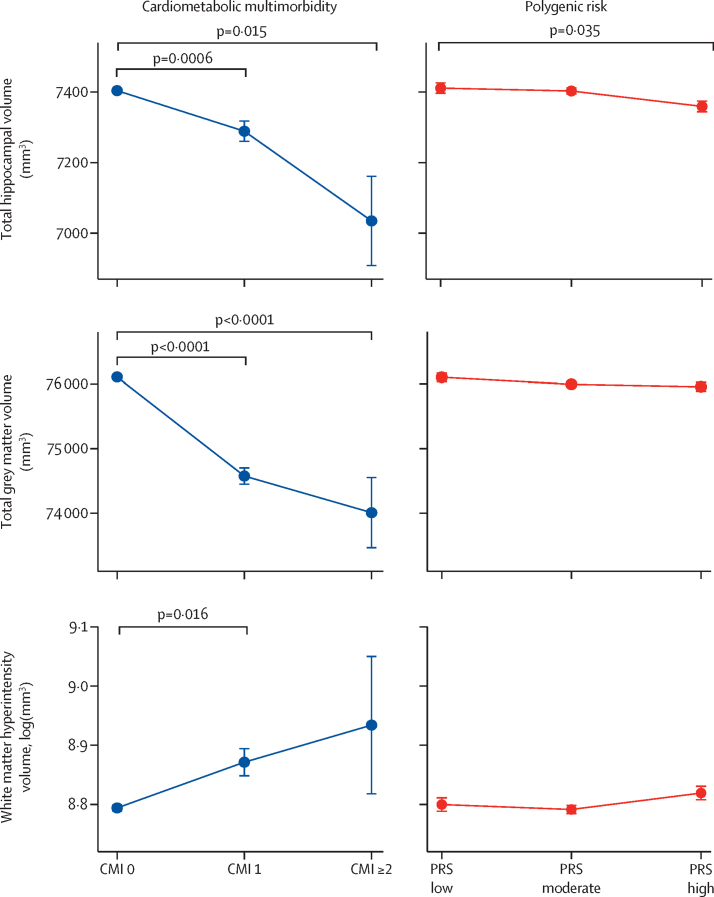
Findings: The dementia risk associated with high cardiometabolic multimorbidity was three times greater than that associated with high genetic risk (hazard ratio [HR] 5·55, 95% CI 3·39-9·08, p<0·0001, and 1·68, 1·53-1·84, p<0·0001, respectively). Participants with both a high genetic risk and a cardiometabolic multimorbidity index of two or greater had an increased risk of developing dementia (HR 5·74, 95% CI 4·26-7·74, p<0·0001), compared with those with a low genetic risk and no cardiometabolic conditions. Crucially, we found no interaction between cardiometabolic multimorbidity and polygenic risk (p=0·18). Cardiometabolic multimorbidity was independently associated with more extensive, widespread brain structural changes including lower hippocampal volume (F2, 12 110 = 10·70; p<0·0001) and total grey matter volume (F2, 12 236 = 55·65; p<0·0001).
Interpretation: Cardiometabolic multimorbidity was independently associated with the risk of dementia and extensive brain imaging differences to a greater extent than was genetic risk. Targeting cardiometabolic multimorbidity might help to reduce the risk of dementia, regardless of genetic risk.
Funding: Wellcome Trust, Alzheimer's Research UK, Alan Turing Institute/Engineering and Physical Sciences Research Council, the National Institute for Health Research Applied Research Collaboration South West Peninsula, National Health and Medical Research Council, JP Moulton Foundation, and National Institute on Aging/National Institutes of Health.
© 2022 The Author(s). Published by Elsevier Ltd. This is an Open Access article under the CC BY 4.0 license.
Conflict of interest statement
We declare no competing interests.
Figures
Comment in
-
Association of cardiometabolic and genetic risk with incidence of dementia.Lancet Healthy Longev. 2022 Jun;3(6):e374-e375. doi: 10.1016/S2666-7568(22)00127-1. Epub 2022 Jun 9. Lancet Healthy Longev. 2022. PMID: 36098314 No abstract available.
References
-
- Cooper C, Sommerlad A, Lyketsos CG, Livingston G. Modifiable predictors of dementia in mild cognitive impairment: a systematic review and meta-analysis. Am J Psychiatry. 2015;172:323–334. - PubMed
Publication types
MeSH terms
Grants and funding
LinkOut - more resources
Full Text Sources
Medical
Miscellaneous
