. 2022 Jun 8;2(6):None.
doi: 10.1016/j.xgen.2022.100133.

Population dynamics and genetic connectivity in recent chimpanzee history

Claudia Fontsere  1 Martin Kuhlwilm  1   2   3 Carlos Morcillo-Suarez  1 Marina Alvarez-Estape  1 Jack D Lester  4 Paolo Gratton  4   5 Joshua M Schmidt  6   7 Paula Dieguez  4   8 Thierry Aebischer  9 Paula Álvarez-Varona  10 Anthony Agbor  4 Samuel Angedakin  4 Alfred K Assumang  11 Emmanuel A Ayimisin  4 Emma Bailey  4 Donatienne Barubiyo  4 Mattia Bessone  4 Andrea Carretero-Alonso  12 Rebecca Chancellor  13 Heather Cohen  4   14 Emmanuel Danquah  11 Tobias Deschner  4 Andrew Dunn  15 Jef Dupain  16 Villard E Egbe  4 Olga Feliu  17 Annemarie Goedmakers  18 Anne-Céline Granjon  4 Josephine Head  4 Daniela Hedwig  19 Veerle Hermans  20 R Adriana Hernandez-Aguilar  10   21 Inaoyom Imong  15 Sorrel Jones  4   22 Jessica Junker  8 Parag Kadam  23 Mike Kaiser  4 Mbangi Kambere  4 Magloire V Kambale  4 Ammie K Kalan  23   24 Ivonne Kienast  4 Deo Kujirakwinja  15 Kevin Langergraber  25   26   27 Juan Lapuente  4 Bradley Larson  4 Anne Laudisoit  28   29 Kevin Lee  4   25 Manuel Llana  10 Miquel Llorente  17   30 Sergio Marrocoli  4 David Morgan  31 Felix Mulindahabi  15 Mizuki Murai  4 Emily Neil  4 Sonia Nicholl  4 Stuart Nixon  32 Emma Normand  33 Chris Orbell  34 Lucy J Ormsby  4 Liliana Pacheco  35 Alex Piel  23   36 Laura Riera  17 Martha M Robbins  4 Aaron Rundus  37 Crickette Sanz  38   39 Lilah Sciaky  4 Volker Sommer  36   40 Fiona A Stewart  23   36   41 Nikki Tagg  20 Luc Roscelin Tédonzong  20 Els Ton  18 Joost van Schijndel  4   18 Virginie Vergnes  33 Erin G Wessling  42 Jacob Willie  20   43 Roman M Wittig  4   44 Yisa G Yuh  4   45 Kyle Yurkiw  4 Klaus Zuberbuehler  46   47 Jochen Hecht  48 Linda Vigilant  4 Christophe Boesch  4 Aida M Andrés  6 David A Hughes  49   50 Hjalmar S Kühl  4   8 Esther Lizano  1   51 Mimi Arandjelovic  4   8 Tomas Marques-Bonet  1   48   51   52
Affiliations

Population dynamics and genetic connectivity in recent chimpanzee history

Claudia Fontsere et al. Cell Genom. .

Abstract

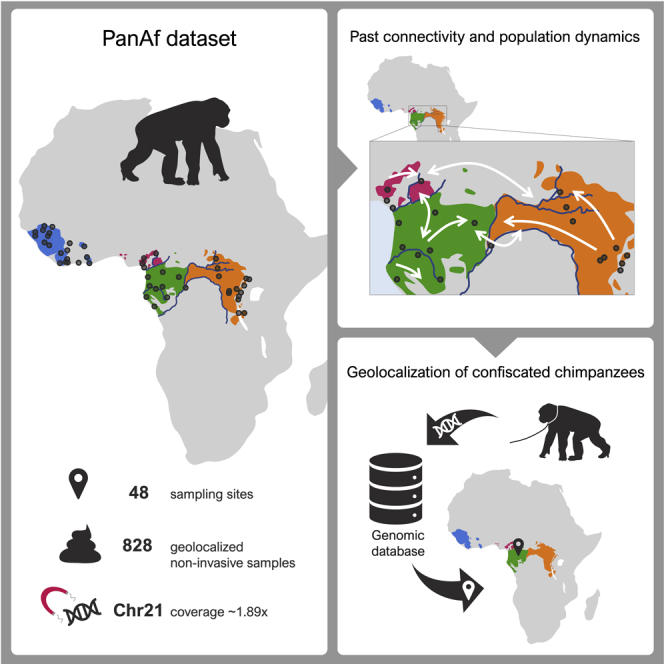
Knowledge on the population history of endangered species is critical for conservation, but whole-genome data on chimpanzees (Pan troglodytes) is geographically sparse. Here, we produced the first non-invasive geolocalized catalog of genomic diversity by capturing chromosome 21 from 828 non-invasive samples collected at 48 sampling sites across Africa. The four recognized subspecies show clear genetic differentiation correlating with known barriers, while previously undescribed genetic exchange suggests that these have been permeable on a local scale. We obtained a detailed reconstruction of population stratification and fine-scale patterns of isolation, migration, and connectivity, including a comprehensive picture of admixture with bonobos (Pan paniscus). Unlike humans, chimpanzees did not experience extended episodes of long-distance migrations, which might have limited cultural transmission. Finally, based on local rare variation, we implement a fine-grained geolocalization approach demonstrating improved precision in determining the origin of confiscated chimpanzees.

Keywords: chimpanzee; chimpanzee demography; conservation genomics; fecal samples; geolocalization; hybridization capture; non-invasive samples; population dynamics; population genetics.


Conflict of interest statement

The authors declare no competing interests.

Figures
None
Graphical abstract
Figure 1
Figure 1
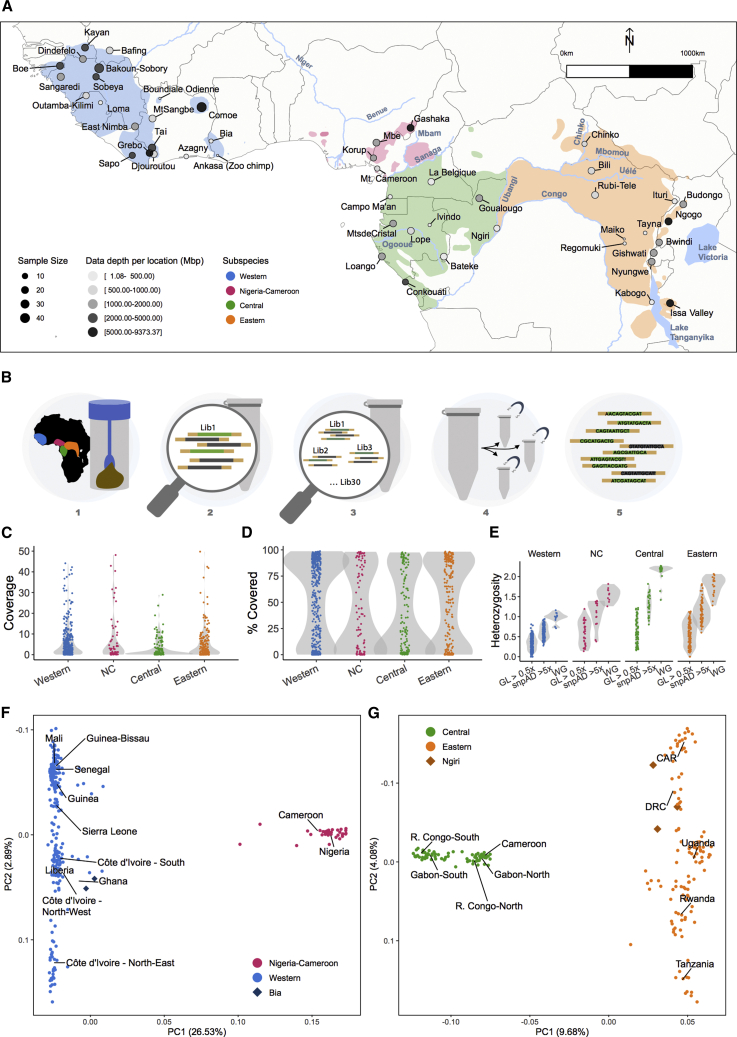
Overview on sampling, capture, and chimpanzee population history (A) Geographic distribution of chimpanzee subspecies and PanAf sampling locations. The western chimpanzee range is shown in blue, Nigeria-Cameroon in pink, central in green, and eastern in orange. The size of the dots represents the number of sequenced samples (n = 828) and color intensity represents the amount of chimpanzee genetic data generated (mega-base pairs of mapped sequence) from each sampling site. (B) Experimental pipeline. (1) Samples were collected from 48 sampling sites, DNA extracted and screened for amplification success, uniqueness, and relatedness using microsatellites; (2) one library per individual was prepared; (3) between 10 and 30 libraries were pooled equi-endogenously; (4) enrichment for chromosome 21 with target capture methods, between three and five times per library; (5) sequencing data were generated with Illumina. (C) Average coverage on the target region of chromosome 21 for each sample. (D) Percentage of the target space covered by at least one read. (E) Heterozygosity estimates per subspecies derived from ANGSD genotype likelihood on PanAf samples with more than 0.5-fold coverage (GL > 0.5×), from snpAD genotype calls on PanAf samples with more than 5-fold coverage, and from GATK genotype calls on previously published whole-genome (WG) chimpanzee samples. (F) PCA of western (blue) and Nigeria-Cameroon (pink) chimpanzee subspecies. Dark blue diamonds, Bia sampling site in Ghana at the eastern fringe of the extant western chimpanzee range. (G) PCA of central (green) and eastern (orange) chimpanzee subspecies. Dark orange diamonds, Ngiri sampling site at the western fringe of the eastern chimpanzee distribution. CAR, Central African Republic; DRC, Democratic Republic of Congo; R. Congo, Republic of Congo. See also Figures S3–S13, S29–S39, and Table S4
Figure 2
Figure 2
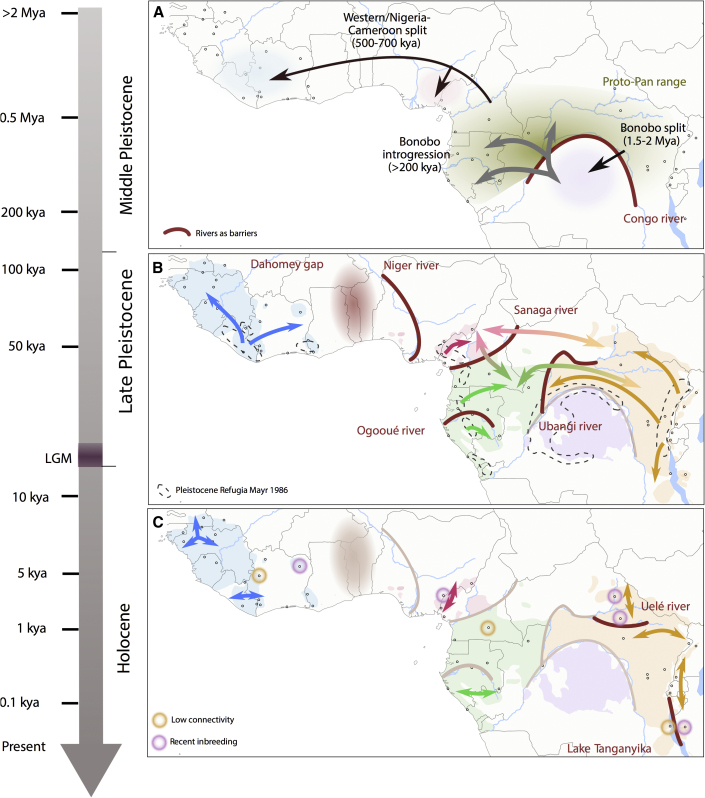
Reconstruction of chimpanzee genetic history Major rivers and lakes (red lines) and the Dahomey gap (red shading) represent geographical barriers separating populations at different timescales. (A) Formation of and migration between Pan species (chimpanzees and bonobos) and subspecies formation during the Middle Pleistocene; separation and migration events inferred in previous studies,,, additional gene flow into southern central populations was inferred here using admixfrog. (B) Corridors of gene flow (arrows) during the Late Pleistocene and after the Last Glacial Maximum (LGM), when chimpanzee populations expanded from refugia;, within subspecies based on migration surfaces obtained with EEMS and shared rare variation, between subspecies based on short IBD-like tracts (<0.5 Mbp) and shared fragments of ancestry inferred with admixfrog. (C) Population connectivity and isolation during the Holocene; connectivity was determined by long (>0.5 Mbp) IBD-like fragments between sampling locations within subspecies and supported by presence or absence of shared rare variation; signatures of recent inbreeding are represented by long regions of homozygosity in individuals from a given sampling location. See also Figures S40–S53, S57–S60, S64, S66, S76–S79, S82–S85, and S92.
Figure 3
Figure 3
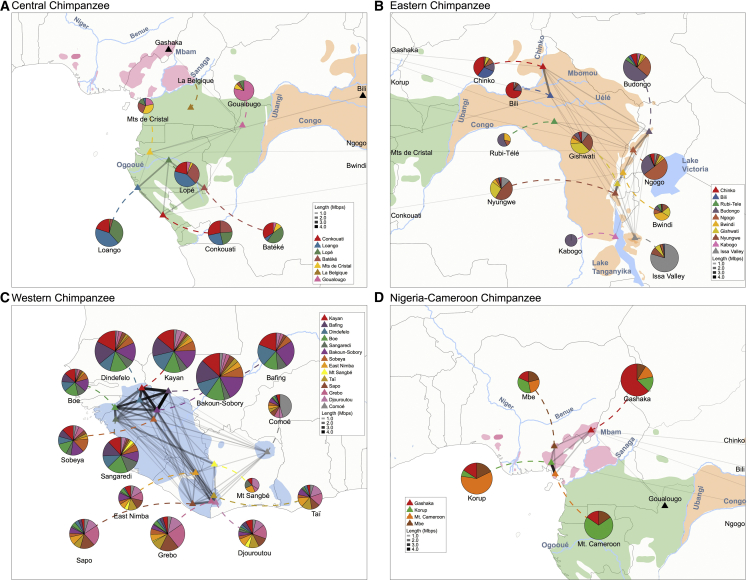
Recent connectivity between chimpanzee populations (A–D) The size of the pie charts represents the pairwise number of shared fragments, normalized by the number of pairs. Thickness of lines indicates the average length of IBD-like tracts (in Mbp). Triangles show the location of sites. Colors in pies indicate the origin of IBD-like tracts, including comparison between samples from the same site. (A) Central chimpanzees, (B) eastern chimpanzees, (C) western chimpanzees, and (D) Nigeria-Cameroon chimpanzees. Note also few and short IBD-like fragment connections between central, eastern, and Nigeria-Cameroon subspecies. See also Figures S86–S94.
Figure 4
Figure 4
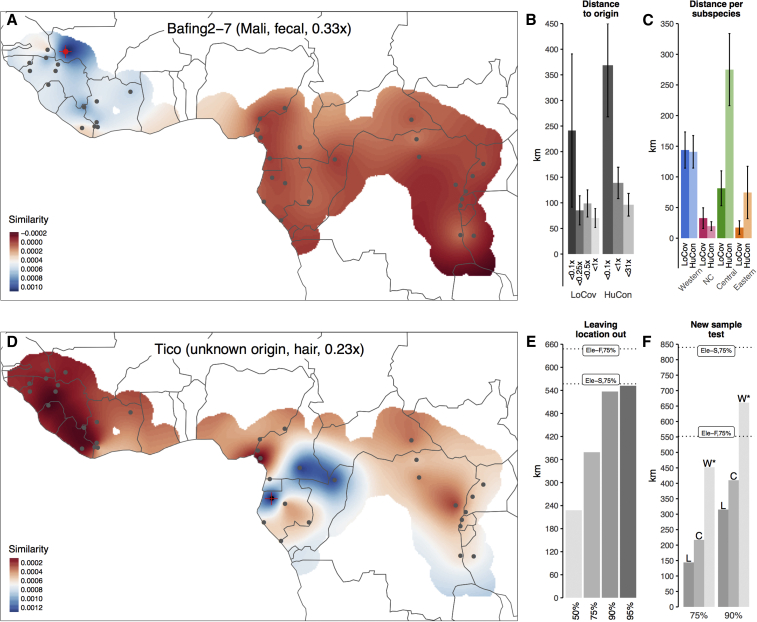
Chimpanzee geolocalization based on rare variation (A) Spatial model of shared rare alleles with 38 sampling locations. Red indicates lower amounts, while blue indicates larger amounts of shared rare alleles. Black dots, locations included in the reference panel; red dot, known place of origin (low-coverage sample Baf2-7 from Bafing, Mali); red cross, inferred origin. Red cross and dot overlap in this correctly assigned sample. (B) Average distance (km) of best matching to true location in bins of coverage for samples with low coverage and contamination (LoCov) (n = 99) and samples with human contamination of more than 0.5% (HuCon) (n = 139). Error bars represent the SEM. (C) Average distance of best matching to true location per subspecies, stratified by low-coverage and human-contaminated samples; note that the Nigeria-Cameroon chimpanzee range is smaller than that of other subspecies, thus resulting in smaller distances. Error bars represent the SEM. (D) Geolocalization of the chimpanzee Tico from a rescue center in Spain, here assigned to Gabon or Equatorial Guinea. (E) Assignment accuracy when leaving full locations out (n = 434), with 50th, 75th, 90th, and 95th percentiles for the distance of inferred to true origin; for comparison, best 75th percentiles for geolocalization of elephants are shown as dotted lines (Ele-S, Savanna elephant; Ele-F, forest elephant). (F) Assignment accuracy for samples not included in the reference panel (L, low coverage; C, contaminated; W, whole-genome data6); for comparison, the 75th percentiles of the single sample test in elephants are shown as dotted lines; the asterisk marks that the origin for whole genomes may be different from the place of confiscation reported for these individuals. See also Figures S67–S75, S80, and S81.

References

    1. Fischer A., Pollack J., Thalmann O., Nickel B., Pääbo S. Demographic history and genetic differentiation in apes. Curr. Biol. 2006;16:1133–1138. doi: 10.1016/j.cub.2006.04.033. - DOI - PubMed
    1. Becquet C., Przeworski M. A new approach to estimate parameters of speciation models with application to apes. Genome Res. 2007;17:1505–1519. doi: 10.1101/gr.6409707. - DOI - PMC - PubMed
    1. Prado-Martinez J., Sudmant P.H., Kidd J.M., Li H., Kelley J.L., Lorente-Galdos B., Veeramah K.R., Woerner A.E., O’Connor T.D., Santpere G., et al. Great ape genetic diversity and population history. Nature. 2013;499:471–475. doi: 10.1038/nature12228. - DOI - PMC - PubMed
    1. Lobon I., Tucci S., De Manuel M., Ghirotto S., Benazzo A., Prado-Martinez J., Lorente-Galdos B., Nam K., Dabad M., Hernandez-Rodriguez J., et al. Demographic history of the genus Pan inferred from whole mitochondrial genome reconstructions. Genome Biol. Evol. 2016;8:2020–2030. doi: 10.1093/gbe/evw124. - DOI - PMC - PubMed
    1. Hallast P., Maisano Delser P., Batini C., Zadik D., Rocchi M., Schempp W., Tyler-Smith C., Jobling M.A. Great ape Y Chromosome and mitochondrial DNA phylogenies reflect subspecies structure and patterns of mating and dispersal. Genome Res. 2016;26:427–439. doi: 10.1101/gr.198754.115. - DOI - PMC - PubMed

LinkOut - more resources