


Identifying the Common Genetic Basis of Antidepressant Response
- PMID: 35712048
- PMCID: PMC9117153
- DOI: 10.1016/j.bpsgos.2021.07.008
Identifying the Common Genetic Basis of Antidepressant Response
Abstract
Background: Antidepressants are a first-line treatment for depression. However, only a third of individuals experience remission after the first treatment. Common genetic variation, in part, likely regulates antidepressant response, yet the success of previous genome-wide association studies has been limited by sample size. This study performs the largest genetic analysis of prospectively assessed antidepressant response in major depressive disorder to gain insight into the underlying biology and enable out-of-sample prediction.
Methods: Genome-wide analysis of remission (n remit = 1852, n nonremit = 3299) and percentage improvement (n = 5218) was performed. Single nucleotide polymorphism-based heritability was estimated using genome-wide complex trait analysis. Genetic covariance with eight mental health phenotypes was estimated using polygenic scores/AVENGEME. Out-of-sample prediction of antidepressant response polygenic scores was assessed. Gene-level association analysis was performed using MAGMA and transcriptome-wide association study. Tissue, pathway, and drug binding enrichment were estimated using MAGMA.
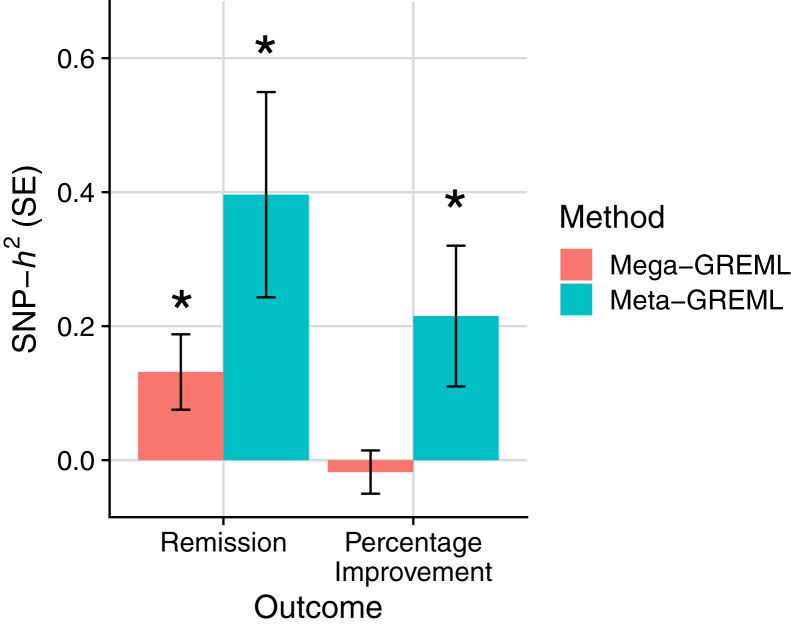
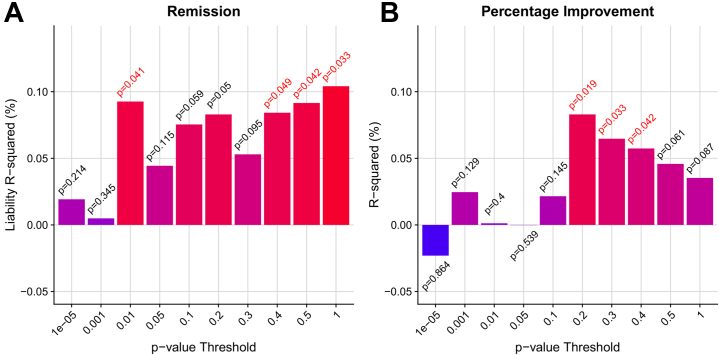
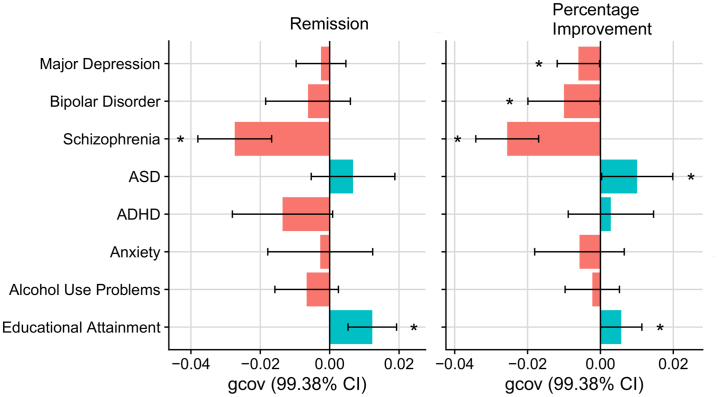
Results: Neither genome-wide association study identified genome-wide significant associations. Single nucleotide polymorphism-based heritability was significantly different from zero for remission (h 2 = 0.132, SE = 0.056) but not for percentage improvement (h 2 = -0.018, SE = 0.032). Better antidepressant response was negatively associated with genetic risk for schizophrenia and positively associated with genetic propensity for educational attainment. Leave-one-out validation of antidepressant response polygenic scores demonstrated significant evidence of out-of-sample prediction, though results varied in external cohorts. Gene-based analyses identified ETV4 and DHX8 as significantly associated with antidepressant response.
Conclusions: This study demonstrates that antidepressant response is influenced by common genetic variation, has a genetic overlap schizophrenia and educational attainment, and provides a useful resource for future research. Larger sample sizes are required to attain the potential of genetics for understanding and predicting antidepressant response.
Keywords: Antidepressant response; Depression; GWAS; Genetics; MDD; Polygenic score.
© 2021 The Authors.
Figures
References
-
- Vos T., Allen C., Arora M., Barber R.M., Bhutta Z.A., Brown A., et al. Global, regional, and national incidence, prevalence, and years lived with disability for 310 diseases and injuries, 1990–2015: A systematic analysis for the Global Burden of Disease Study 2015. Lancet. 2016;388:1545–1602. - PMC - PubMed
-
- Brådvik L., Mattisson C., Bogren M., Nettelbladt P. Long-term suicide risk of depression in the Lundby cohort 1947–1997—Severity and gender. Acta Psychiatr Scand. 2008;117:185–191. - PubMed
-
- Sobocki P., Jönsson B., Angst J., Rehnberg C. Cost of depression in Europe. J Ment Health Policy Econ. 2006;9:87–98. - PubMed
-
- Pratt L.A., Brody D.J., Gu Q. Antidepressant use among persons aged 12 and over: United States, 2011-2014. NCHS Data Brief. 2017;283:1–8. - PubMed
-
- Iacobucci G. NHS prescribed record number of antidepressants last year. BMJ. 2019;364:l1508. - PubMed
