


Modeling COVID-19 Impact on Consumption and Mobility in Europe: A Legacy Toward Sustainable Business Performance
- PMID: 35712213
- PMCID: PMC9195302
- DOI: 10.3389/fpsyg.2022.862854
Modeling COVID-19 Impact on Consumption and Mobility in Europe: A Legacy Toward Sustainable Business Performance
Retraction in
-
Retraction: Modeling COVID-19 impact on consumption and mobility in Europe: a legacy toward sustainable business performance.Front Psychol. 2025 Aug 7;16:1675481. doi: 10.3389/fpsyg.2025.1675481. eCollection 2025. Front Psychol. 2025. PMID: 40851561 Free PMC article.
Abstract
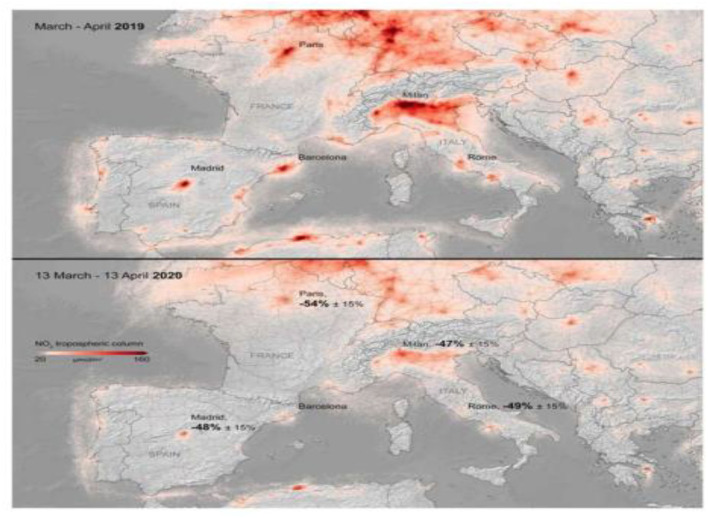
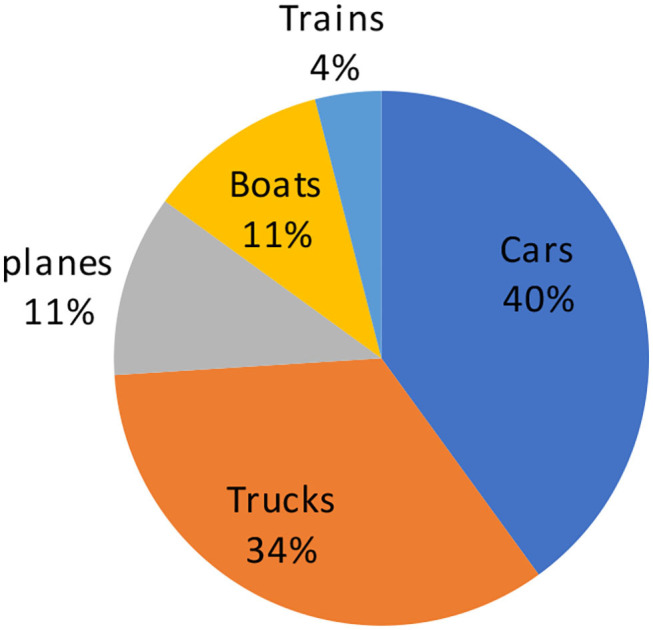
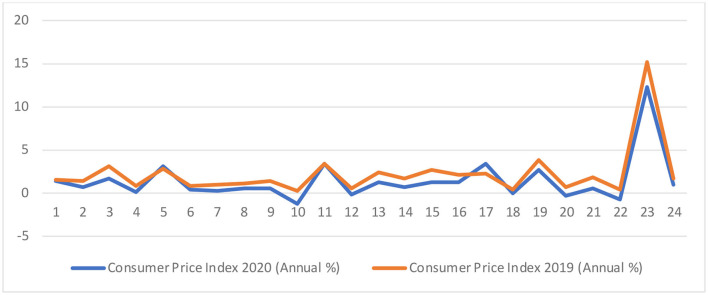
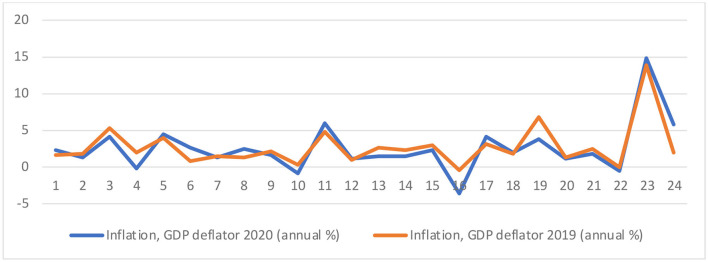
This article has explored the impact of coronavirus disease 2019 (COVID-19)-induced decline in consumer durables and mobility on nitrogen dioxide (NO2) emission in Europe by providing empirical and graphical justifications based on consumer price index (CPI) and gross domestic product (GDP) deflator indexes. The empirical estimations show that carbon dioxide (CO2) and NOx emission along with other greenhouse gases drastically decreased in the wake of COVID-19-induced lockdowns and decrease in the demand of consumer goods in Europe. This means that COVID-19 improved environment in the European region. However, high cost (e.g., unemployment, loss of life, and social segregation) makes COVID-19 an unstable solution to environmental woes where positive impact of COVID-19 on environment achieved in short run cannot be guaranteed in the long run. Besides environment, COVID-19 drastically curtailed economic activities and exposed them to the risk of economic crisis particularly in case of Europe.
Keywords: COVID-19; developing countries; economics; environment; lockdown.
Copyright © 2022 Ameer, Chau, Mumtaz, Irfan and Mumtaz.
Conflict of interest statement
The authors declare that the research was conducted in the absence of any commercial or financial relationships that could be construed as a potential conflict of interest.
Figures
References
-
- Abbasi K. R., Shahbaz M., Zhang J., Irfan M., Lv K. (2022). Analyze the environmental sustainability factors of China: the role of fossil fuel energy and renewable energy. Renew. Energy 187, 390–402. 10.1016/j.renene.2022.01.066 - DOI
-
- Adams W. M. (2009). Green Development: Environment and Sustainability in a Developing World, 3rd Edn. Routledge.
-
- Ahmad B., Da L., Asif M. H., Irfan M., Ali S., Akbar M. I. U. D. (2021). Understanding the antecedents and consequences of service-sales ambidexterity: a motivation-opportunity-ability (MOA) framework. Sustainability 13, 9675. 10.3390/su13179675 - DOI
-
- Ahmad B., Irfan M., Salem S., Asif M. H. (2022). Energy efficiency in the post-COVID-19 era: exploring the determinants of energy-saving intentions and behaviors. Front. Energy Res. 9, 824318. 10.3389/fenrg.2021.824318 - DOI
-
- Ali S., Yan Q., Sajjad Hussain M., Irfan M., Ahmad M., Razzaq A., et al. (2021). Evaluating green technology strategies for the sustainable development of solar power projects: evidence from Pakistan. Sustainability 13, 12997. 10.3390/su132312997 - DOI
Publication types
LinkOut - more resources
Full Text Sources
