


Validation of the parent global assessment as a health-related quality of life measure in juvenile idiopathic arthritis: results from ReACCh-Out
- PMID: 35713497
- PMCID: PMC9949712
- DOI: 10.1093/rheumatology/keac350
Validation of the parent global assessment as a health-related quality of life measure in juvenile idiopathic arthritis: results from ReACCh-Out
Abstract
Objectives: To (i) validate the JIA parent global assessment (parent global) as a health-related quality of life (HRQoL) instrument; (ii) evaluate measurement properties of accepted HRQoL measures relative to those of the parent global; and (iii) assess causal pathways determining parent global scores.
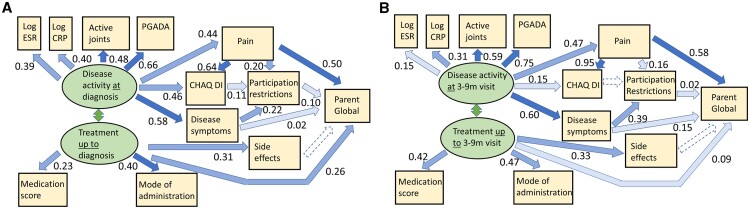
Methods: Data from the Research in Arthritis in Canadian Children emphasizing outcomes (ReACCh-Out) cohort were used. Measurement properties were assessed in 344 patients at enrolment and 6 months later. Causal pathways were tested by structural equation modelling to understand root causes and mediators leading to parent global scores.
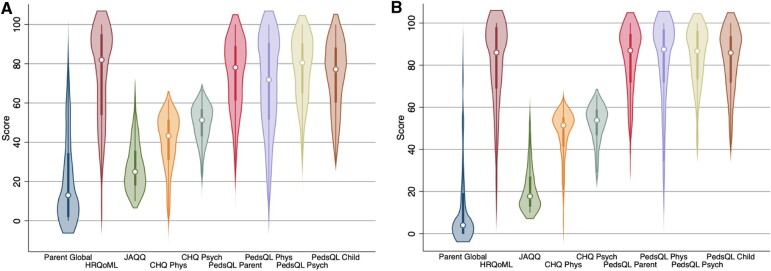
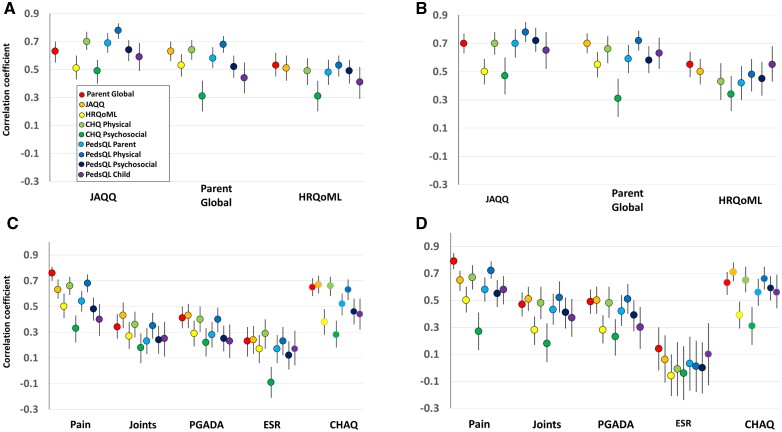
Results: Construct validity was supported by Spearman correlations of 0.53-0.70 for the parent global with the Juvenile Arthritis Quality of Life Questionnaire, Quality of My Life health scale (HRQoML), Pediatric Quality of Life Inventory (PedsQL)-Parent, and Child Health Questionnaire (CHQ)-Physical. Exceptions were PedsQL-Child (0.44) and CHQ-Psychosocial (0.31). Correlations were lower (0.14-0.49) with disease activity measures (physician global assessment of disease activity, active joint count, ESR). Responsiveness of the parent global to improvement according to parent ratings (0.51) was acceptable and within the range (0.32-0.71) of that of other measures. Reliability estimates and measurement errors for all measures were unsatisfactory, likely due to the prolonged time between assessments. Causal pathways for the parent global matched those previously reported for HRQoML.
Conclusions: Our results offer support for the parent global as a valid measure of HRQoL for JIA. If confirmed, existing studies using the parent global may be re-interpreted, enhancing our knowledge of HRQoL in children with JIA.
Keywords: JIA; Parent global assessment; health-related quality of life.
© The Author(s) 2022. Published by Oxford University Press on behalf of the British Society for Rheumatology. All rights reserved. For permissions, please email: journals.permissions@oup.com.
Figures
Comment in
-
Is the parent global assessment a reliable quality of life measure in juvenile idiopathic arthritis?Rheumatology (Oxford). 2023 Jun 1;62(6):2023-2024. doi: 10.1093/rheumatology/keac600. Rheumatology (Oxford). 2023. PMID: 36264131 No abstract available.
References
-
- Singh G, Athreya BH, Fries JF, Goldsmith DP.. Measurement of health status in children with juvenile rheumatoid arthritis. Arthritis Rheum 1994;37:1761–9. - PubMed
-
- Shoop-Worrall SJW, Hyrich KL, Wedderburn LR, Thomson W, Geifman N; CAPS the CLUSTER Consortium. Patient-reported wellbeing and clinical disease measures over time captured by multivariate trajectories of disease activity in individuals with juvenile idiopathic arthritis in the UK: a multicentre prospective longitudinal study. Lancet Rheumatol 2021;3:e111–21. - PMC - PubMed
-
- Prince FH, Twilt M, ten Cate R. et al. Long-term follow-up on effectiveness and safety of etanercept in juvenile idiopathic arthritis: the Dutch national register. Ann Rheum Dis 2009;68:635–41. - PubMed
-
- Minden K, Horneff G, Niewerth M. et al. Time of disease-modifying antirheumatic drug start in juvenile idiopathic arthritis and the likelihood of a drug-free remission in young adulthood. Arthritis Care Res 2019;71:471–81. - PubMed
-
- Nordal E, Zak M, Aalto K. et al. Ongoing disease activity and changing categories in a long-term Nordic cohort study of juvenile idiopathic arthritis. Arthritis Rheum 2011;63:2809–18. - PubMed
Publication types
MeSH terms
Grants and funding
LinkOut - more resources
Full Text Sources
Medical
Miscellaneous
