


Subjective Memory Decline Predicts Incident Cognitive Impairment Among White-But Not Black or Hispanic-Older Adults
- PMID: 35716360
- PMCID: PMC10167759
- DOI: 10.1093/geront/gnac086
Subjective Memory Decline Predicts Incident Cognitive Impairment Among White-But Not Black or Hispanic-Older Adults
Abstract
Background and objectives: This study investigates whether subjective memory decline (SMD) in a racially diverse sample of older adults without cognitive impairment at baseline is associated with incident cognitive impairment during a 12-year follow-up period.
Research design and methods: With panel data from a national sample (N = 9,244) of cognitively intact Black, White, and Hispanic Americans 65 years or older in 2004, we examine if SMD is associated with the loss of normal cognition by 2016. Cognitive status was assessed every 2 years with a modified version of the Telephone Interview for Cognitive Status to identify the transition from normal cognition to cognitive impairment.
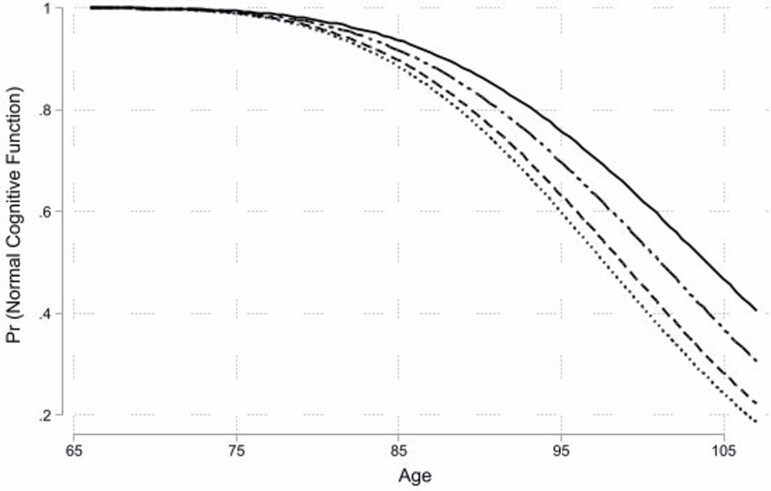
Results: Estimates from Weibull accelerated failure-time models reveal that SMD is associated with earlier incident cognitive impairment (time ratio = 0.96, p < .05). In subsequent models stratified by race-ethnicity, this association was evident among White respondents (time ratio = 0.95, p < .01) but not among Black, U.S.-born Hispanic, or foreign-born Hispanic respondents.
Discussion and implications: Given that the prognostic validity of SMD differs by race and ethnicity, caution is warranted when using it as a screening or clinical tool in diverse populations.
Keywords: Cognitive function; Disparities; Racial-ethnic differences; Self-reported memory.
© The Author(s) 2022. Published by Oxford University Press on behalf of The Gerontological Society of America. All rights reserved. For permissions, please e-mail: journals.permissions@oup.com.
Conflict of interest statement
None declared.
Figures
References
-
- Adams, M. L., Deokar, A. J., Anderson, L. A., & Edwards, V. J. (2013). Self-reported increased confusion or memory loss and associated functional difficulties among adults aged ≥60 years—21 states, 2011. MMWR. Morbidity and Mortality Weekly Report, 62(18), 345. doi: 10.1016/j.jalz.2013.05.1759 - DOI - PubMed
-
- Arvanitakis, Z., Leurgans, S. E., Fleischman, D. A., Schneider, J. A., Rajan, K. B., Pruzin, J. J., Shah, R. C., Evans, D. A., Barnes, L. L., & Bennett, D. A. (2018). Memory complaints, dementia, and neuropathology in older blacks and whites. Annals of Neurology, 83(4), 718–729. doi: 10.1002/ana.25189 - DOI - PMC - PubMed
-
- Brown, L. L., Mitchell, U. A., & Ailshire, J. A. (2020). Disentangling the stress process: Race/ethnic differences in the exposure and appraisal of chronic stressors among older adults. The Journals of Gerontology, Series B: Psychological Sciences and Social Sciences, 75(3), 650–660. doi: 10.1093/geroni/igx004.486 - DOI - PMC - PubMed
-
- Frey, W. H.(2018). Diversity explosion: How new racial demographics are remaking America. Brookings Institution Press. doi: 10.1080/01944363.2015.1030932 - DOI
Publication types
MeSH terms
Grants and funding
LinkOut - more resources
Full Text Sources
Medical
