


Ethnic differences in adverse iron status in early pregnancy: a cross-sectional population-based study
- PMID: 35720171
- PMCID: PMC9161035
- DOI: 10.1017/jns.2022.35
Ethnic differences in adverse iron status in early pregnancy: a cross-sectional population-based study
Abstract
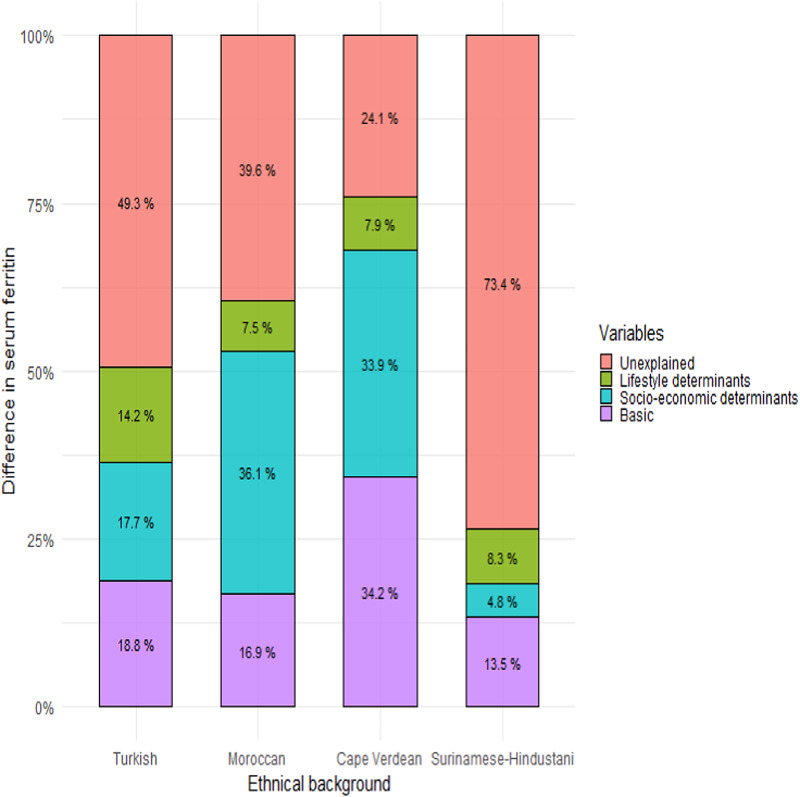
We studied ethnic differences in terms of iron status during pregnancy between Dutch women and other ethnicities and explore to what extent these differences can be explained by environmental factors. This cross-sectional population-based study (2002-2006) was embedded in the Generation R study and included a total of 4737 pregnant women from seven ethnic groups (Dutch, Turkish, Moroccan, Cape Verdean, Surinamese-Hindustani, Surinamese-Creole and Antillean). Ethnicity was defined according to the Dutch classification of ethnic background. Ferritin, iron and transferrin were measured in early pregnancy. The overall prevalence of iron deficiency was 7 %, ranging from 4 % in both Dutch and Surinamese-Creoles, to 18 % in Turkish, Moroccan and Surinamese-Hindustani women. Iron overload was most prevalent in Surinamese-Creole (11 %) and Dutch (9 %) women. Socioeconomic factors accounted for 5-36 % of the differences. Income was the strongest socioeconomic factor in the Cape Verdean and Surinamese-Hindustani groups and parity for the Turkish and Moroccan groups. Lifestyle determinants accounted for 8-14 % of the differences. In all groups, the strongest lifestyle factor was folic acid use, being associated with higher iron status. In conclusion, in our population, both iron deficiency and iron overload were common in early pregnancy. Our data suggest that ethnic differences in terms of socioeconomic and lifestyle factors only partly drive the large ethnic differences in iron status. Our data support the development of more specific prevention programmes based on further exploration of socioeconomic inequities, modifiable risk and genetic factors in specific ethnic subgroups, as well as the need for individual screening of iron status before supplementation.
Keywords: Ferritin; Haemoglobin; Iron overload; Iron-deficiency anaemia.
© The Author(s) 2022.
Figures
References
-
- World Health Organization (2012) Sixty-fifth World Health Assembly 2012, Comprehensive Implementation Plan on Maternal, Infant and Young Child Nutrition. Resolutions and decisions, annexes. Geneva. Available at http://www.who.int/nutrition/topics/WHA65.6_resolution_en.pdf?ua=1.
-
- World Health Organization (2017) Global Targets 2025 to Improve Maternal, Infant and Young Children Nutrition. Available at https://www.who.int/nutrition/global-target-2025/en/.
-
- World Health Organization (2001) Iron Deficiency Anemia. Assessment, Prevention, and Control. A Guide for Programme Managers, pp. 47–62. Available at https://www.who.int/nutrition/publications/en/ida_assessment_prevention_....
Publication types
MeSH terms
Substances
Grants and funding
LinkOut - more resources
Full Text Sources
Medical
