Preparation and Characterization of Dual-Modified Cassava Starch-Based Biodegradable Foams for Sustainable Packaging Applications
- PMID: 35722021
- PMCID: PMC9202043
- DOI: 10.1021/acsomega.2c01292
Preparation and Characterization of Dual-Modified Cassava Starch-Based Biodegradable Foams for Sustainable Packaging Applications
Abstract
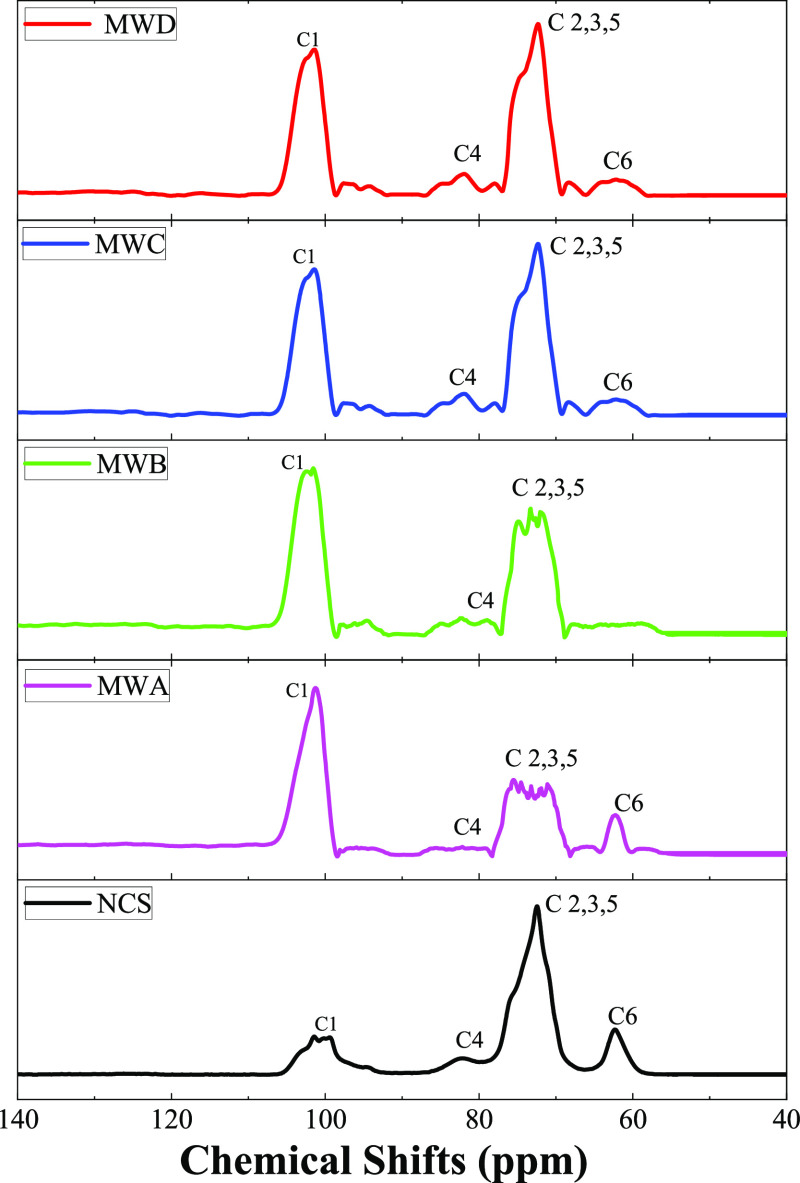
Starch and its derivatives have recently emerged as a sustainable and renewable alternative for petroleum-based expanded polystyrene (EPS) and expanded polypropylene (EPP) foam materials. In this study, biodegradable foam materials were prepared from cassava starch using a novel dual modification technique, combining microwave treatment and freeze-drying. The foam materials were prepared from starch solutions microwaved over different intervals. The starch-based foam materials were characterized using Fourier transform infrared (FTIR) spectroscopy, thermogravimetric analysis (TGA), X-ray diffraction (XRD), scanning electron microscopy (SEM), 13C nuclear magnetic resonance (13C-NMR) spectroscopy, and compression set test. Moreover, the water absorption capacities and density values of the foam materials were measured according to ASTM standards. The biodegradability test was carried out according to the aerobic compost environment test. The lowest water absorption capacities of 65.56% and 70.83% were exhibited for the cassava starch foam sample (MWB) prepared at a 20 s microwave treatment time and immersed in distilled water for 2 and 24 h, respectively. Furthermore, the lightweight cassava starch-based foam materials displayed density ranging from 124 to 245 kg/m3. The biodegradation test exhibited significant biodegradation of over 50% after 15 days for all the foam materials prepared. These results suggest that the dual-modified cassava starch-based biodegradable foams show potential in sustainable packaging applications by replacing petroleum-based materials.
© 2022 The Authors. Published by American Chemical Society.
Conflict of interest statement
The authors declare no competing financial interest.
Figures




References
-
- Kannan P.; Biernacki J. J.; Visco D. P. Jr. A review of physical and kinetic models of thermal degradation of expanded polystyrene foam and their application to the lost foam casting process. J. Anal. Appl. Pyrolysis 2007, 78, 162–171. 10.1016/j.jaap.2006.06.005. - DOI
-
- Ramli Sulong N. H.; Mustapa S. A. S.; Abdul Rashid M. K. Application of expanded polystyrene (EPS) in buildings and constructions: A review. J. Appl. Polym. Sci. 2019, 136, 47529.10.1002/app.47529. - DOI
-
- Cinelli P.; Chiellini E.; Lawton J. W.; Imam S. H. Foamed articles based on potato starch, corn fibers and poly (vinyl alcohol). Polym. Degrad. Stab. 2006, 91, 1147–1155. 10.1016/j.polymdegradstab.2005.07.001. - DOI
-
- Glenn G. M.; Orts W. J. Properties of starch-based foam formed by compression / explosion processing. Ind. Crops Prod. 2001, 13, 135–143. 10.1016/S0926-6690(00)00060-1. - DOI
-
- Cronin D. S.; Ouellet S. Low density polyethylene, expanded polystyrene and expanded polypropylene: Strain rate and size effects on mechanical properties. Polym. Test. 2016, 40–50. 10.1016/j.polymertesting.2016.04.018. - DOI
LinkOut - more resources
Full Text Sources