Review
. 2022 May 12;25(2):54-65.
doi: 10.1002/ajum.12296. eCollection 2022 May.

Urgent and emergent breast lesions - A primer for the general radiologist, on-call resident and sonographer

Affiliations
Review

Urgent and emergent breast lesions - A primer for the general radiologist, on-call resident and sonographer

Asha A Bhatt et al. Australas J Ultrasound Med. .

Abstract

There are very few true breast emergencies. While infrequent, women do present to emergency departments or urgent care centres with breast-related concerns. In this case-based review, both common and uncommon urgent and emergent breast lesions are presented, emphasising ultrasound characteristics and imaging optimisation to improve accurate diagnosis and appropriate recommendations.

Keywords: breast abscess; breast emergencies; breast necrotising fasciitis; breast pseudoaneurysm; mastitis; nipple piercings.


Conflict of interest statement

None declared.

Figures

Figure 1
Figure 1
Stages of breast infection: Normal breast tissue and overlying skin (a). Cellulitis is the early mild form of a breast infection, which only involves the dermis (b). Subsequent progression to mastitis results in inflammation of the breast parenchyma and lobules (c). Continued progression can involve microabscesses and phlegmonous change (d), which can form an organised abscess (e). The last possible stage in a breast infection, often associated with diabetes, is necrotising fasciitis, a gas‐forming infection that traverses into multiple facial planes (f). Source: Used with permission of Mayo Foundation for Medical Education and Research, all rights reserved.
Figure 2
Figure 2
30‐year‐old woman presented with redness and tenderness in the lower central left breast. She was evaluated and started on Bactrim double‐strength twice daily. Subsequently, the patient noticed purulent drainage from the skin with some improvement in her symptoms. The breast ultrasound was performed with a ML6‐15 MHz transducer with a frequency set to 11 MHz. The images were captured from the skin to the chest wall. Targeted ultrasound at the site of focal erythema demonstrated mild skin thickening measuring 4 mm (bracket) with heterogeneous increased echogenicity seen with oedema (a), and associated increased vascularity (b, arrows). No underlying breast findings were observed. Imaging findings are consistent with focal left breast cellulitis without an underlying abscess. Clinical follow‐up of the left breast erythema with repeat targeted imaging in the setting of worsening symptoms was recommended.
Figure 3
Figure 3
42‐year‐old woman with a history of breast conservation therapy performed 9 months prior presented to the emergency department with worsening right breast pain and redness despite being treated empirically with clindamycin. In the upper outer right breast at the site of clinical concern, ultrasound was performed with an L3‐12 MHz transducer with harmonics and the images were captured from the skin to the chest wall. Targeted ultrasound demonstrated skin thickening measuring 6 mm (bracket) and underlying oedema manifested as subtly increased echogenicity (chevrons), but no drainable fluid collection (a). A comparison with the contralateral (left) breast was performed, which showed normal skin thickness measuring 1 mm (bracket) and normal heterogeneously dense fibroglandular tissue (asterisk) (b). Imaging findings are consistent with right breast mastitis and overlying cellulitis without an underlying abscess. Clinical follow‐up of the right breast erythema and pain with repeat targeted imaging in the setting of worsening symptoms was recommended. Fortunately, this patient's symptoms were fully resolved, and she did not require additional targeted imaging.
Figure 4
Figure 4
38‐year‐old lactating woman presented with concerns about redness of the left periareolar breast. Greyscale (a) and Color Doppler (b) Ultrasound was performed with a ML6‐15 MHz transducer with the frequency set to 11 MHz, and the images were captured from the skin to the chest wall. Targeted ultrasound evaluation at 6 o'clock 2 cm from the nipple demonstrated mild skin thickening measuring 4 mm (bracket), linear hypoechoic regions of interstitial fluid (chevrons) and associated hypervascularity (arrows). No discrete drainable fluid collection was identified. Constellation of findings was consistent with left breast mastitis with phlegmon. The patient was instructed to continue breastfeeding on a frequent basis, with warm compresses and massage in between, and to complete her 10‐day course of Keflex. Her symptoms were fully resolved, and she did not require a follow‐up ultrasound.
Figure 5
Figure 5
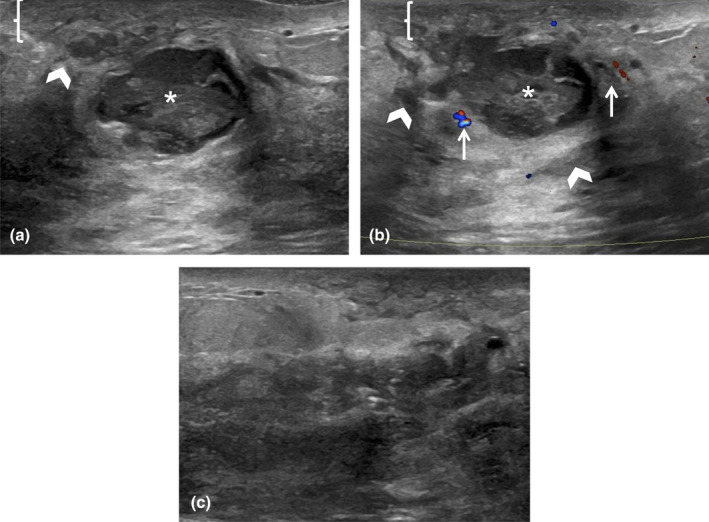
25‐year‐old lactating woman initially felt a 25 mm firm lump in her right breast, which progressively increased in size over 1 week. Ultrasound was performed with an ML6‐15 MHz transducer with the frequency set to 11 MHz, and the images were acquired from the skin to the chest wall. Targeted ultrasound of the redness in the subareolar right breast showed mild skin thickening measuring 4 mm (bracket), oedematous hyperechoic fibroglandular tissue (chevrons) and a discrete complex fluid collection measuring 4.4 cm (asterisk) (a and b). There was also mild surrounding increased vascularity (arrows) (b). Findings were consistent with an abscess, which was confirmed on subsequent percutaneous ultrasound‐guided aspiration, with the near‐complete collapse of the abscess cavity post‐aspiration (c). 15 mL of purulent fluid was aspirated with an 18‐gauge needle and sent to the laboratory to obtain organism sensitivities prior to the initiation of antimicrobial therapy. The patient's symptoms continued and required 2 additional aspirations at 3 and 6 days later.
Figure 6
Figure 6
37‐year‐old woman presented to the emergency room with a breast lump, clinically concerning for an abscess. Ultrasound was performed with an ML6‐15 MHz transducer with the frequency set to 9 MHz, and the colour scale was set to 5 cm/s. Targeted ultrasound showed a 4.8 cm heterogeneous hypoechoic mass with internal cystic spaces (arrows) (a). Colour image showed internal vascularity (chevron) but a drainable fluid component was not identified (b). A recommendation was made for further completed diagnostic workup for malignancy in the breast clinic and breast imaging. The evaluation was completed in the breast imaging department 18 days later, where a biopsy was performed confirming invasive ductal carcinoma, with a Nottingham grade of 3/3.
Figure 7
Figure 7
43‐year‐old woman with a history of diabetes and obesity presented with clinical signs of cellulitis and mastitis. Ultrasound was performed with a ML6‐15 MHz transducer with the frequency set to 11 MHz, and the images were acquired from the skin to the chest wall. Targeted ultrasound imaging of the area of clinical concern in the left breast demonstrated mild skin thickening measuring 3 mm (bracket) and mild echogenic breast parenchyma (asterisk) involving the lateral portion of the breast (a). Additional imaging at the area of marked erythema in the medial and inferior breast showed skin thickening measuring 4 mm (bracket) and multiple scattered echogenic foci (chevrons) with posterior dirty shadowing suggestive of subcutaneous air (b). The ultrasound artefact obscured the visualisation of the breast parenchyma posteriorly. Chest CT was immediately performed, revealing gas in the left breast (chevrons) with overlying skin thickening (arrows) as seen on a sagittal image on lung windows (c). Axial chest CT image on lung windows demonstrates air throughout the inner and central left breast extending into the left parasternal subcutaneous tissue (chevrons) with skin thickening (arrows) (d). The on‐call breast surgeon was notified of these critical findings, and the patient was subsequently taken for wide local debridement in the operating room the same day. She required multiple subsequent surgical debridements and ultimately had a mastectomy.
Figure 8
Figure 8
25‐year‐old woman with a right nipple piercing presented with periareolar right breast pain and a lump. Ultrasound evaluation was performed with a L4‐18 MHz transducer with harmonics and the colour gain set to 2.5 cm/s. Greyscale image showed a large complex collection (asterisk) with posterior acoustic through transmission (a). Colour image showed marker peripheral hyperaemia and vascularity (arrows) (b). Both images included linear echogenicity with reverberation artefact from the nipple piercing (chevron).
Figure 9
Figure 9
49‐year‐old man with a previous right nipple piercing presented due to a painful palpable lump within the right subareolar region. Ultrasound evaluation was performed with a ML6‐15 MHz transducer at a frequency of 15 mHZ and the colour gain set to 5 cm/s. Greyscale (a) and colour (b) images showed a hypoechoic cystic collection (arrow) directly behind the nipple with minimal surrounding echogenicity and vascularity (chevron).
Figure 10
Figure 10
73‐year‐old woman with increased pain and bruising after an ultrasound‐guided biopsy, which was performed with a 9‐gauge vacuum‐assisted device. Ultrasound of the right breast at 9 o'clock 4 cm from the nipple shows a complex cystic collection measuring 3 cm (asterisk), consistent with a post‐biopsy haematoma (a). Colour Doppler imaging shows a single prominent adjacent vessel (arrow) without active bleeding or pseudoaneurysm (b). The breast/chest was wrapped in a compression bandage and instructed to limit activity and return to care if symptoms worsened.
Figure 11
Figure 11
75‐year‐old woman with a biopsy performed at an outside institution with a 9‐gauge vacuum‐assisted device. This was a lump that was enlarging after the biopsy site on physical examination. Targeted ultrasound evaluation at 2 o'clock 11 cm from the nipple, adjacent to the biopsy‐proven malignancy, demonstrated a (a) 3.0 cm heterogeneous fluid collection (asterisk) with mobile swirling echoes observed real time, and (b) colour Doppler showed a yin–yang colour pattern in the collection, with a (c) single feeding vessel (arrow). (d) Spectral Doppler of the feeding vessel neck revealed a to‐and‐fro waveform, consistent with a pseudoaneurysm. With a narrow neck, this pseudoaneurysm was amenable to percutaneous thrombin injection (1 mL of 1000 IU/mL thrombin). (e) Immediate post‐thrombin injection image showed complete thrombosis of the PsA. (f) A follow‐up ultrasound 1 week later showed that most of the PsA had thrombosed with a small residual pseudoaneurysm (arrow). Repeat thrombin injection was performed with a total of 1.7 mL of thrombin injected at the pseudoaneurysmal neck and other small contributors to the pseudoaneurysm. No further intervention with thrombin was required.
Figure 12
Figure 12
41‐year‐old woman with no prior history of trauma or intervention presented with a palpable left breast lump. Targeted ultrasound showed a 1.0 cm anechoic cystic structure (asterisk) at 11 o'clock 14 cm from the nipple (a), with turbulent flow colour with some mural thrombus (b). Spectral Doppler of the feeding vessel demonstrates a low resistive arterial waveform (c) and to‐and‐fro flow was not seen. This did not have the typical appearance of a pseudoaneurysm, but rather a true aneurysm. Given this, thrombin injection was deferred, and surgery consultation was recommended. Breast and vascular surgery agreed on short‐interval follow‐up given the mild symptoms. This patient returned 5 months later, and the true aneurysm was smaller in size and had completely thrombosed (d).
Figure 13
Figure 13
Artist comparison of a PsA ve rsus a true saccular aneurysm. (a) Illustration of the pseudoaneurysm, which does not contain all 3 layers of the arterial wall. (b) In comparison, a true saccular aneurysm involves the intima, media and adventitia. Source: Used with permission of Mayo Foundation for Medical Education and Research, all rights reserved.
Figure 14
Figure 14
56‐year‐old woman presented to the emergency department due to uncontrolled right breast bleeding. Initial overnight ultrasound images performed with a C1‐6 MHz transducer set to a frequency of 5 MHz by the general sonographer showed a large unilocular cystic lesion with homogeneous internal low‐level echoes and mural nodules (arrow) (a). Repeat imaging 1 day later was done prior to biopsy using a ML6‐15 MHz transducer with the frequency set to 9 MHz in the breast imaging department confirming the large unilocular cystic lesion with irregular margins and homogeneous internal low‐level echoes (b). With reduced manual compression from the transducer and the colour scale set to 5 cm/s, internal vascularity was identified in the mural nodules (arrow) (c). Ultrasound‐guided aspiration of the fluid component and biopsy of the solid component was performed revealing intracystic papillary carcinoma with a low nuclear grade associated with a haematoma.
Figure 15
Figure 15
89‐year‐old woman with trauma to the left breast after a fall, which resulted in extensive bruising and multiple palpable lumps. Targeted ultrasound was performed with a ML6‐15 MHz transducer with the frequency set to 15 MHz and showed a 3 cm area of superficial hyperechogenicity (arrows) containing a few small cystic spaces, most consistent with acute fat necrosis.
Figure 16
Figure 16
37‐year‐old woman presented to the emergency department with left breast pain. An electronic medical chart review showed a history of breast trauma a month prior. Ultrasound evaluation to exclude a fluid collection carried out by the general on‐call sonographer was performed with a ML6‐15 MHz transducer with the frequency set to 13 MHz. Greyscale (a) and colour doppler (b) images demonstrated multiple round and oval circumscribed masses (arrows), which have the appearance of subacute fat necrosis.
Figure 17
Figure 17
Illustration of how seat belt positioning affects the location of the injury depending on if the patient is seated on the driver's side or the passenger's side of the vehicle. The orientation of the seat belt will determine the location and pattern of injury. Knowing the non‐ductal distribution helps evaluate sites of injury during the initial evaluation. However, this distribution plays an important role in the subsequent non‐emergent follow‐up for the patient. Source: Used with permission of Mayo Foundation for Medical Education and Research, all rights reserved.
Figure 18
Figure 18
Serial right breast MLO mammogram images (a–e) in a patient with a seat belt injury after a motor vehicle collision where the patient was in the driver seat in 2011 (a). In 2012 the classic described non‐ducal band‐like pattern and location of fat necrosis in the upper right breast was seen (a). An asymmetry developed in 2012 (b), with initial diagnostic evaluation attributing the findings to fat necrosis in the setting of trauma. Subsequent images (c–e) show the normal evolution of fat necrosis into oil cysts in a band‐like orientation, which slowly retracts over several years. Abbreviation: MLO, Mediolateral Oblique.

References

    1. Hines N, Leibman A, David M. Breast problems presenting in the emergency room. Emerg Radiol 2007; 14(1): 23–8. - PubMed
    1. D’Orsi CJ, Sickles EA, Mendelson EB, Morris EA. ACR BI‐RADS® Atlas Breast Imaging Reporting and Data System. Reston, VA: American College of Radiology; 2013. pp. 533–9.
    1. Carpentier B, Hayward J, Strachowski L. Enhancing your acoustics: ultrasound image optimization of breast lesions. J Ultrasound Med 2017; 36(7): 1479–85. - PubMed
    1. ACR practice parameter for the performance of ultrasound‐guided percutaneous breast interventional procedures, (n.d.). Available from: https://www.acr.org/‐/media/ACR/Files/Practice‐Parameters/US‐GuidedBreas.... Retrieved 26 Mar 2020.
    1. Mendelson EB, Böhm‐Vélez M, Berg WA, Whitman GJ, Feldman MI, Madjar WA, et al. ACR BI‐RADS® Ultrasound. ACR BI‐RADS® Atlas, Breast Imaging Reporting and Data System. Reston, VA: American College of Radiology; 2013.