


The "Mirror Effect Plus Protocol" for acute Bell's palsy: A randomized controlled trial with 1-year follow-up
- PMID: 35722671
- PMCID: PMC9420890
- DOI: 10.1177/02692155221107090
The "Mirror Effect Plus Protocol" for acute Bell's palsy: A randomized controlled trial with 1-year follow-up
Abstract
Objective: To study the effects of the "Mirror Effect Plus Protocol" (MEPP) on global facial function in acute and severe Bell's Palsy.
Design: Single blind and randomized controlled trial to compare the effects of basic counseling (control group) versus MEPP (experimental group) over one year.
Setting: Outpatient clinic following referrals from Emergency or Otorhinolaryngology Departments.
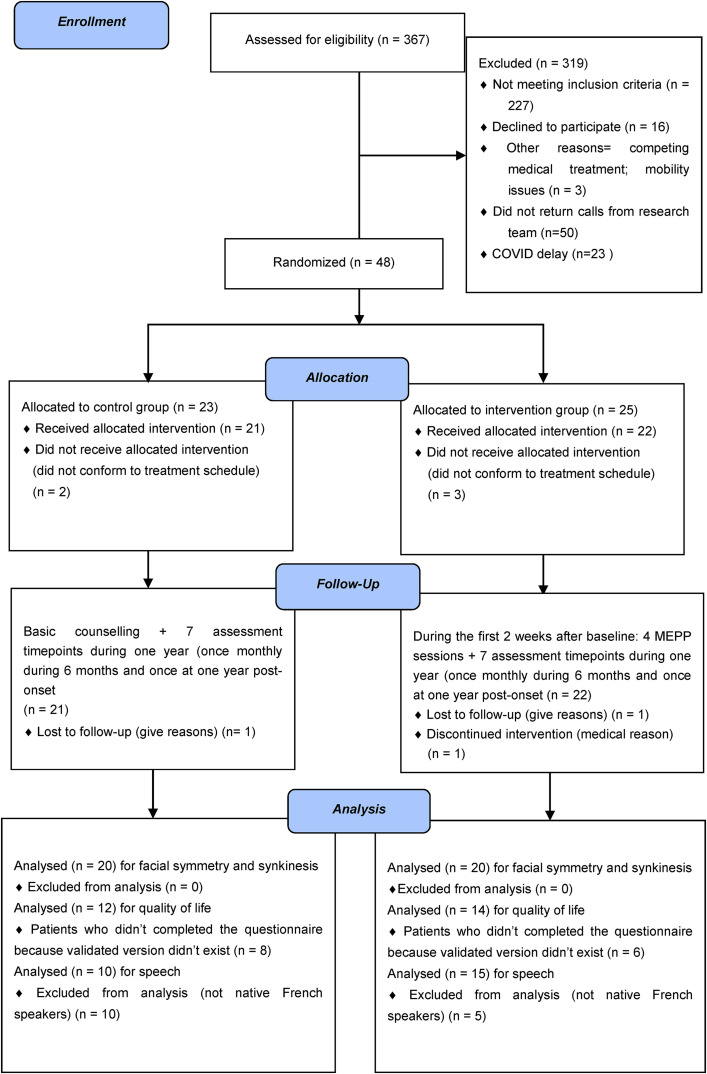
Subjects: 40 patients (n = 20 per group) with moderately severe to total palsy who received standard medication were recruited within 14 days of onset. Baseline characteristics were comparable between the groups.
Interventions: The experimental group received the MEPP program (motor imagery + manipulations + facial mirror therapy) while the control group received basic counseling. Both groups met the clinician monthly until 6 months and at one-year post-onset for assessments.
Outcome measures: Facial symmetry, synkinesis, and quality of life were measured using standardized scales. Perceived speech intelligibility was rated before and after therapy by naïve judges.
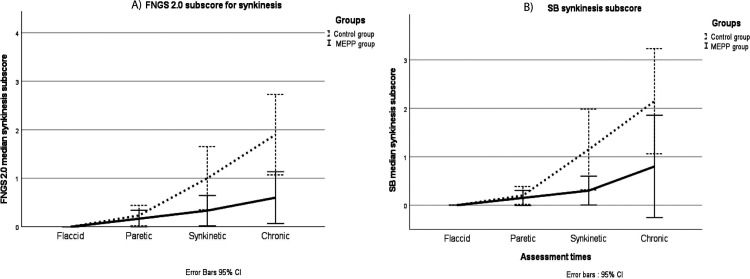
Results: Descriptive statistics demonstrated improvements in favor of the MEPP for each measured variable. Significant differences were found for one facial symmetry score (House-Brackmann 2.0 mean (SD) = 7.40 (3.15) for controls versus 5.1 (1.44) for MEPP), for synkinesis measures (p = 0.008) and for quality-of-life ratings (mean (SD) score = 83.17% (17.383) for controls versus 98.36% (3.608) for MEPP (p = 0.002)). No group difference was found for perceived speech intelligibility.
Conclusion: The MEPP demonstrates promising long-term results when started during the acute phase of moderately severe to total Bell's Palsy.
Keywords: Bell palsy; facial nerve diseases; facial paralysis; mirror therapy; rehabilitation; synkinesis.
Conflict of interest statement
Figures
References
-
- Luijmes RE, Pouwels S, Beurskens CH, et al. Quality of life before and after different treatment modalities in peripheral facial palsy: a systematic review. Laryngoscope 2017; 127: 1044–1051. 2016/11/20. - PubMed
-
- Gyori E, Przestrzelski C, Pona I, et al. Quality of life and functional assessment of facial palsy patients: a questionnaire study. Int J Surg 2018; 55: 92–97. 2018/05/23. - PubMed
-
- Ferreira M, Marques EE, Duarte JA, et al. Physical therapy with drug treatment in Bell palsy: a focused review. Am J Phys Med Rehabil 2015; 94: 331–340. 2015/03/19. - PubMed
-
- Nicastri M, Mancini P, De Seta D, et al. Efficacy of early physical therapy in severe Bell’s palsy: a randomized controlled trial. Neurorehabil Neural Repair 2013; 27: 542–551. - PubMed
-
- Infante-Cossio P, Prats-Golczer V-E, Lopez-Martos R, et al. Effectiveness of facial exercise therapy for facial nerve dysfunction after superficial parotidectomy: a randomized controlled trial. Clin Rehabil 2016; 30: 1097–1107. - PubMed
Publication types
MeSH terms
LinkOut - more resources
Full Text Sources
Medical
Miscellaneous
