. 2022 Jun 20;22(1):503.
doi: 10.1186/s12884-022-04764-2.

Clarithromycin prevents preterm birth and neonatal mortality by dampening alarmin-induced maternal-fetal inflammation in mice

Affiliations

Clarithromycin prevents preterm birth and neonatal mortality by dampening alarmin-induced maternal-fetal inflammation in mice

Jose Galaz et al. BMC Pregnancy Childbirth. .

Abstract

Background: One of every four preterm neonates is born to a woman with sterile intra-amniotic inflammation (inflammatory process induced by alarmins); yet, this clinical condition still lacks treatment. Herein, we utilized an established murine model of sterile intra-amniotic inflammation induced by the alarmin high-mobility group box-1 (HMGB1) to evaluate whether treatment with clarithromycin prevents preterm birth and adverse neonatal outcomes by dampening maternal and fetal inflammatory responses.

Methods: Pregnant mice were intra-amniotically injected with HMGB1 under ultrasound guidance and treated with clarithromycin or vehicle control, and pregnancy and neonatal outcomes were recorded (n = 15 dams each). Additionally, amniotic fluid, placenta, uterine decidua, cervix, and fetal tissues were collected prior to preterm birth for determination of the inflammatory status (n = 7-8 dams each).

Results: Clarithromycin extended the gestational length, reduced the rate of preterm birth, and improved neonatal mortality induced by HMGB1. Clarithromycin prevented preterm birth by interfering with the common cascade of parturition as evidenced by dysregulated expression of contractility-associated proteins and inflammatory mediators in the intra-uterine tissues. Notably, clarithromycin improved neonatal survival by dampening inflammation in the placenta as well as in the fetal lung, intestine, liver, and spleen.

Conclusions: Clarithromycin prevents preterm birth and improves neonatal survival in an animal model of sterile intra-amniotic inflammation, demonstrating the potential utility of this macrolide for treating women with this clinical condition, which currently lacks a therapeutic intervention.

Keywords: Amniotic cavity; Antibiotic; Cytokine; Gene expression; HMGB1; Macrolide; Sterile intra-amniotic inflammation.


Conflict of interest statement

The authors declare that they have no competing interests.

Figures
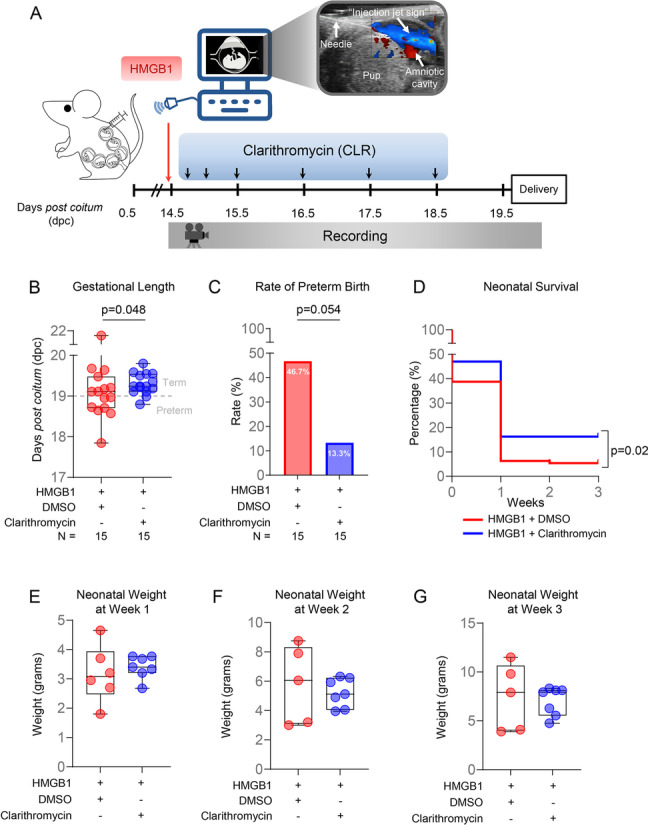
Fig. 1
Fig. 1
Clarithromycin prevents preterm birth and improves neonatal survival induced by intra-amniotic injection of HMGB1. A Dams were intra-amniotically injected with HMGB1 in each sac under ultrasound guidance on 14.5 days post coitum (dpc) and treated with 75 mg/kg of clarithromycin (CLR; n = 15) or DMSO (vehicle control; n = 15) at 6, 12, 24, 48, 72, and 96 h post-injection. Dams were monitored until delivery, and neonates were followed until three weeks of age. B Gestational length (dpc) of dams intra-amniotically injected with HMGB1 and treated with CLR (blue dots) or DMSO (red dots). Data are represented as box-and-whisker plots with medians, interquartile ranges, and min/max ranges. P-value was determined using the one-sided Mann–Whitney U-test. C Rate of preterm birth of dams intra-amniotically injected with HMGB1 and treated with CLR (blue bar plot) or DMSO (red bar plot). P-value was determined using the one-sided Fisher’s exact test. D Kaplan–Meier survival curve showing the percentage of surviving neonates at 1, 2, and 3 weeks of age from dams intra-amniotically injected with HMGB1 and treated with CLR (blue line) or DMSO (red line). P-value was determined using the Mantel-Cox test. E–G Neonatal weights per litter at 1, 2, and 3 weeks of age from dams intra-amniotically injected with HMGB1 and treated with CLR [blue dots, 2–6 (mean = 3.8) neonates/litter] or DMSO [red dots, 1–2 (mean = 1.5) neonates/dam]. Data are represented as box-and-whisker plots with medians, interquartile ranges, and min/max ranges. P-value was determined using the one-sided Mann–Whitney U-test
Fig. 2
Fig. 2
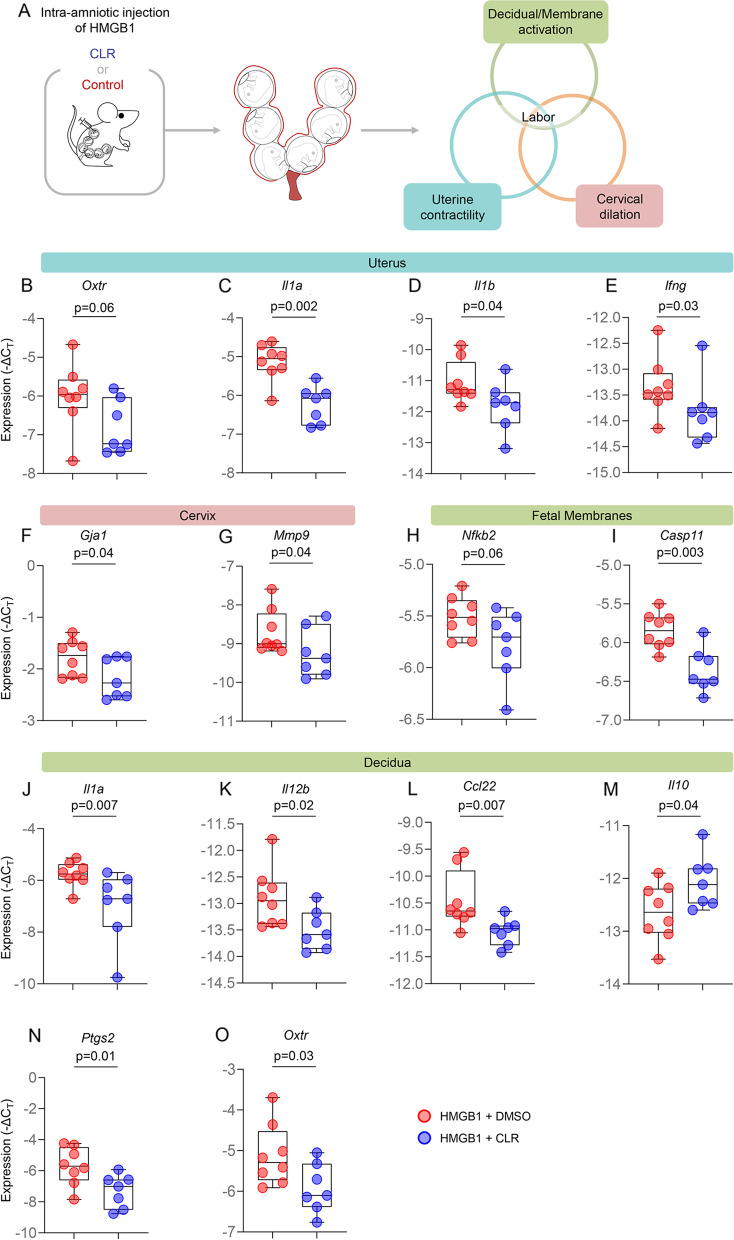
Clarithromycin interferes with the common pathway of labor. A Dams were intra-amniotically injected with HMGB1 under ultrasound guidance on 14.5 days post coitum (dpc) and treated with 75 mg/kg of clarithromycin (CLR; n = 7) or DMSO (vehicle control; n = 8) at 6, 12, 24, 48, 72, and 96 h post-injection. On 18.5 dpc, two hours after the last dose of CLR or DMSO, mice were euthanized and tissue collection was performed to obtain the decidua, uterus, cervix, fetal membranes, placenta, fetal lung, fetal intestine, fetal liver, and fetal spleen. Expression (-ΔCT) of B Oxtr, C Il1a, D Il1b, and E Ifng in the uteri of HMGB1-injected dams treated with CLR (blue dots) or DMSO (red dots). Expression (-ΔCT) of F Gja1 and G Mmp9 in the cervices of HMGB1-injected dams treated with CLR (blue dots) or DMSO (red dots). Expression (-ΔCT) of H Nfkb2 and I Casp11 in the fetal membranes of neonates born to HMGB1-injected dams treated with CLR (blue dots) or DMSO (red dots). Expression (-ΔCT) of J Il1a, K Il12b, L Ccl22, M Il10, N Ptgs2, and O Oxtr in the decidua of HMGB1-injected dams treated with CLR (blue dots) or DMSO (red dots). Data are represented as box-and-whisker plots with medians, interquartile ranges, and min/max ranges. P-values were determined using the one-sided Mann–Whitney U-test
Fig. 3
Fig. 3
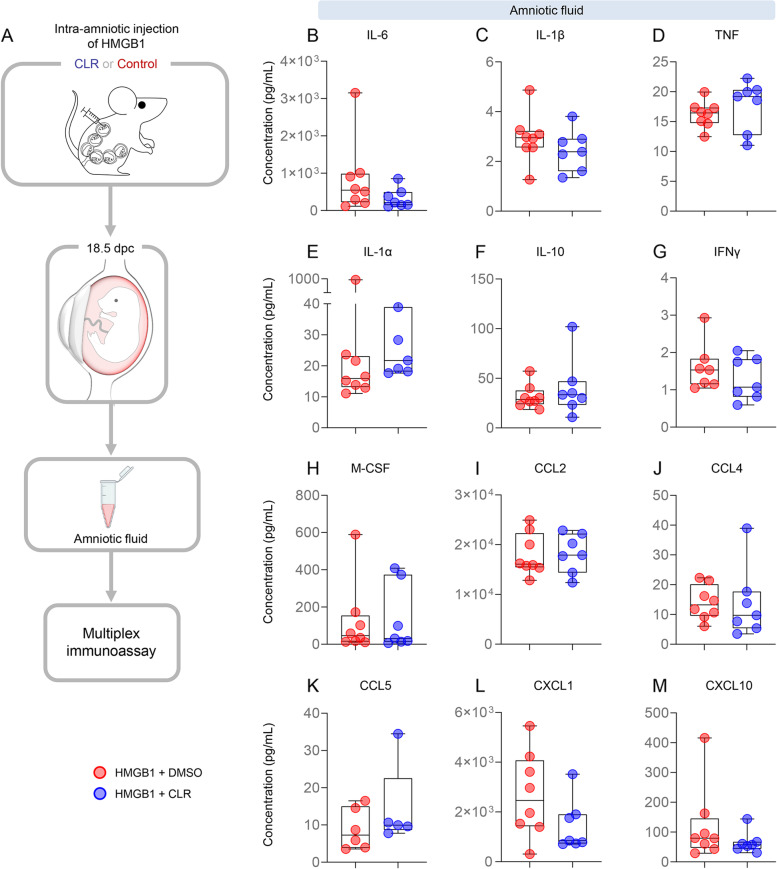
Clarithromycin does not alter HMGB1-induced cytokine concentrations in amniotic fluid. A Dams were intra-amniotically injected with HMGB1 under ultrasound guidance on 14.5 days post coitum (dpc) and treated with 75 mg/kg of clarithromycin (CLR; n = 7) or DMSO (vehicle control; n = 8) at 6, 12, 24, 48, 72, and 96 h post-injection. On 18.5 dpc, two hours after the last dose of CLR or DMSO, mice were euthanized and collection of amniotic fluid was performed to assess the concentrations of cytokines in the amniotic cavity. Amniotic fluid cytokine levels (pg/mL) of B IL-6, C IL-1β, D TNF, E IL-1α, F IL-10, G IFNγ, H M-CSF, I CCL2, J CCL4, K CCL5, L CXCL1, and M CXCL10 from dams intra-amniotically injected with HMGB1 and treated with CLR (blue dots) or DMSO (red dots). Data are represented as box-and-whisker plots with medians, interquartile ranges, and min/max ranges. P-values were determined using the one-sided Mann–Whitney U-test
Fig. 4
Fig. 4
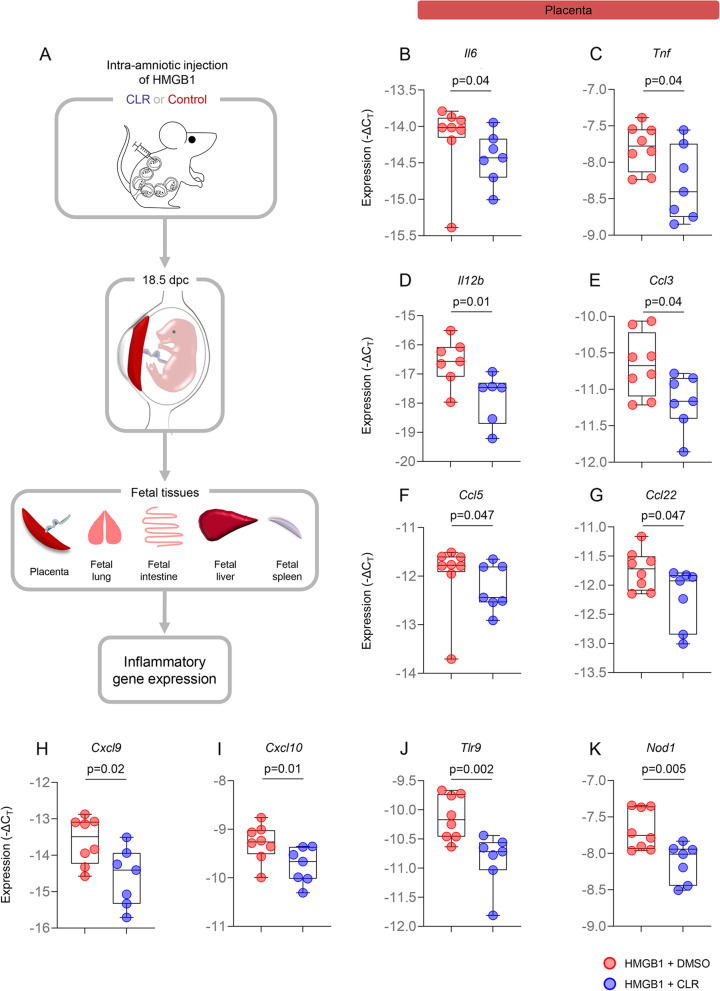
Clarithromycin downregulates inflammatory gene expression in the placenta. A Dams were intra-amniotically injected with HMGB1 under ultrasound guidance on 14.5 days post coitum (dpc) and treated with 75 mg/kg of clarithromycin (CLR; n = 7) or DMSO (vehicle control; n = 8) at 6, 12, 24, 48, 72, and 96 h post-injection. On 18.5 dpc, two hours after the last dose of CLR or DMSO, mice were euthanized and tissue collection was performed to obtain the placenta and assess inflammatory gene expression. Expression (-ΔCT) of B Il6, C Tnf, D Il12b, E Ccl3, F Ccl5, G Ccl22, H Cxcl9, I Cxcl10, J Tlr9, and K Nod1 from dams intra-amniotically injected with HMGB1 and treated with CLR (blue dots) or DMSO (red dots). Data are represented as box-and-whisker plots with medians, interquartile ranges, and min/max ranges. P-values were determined using the one-sided Mann–Whitney U-test
Fig. 5
Fig. 5
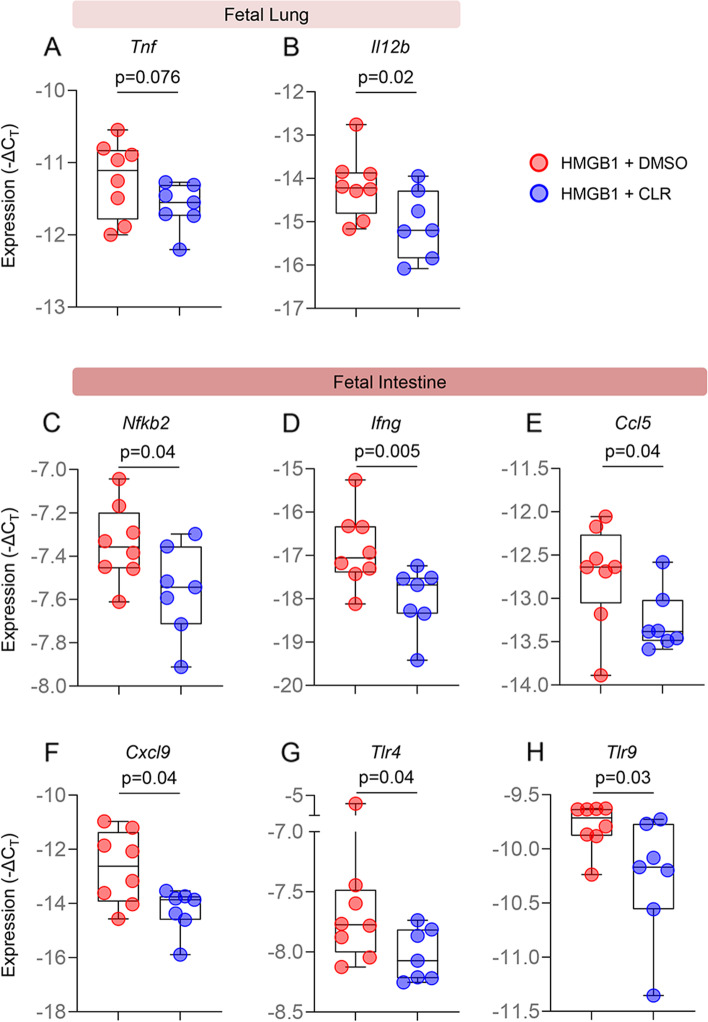
Clarithromycin downregulates inflammatory gene expression in the fetal lung and intestine. Expression (-ΔCT) of A Tnf and B Il12b in the lungs of fetuses from dams intra-amniotically injected with HMGB1 and treated with CLR (blue dots) or DMSO (red dots). Expression (-ΔCT) of C Nfkb2, D Ifng, E Ccl5, F Cxcl9, G Tlr4, and H Tlr9 in the intestines of fetuses from dams intra-amniotically injected with HMGB1 and treated with CLR (blue dots) or DMSO (red dots). Data are represented as box-and-whisker plots with medians, interquartile ranges, and min/max ranges. P-values were determined using the one-sided Mann–Whitney U-test
Fig. 6
Fig. 6
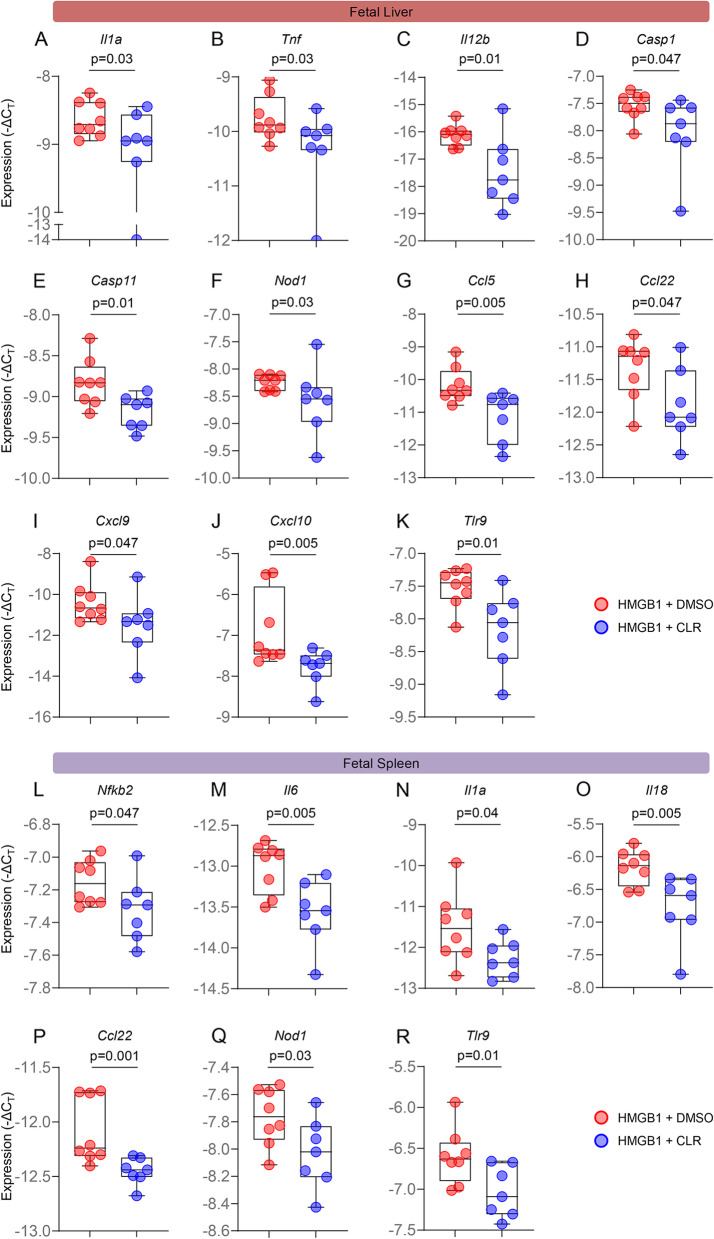
Clarithromycin downregulates inflammatory gene expression in the fetal liver and spleen. Expression (-ΔCT) of A Il1a, B Tnf, C Il12b, D Casp1, E Casp11, F Nod1, G Ccl5, H Ccl22, I Cxcl9, J Cxcl10, and K Tlr9 in the livers of fetuses from dams intra-amniotically injected with HMGB1 and treated with CLR (blue dots) or DMSO (red dots). Expression (-ΔCT) of L Nfkb2, M Il6, N Il1a, O Il18, P Ccl22, Q Nod1, and R Tlr9 in the spleens of fetuses from dams intra-amniotically injected with HMGB1 and treated with CLR (blue dots) or DMSO (red dots). Data are represented as box-and-whisker plots with medians, interquartile ranges, and min/max ranges. P-values were determined using the one-sided Mann–Whitney U-test

References

    1. Liu L, Oza S, Hogan D, Perin J, Rudan I, Lawn JE, et al. Global, regional, and national causes of child mortality in 2000–13, with projections to inform post-2015 priorities: an updated systematic analysis. Lancet. 2015;385(9966):430–440. doi: 10.1016/S0140-6736(14)61698-6. - DOI - PubMed
    1. Chawanpaiboon S, Vogel JP, Moller AB, Lumbiganon P, Petzold M, Hogan D, et al. Global, regional, and national estimates of levels of preterm birth in 2014: a systematic review and modelling analysis. Lancet Glob Health. 2019;7(1):e37–e46. doi: 10.1016/S2214-109X(18)30451-0. - DOI - PMC - PubMed
    1. Guo X, Li X, Qi T, Pan Z, Zhu X, Wang H, et al. A birth population-based survey of preterm morbidity and mortality by gestational age. BMC Pregnancy Childbirth. 2021;21(1):291. doi: 10.1186/s12884-021-03726-4. - DOI - PMC - PubMed
    1. Romero R, Dey SK, Fisher SJ. Preterm labor: One syndrome, many causes. Sci. 2014;345(6198):760–765. doi: 10.1126/science.1251816. - DOI - PMC - PubMed
    1. Goldenberg RL, Culhane JF, Iams JD, Romero R. Epidemiology and causes of preterm birth. Lancet. 2008;371(9606):75–84. doi: 10.1016/S0140-6736(08)60074-4. - DOI - PMC - PubMed

LinkOut - more resources